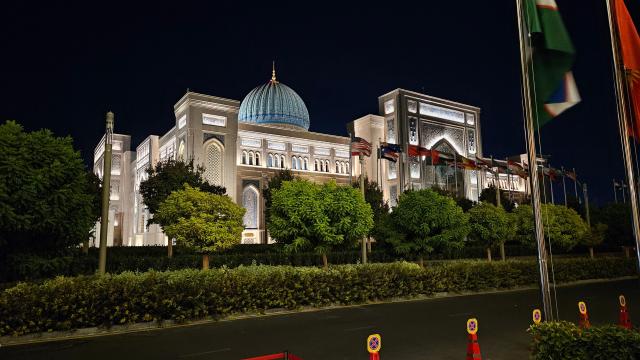
SEOUL, September 02 (AJP) - The Center for Islamic Civilization, sprawling across a site roughly the size of 14 soccer fields, embodies in its glittering magnificence and grandeur what “New Uzbekistan” envisions: ushering a young, increasingly digital population into the AI age while keeping it firmly anchored in Islamic heritage and spirituality.
The sprawling cultural and research complex cost about $161.8 million to build, according to a government construction directorate. Its three-story building offers more than 42,000 square meters of usable space beneath a 65-meter dome.
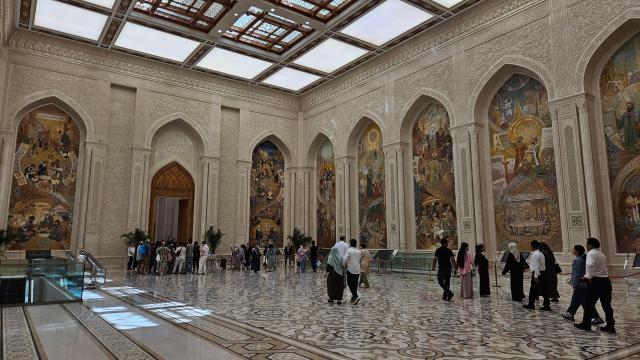
Its exhibitions trace the territory's history from the pre-Islamic era through what Uzbekistan calls its First and Second Renaissances before culminating in a section titled “New Uzbekistan — the Foundation of the Third Renaissance.”
At its heart sits the ancient Uthman Quran, surrounded by manuscripts, archaeological discoveries and artifacts documenting centuries of Islamic scholarship.
In the official narrative, the First Renaissance refers roughly to the ninth through 12th centuries, when Central Asian scholars including Muhammad al-Khwarizmi, al-Biruni and Ibn Sina made foundational contributions to mathematics, astronomy, medicine and philosophy.
The Second Renaissance is associated with the Timurid period and figures including astronomer and ruler Ulugh Beg.
The Third, President Shavkat Mirziyoyev argues, should happen now.
The Center for Islamic Civilization gives that ambition a physical home.
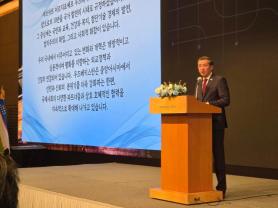
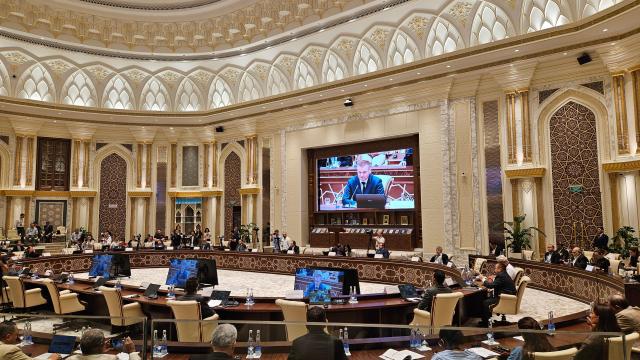
It has also quickly become an international stage. Forums bringing scholars, journalists and cultural figures from around the world to Tashkent have put the building at the center of the government's effort to introduce Uzbekistan's Islamic heritage to a wider audience.
Mirziyoyev elevated that message further during celebrations marking the country's 35th anniversary of independence.
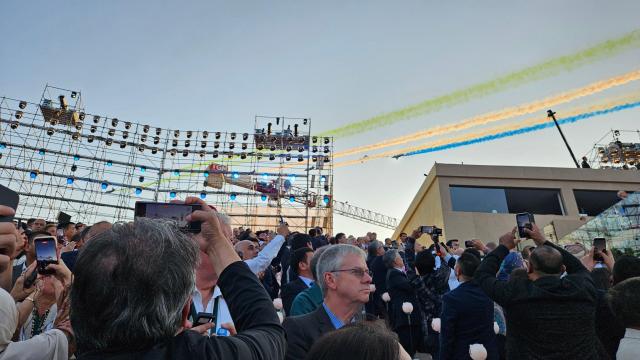
Some 6,000 people filled a vast open-air amphitheater in New Tashkent on Aug. 28, four days before Independence Day.
Speaking before the crowd, Mirziyoyev moved through economic development, education and national identity before turning to the country's Islamic heritage.
“We have built unique scientific and educational institutions such as the Center for Islamic Civilization and the Imam Bukhari and Burhaniddin Marginani memorial complexes,” Mirziyoyev said.
The audience rose in sustained applause.
The scene illustrated the role Islamic civilization has come to play in Mirziyoyev's vision of “New Uzbekistan”: not primarily as a story of religion, but of science, scholarship, enlightenment and modernization.
A museum of the 'Third Renaissance'
Mirziyoyev formally opened the Center for Islamic Civilization on March 17.
Its galleries are arranged almost as a physical version of the historical narrative his government has promoted since he took power in 2016.
Visitors move from ancient Uzbekistan into the Islamic golden age, through the Timurid period and eventually into modern independent Uzbekistan.
The final destination is not the past at all, but the government's proposed future: the “Third Renaissance.”
Mirziyoyev has described the center as one of its foundations while stressing that the institution should be scientific, secular and modern.
The message is straightforward: the same land that produced scholars who transformed world knowledge should produce another generation capable of succeeding in science, technology and education.
That connection was apparent in his Aug. 28 independence speech.
After mentioning the Center for Islamic Civilization and the reconstructed Imam Bukhari complex, Mirziyoyev turned almost immediately to young people, education and the country's next decade of development.
He described the coming 10 years as a period of “national rise” and said the first of seven planned national programs would seek to make knowledge and skills the country's principal capital.
Al-Khwarizmi's mathematics, Ibn Sina's medicine, Ulugh Beg's astronomy and Imam Bukhari's religious scholarship are thus being assembled into a single civilizational inheritance that the government wants today's Uzbekistan to translate into universities, research, artificial intelligence and innovation.
Recovering what independence restored
Mirziyoyev also used the independence anniversary to place the center in a longer story of national recovery.
He told the crowd that the roots of Uzbekistan's independence stretched back more than 3,000 years and invoked al-Khwarizmi, Ahmad al-Fergani, al-Biruni, Ibn Sina, Ulugh Beg and Alisher Navoi.
“Independence, above all, returned to us our honor and dignity, our sacred religion, our mother tongue and our forgotten national values,” he said.
That helps explain why a newly built institution occupies such a prominent place in the country's official story.
Its layout advances an argument: Uzbekistan possessed a great civilization, independence allowed the country to reclaim that inheritance, and “New Uzbekistan” can use it as the foundation of another period of intellectual and economic development.
The center had received about half a million domestic and international visitors by June 1, just two and a half months after opening, averaging around 6,000 visitors a day, according to the presidential office.
From Tashkent to Samarkand
The same philosophy is visible hundreds of kilometers away at the Imam Bukhari Memorial Complex near Samarkand, another institution Mirziyoyev singled out in his independence speech.
Imam Bukhari, born near Bukhara in the ninth century, compiled Sahih al-Bukhari, regarded by Sunni Muslims as one of the most authoritative collections of sayings and actions of the Prophet Muhammad.
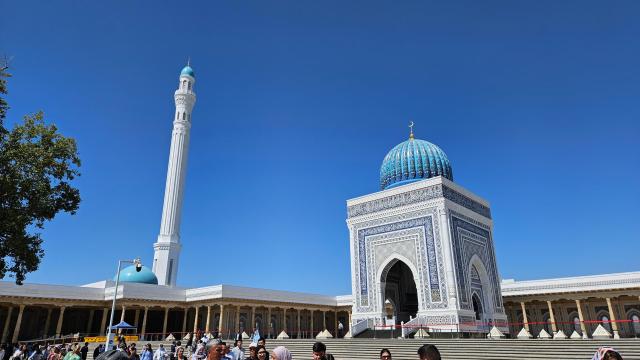
Uzbekistan has rebuilt his burial site on a monumental scale.
The 45-hectare complex now includes a grand mausoleum, a mosque for 10,000 worshippers, four 75-meter minarets, a museum and research and educational facilities.
Its capacity has risen to as many as 65,000 visitors a day from around 12,000 previously.
The government separately allocated 570 billion soums for hotels and trade and service facilities around the pilgrimage center. The development includes one four-star hotel, two three-star hotels and 22 family guesthouses.
More than 1 million domestic and international visitors had passed through the complex by early May, according to the government.
Like the Tashkent center, the Imam Bukhari project ties Islamic history to research, education and tourism rather than treating the site solely as a religious shrine.
Defining the Islam Uzbekistan wants to promote
The projects also reveal the boundaries of the government's approach.
Uzbekistan is not simply encouraging a greater public role for Islam in every form. It is promoting a carefully defined interpretation centered on knowledge, tolerance, scholarship and peace.
The government frequently summarizes that philosophy with the slogan “Enlightenment Against Ignorance.”
In the first half of this year, Uzbekistan's Committee on Religious Affairs said more than 223,000 educational and preventive activities were conducted under that framework, including programs involving young people, vulnerable families and labor migrants.
The idea stretches back to Mirziyoyev's address to the United Nations in 2017, when he argued that ignorance and intolerance could create conditions for extremism and called for education and the humanistic traditions of Islam to play a greater role in combating radicalization.
The Center for Islamic Civilization grew out of that thinking.
Mirziyoyev said when announcing the project at the United Nations that Islam should be associated with goodness, peace and enlightenment rather than violence.
The center therefore represents a specific state-backed interpretation of Islamic civilization: scholarly rather than radical, educational rather than political and compatible with modernization.
Islamic heritage inside a secular state
Uzbekistan has sought international cooperation on manuscripts, digitization, historical research and cultural heritage, while opening an office of the Islamic World Educational, Scientific and Cultural Organization, or ICESCO, in Tashkent.
Mirziyoyev has ordered officials to promote the center in 55 countries and organize presentations about it and scholars including Imam Bukhari, Imam Maturidi and Imam Tirmidhi at U.N. offices in New York and Geneva as well as UNESCO headquarters in Paris.
International forums and press tours held at the center fit directly into that strategy.
Rather than presenting Uzbekistan abroad primarily as an Islamic state, Tashkent is positioning it as a historic center of Islamic civilization whose claim to influence rests on scholars, manuscripts, scientific achievement and cultural heritage.
That message can reach Muslim-majority countries while remaining compatible with secular international institutions.
Uzbekistan's Constitution nevertheless draws a clear legal line.
It defines the country as a “sovereign democratic, legal, social and secular state,” while Article 75 states that religious organizations are separated from the state.
A religious-policy concept adopted under a 2025 law also reaffirmed both freedom of conscience and the country's secular character.
The prominence of the Center for Islamic Civilization therefore does not necessarily signal an Islamization of the Uzbek state.
Instead, it shows how Mirziyoyev's government is bringing Islamic civilization into the national story of a secular Uzbekistan — connecting a celebrated scholarly past with the technological and economic future it wants to build.
AJP Takeaways
-
Uzbekistan’s Center for Islamic Civilization is a flagship of President Shavkat Mirziyoyev’s “New Uzbekistan” vision, linking Islamic heritage with science, education, artificial intelligence and modernization.
-
The Tashkent center presents Uzbekistan’s history as a progression from the First and Second Renaissances toward a state-backed “Third Renaissance,” drawing on scholars including al-Khwarizmi, al-Biruni, Ibn Sina and Ulugh Beg.
-
Uzbekistan is investing heavily in Islamic cultural heritage, including the Center for Islamic Civilization and the expanded Imam Bukhari Memorial Complex near Samarkand, while promoting both sites internationally as centers of scholarship, research and tourism.
-
Mirziyoyev’s government promotes a carefully defined vision of Islam centered on enlightenment, tolerance and knowledge while maintaining Uzbekistan’s constitutional identity as a secular state and keeping religious organizations formally separate from government.
Copyright ⓒ Aju Press All rights reserved.