


Latest by
-
 China's Second-Largest Foundry, Huahong, Announces Expansion of 50,000 Wafer Production China's second-largest foundry, Huahong Semiconductor, is set to expand its production capacity once again.Huahong's subsidiary, Huahong Hongli, announced on the evening of September 1 that it plans to establish a new semiconductor production line (Wuxi Phase 3) in Wuxi, Jiangsu Province. The new production line will have a capacity of 55,000 12-inch wafers per month, with a total investment of $4.1 billion. The company stated that this production line will focus on specialty process foundry services, producing power semiconductors, power management semiconductors, embedded and standalone non-volatile memory, and analog, logic, and RF semiconductors. These products are intended for use in AI data centers and autonomous vehicles.Huahong is rapidly expanding its 12-inch production capacity in Wuxi. A notable example is the Huahong 9 Factory (FAB9), part of the Wuxi Phase 2 project, which was completed last year. By the end of last year, its production capacity reached 40,000 12-inch wafers per month. Additionally, by the end of June, the company completed the installation of additional processing equipment, and it has announced that the new production line will begin operations in the third quarter of this year. Once operational, the production capacity will increase to 83,000 wafers per month.The Huahong 9 Factory announced another expansion plan in March. Equipment installation is scheduled for the fourth quarter of this year, with operations expected to commence next year. This line will also produce 55,000 12-inch wafers per month. Once this line is completed, the production capacity of the Huahong 9 Factory will rise to 138,000 wafers.In the first half of the year, Huahong Semiconductor reported revenue of $1.37846 billion, a 24.5% increase compared to the same period last year. Notably, gross profit surged by 83.2%, improving profitability. Net income reached $59.57 million, a 4.1-fold increase. Revenue from the power management platform grew by approximately 40%, while the embedded non-volatile memory platform saw an increase of over 40%, and the standalone non-volatile memory platform rose by about 80%. Huahong Semiconductor stated, "The demand related to AI is having a distinctly positive impact on our specialty process foundry business," and projected that demand will remain strong in the second half of this year and into 2027, with prices continuing to rise.* This article has been translated by AI. 2026-09-02 11:12:00
 -
 Securities firms lead in six-figure salaries SEOUL, September 2 (AJP) - Employees at South Korea's top 500 companies earned an average 54.99 million won (US$40,100) in the first half of this year, according to an analysis by corporate tracker CEO Score and released Wednesday. The figure was up 3.63 million won or 7.1 percent from 51.36 million won a year earlier, based on its analysis of 345 of the country's top 500 companies. Six-figure salaries were most common among employees at securities firms. Of the 20 companies with average pay of more than 100 million won for the first six months of this year, 12 were securities firms and five were financial holding companies. Chipmaker SK hynix, fintech company Dunamu and industrial group Doosan were the only nonfinancial companies among the highest paying companies. Korea Investment Holdings topped the ranking with average first-half pay of 184 million won per employee, up 13.6 percent from 162 million won a year earlier. Meritz Securities followed at 165.21 million won, ahead of Korea Investment & Securities at 162 million won and Yuanta Securities Korea at 149 million won. SK hynix ranked fifth at 144 million won, the top figure among companies outside the financial sector. Dunamu, the operator of cryptocurrency exchange Upbit, came next at 139.75 million won. Mirae Asset Securities followed at 136 million won, Meritz Financial Group at 130 million won and Hana Securities at 124 million won. NH Investment & Securities recorded 123 million won. Their dominance at the top reflects the industry's heavy reliance on performance-based bonuses in investment banking and trading. Pay levels were noticeably lower at the other end of the list. E-Land World, a fashion and retail company, ranked last with average first-half pay of 17 million won. The gap with Korea Investment Holdings was 167 million won, with the top-ranked company's figure 10.8 times higher. Food distribution and catering company CJ Freshway was second-lowest at 19 million won, followed by integrated food company Hyundai Green Food at 20.32 million won. Battery materials maker L&F and hospitality operator Hanwha Hotels & Resorts each recorded 23 million won. IT solutions and payment services provider Daou Data, food manufacturer OTOKI and retailer EMART each recorded 26 million won. Construction and trading company KOLON Global and food company HARIM were also at 26 million won. The most common pay range was 40 million won to 60 million won. Of the 345 companies surveyed, 150 or 43.5 percent, fell into that bracket. Another 86 companies, or 24.9 percent, fell between 20 million won and 40 million won, while 64 were in the 60 million won to 80 million won range and 23 were between 80 million won and 100 million won. Only two reported averages below 20 million won. Finance also led the industry rankings. Financial holding companies topped the list at 113.88 million won, up 5.2 percent from a year earlier. Securities firms followed at 107.10 million won. Telecommunications ranked a distant third at 69.67 million won, followed by banks at 67 million won, credit finance companies at 64.06 million won and insurers at 61.94 million won. The service sector averaged 58.83 million won, while shipbuilding, machinery and equipment companies recorded 57.51 million won. The year-on-year changes also varied widely by company. Yuanta Securities Korea recorded the biggest increase, with average first-half pay rising by 73 million won from a year earlier. Hana Securities gained 42 million won, Mirae Asset Securities 36 million won, Doosan 34 million won and Meritz Securities 33.82 million won. Beauty company APR recorded the biggest decline, with average pay falling by 32 million won from a year earlier. The research firm attributed the drop to a high comparison base created by gains from employees exercising stock options in the first half of 2025. Kyobo Life Insurance followed with a 15 million won decline, while Meritz Financial Group fell by 14 million won and Dunamu by 12.94 million won. Wind tower manufacturer CS Wind Corporation recorded an 11 million won decline. The figures were calculated from the companies' first-half disclosures and represent average employee compensation over six months, not annual salaries. AJP Takeaways • Average employee pay at 345 of South Korea's top 500 companies rose 7.1 percent to 54.99 million won in the first half of 2026. • South Korean securities firms accounted for 12 of the 20 companies where average six-month employee pay exceeded 100 million won. • Korea Investment Holdings topped the company ranking at 184 million won per employee, 10.8 times E-Land World's 17 million won. • Financial holding companies led the industry ranking with average first-half employee pay of 113.88 million won, followed by securities firms at 107.10 million won. 2026-09-02 11:10:46
 -
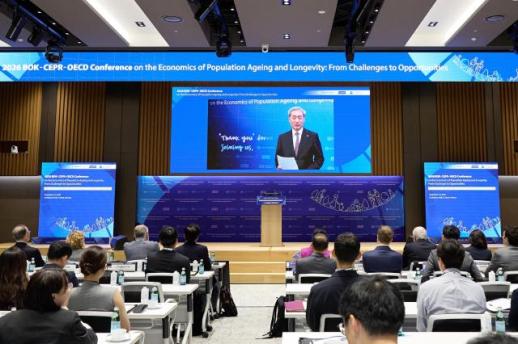 BOK highlights demographic challenges in international forum SEOUL, September 02 (AJP) - The Bank of Korea opened a two-day conference Wednesday on ageing and longevity, where Governor Hyun Song Shin urged early preparation for demographic pressures on growth, productivity and interest rates. The conference, titled “The Economics of Population Ageing and Longevity: From Challenges to Opportunities,” runs through Thursday in Seoul. It is jointly hosted by the BOK, the Centre for Economic Policy Research and the Organisation for Economic Co-operation and Development. The event brings together economists and policymakers to examine how declining fertility and ageing populations could affect economic growth, interest rates, labor markets and technological adaptation. In a video address opening the conference, Shin described demographic change as one of the most important long-term issues confronting central banks. Shin is currently attending the G20 finance ministers and central bank governors meeting in Asheville, North Carolina. He said it would help determine future productivity, potential growth and the long-run equilibrium interest rate. Shin said developments now unfolding in South Korea could offer an early indication of demographic challenges that many other countries will eventually face. “Demography is not destiny,” Shin said, stressing that productivity and long-term growth have historically depended heavily on the creation and diffusion of knowledge. Unlike short-term economic shocks, demographic changes can be foreseen decades in advance. That gives policymakers an opportunity to prepare before their effects fully materialize, he said. Shin pointed to Korea's position in the artificial intelligence ecosystem as a potential advantage in responding to a shrinking and ageing workforce. He also cited the country's strength in semiconductor production and AI-driven investment. Shin said the favorable technological environment means Korea should use the current window to prepare for the economic consequences of demographic change rather than postpone adjustment. 2026-09-02 11:08:03
 -
South Korea Launches Massive Logistics Center in the U.S. A massive public-private logistics center, equivalent to 14 soccer fields, has officially begun operations in the United States. This facility is expected to boost domestic companies' efforts to enter the overseas logistics market, with the capability to deliver across the country within two days.The Ministry of Oceans and Fisheries announced on September 2 that the Elwood Logistics Center, located near Chicago, Illinois, was constructed through a joint investment by South Korean logistics company CJ Logistics and the Korea Ocean Business Corporation (KOBC). The center spans 295,000 square meters with a total floor area of 103,000 square meters, featuring 130 docks for large truck loading and unloading.Elwood's excellent accessibility and strategic location are highlighted as key advantages. The facility is situated approximately 72 kilometers southwest of downtown Chicago and is just 5.5 kilometers from the largest logistics hub in the U.S. (CIC), allowing for nationwide deliveries within two days via rail and road networks.Since 2011, the Ministry has supported overseas logistics market expansion by selecting 5 to 10 companies annually, providing up to 200 million won for feasibility studies. The investment in this logistics center was made possible by funding received for a feasibility study in 2022.Additionally, the Ministry is implementing policies to enhance supply chain stability. It has established a 1 trillion won global logistics supply chain investment fund to assist South Korean logistics companies in acquiring overseas logistics assets. The Ministry plans to secure 40 public-private logistics centers by 2030.Logistics centers jointly invested by public institutions will be designated as overseas joint logistics centers through the Korea Trade-Investment Promotion Agency (KOTRA), enabling South Korean small and medium-sized enterprises to utilize them at lower costs.Kim Hye-jung, Director of the Shipping and Logistics Bureau at the Ministry, stated, "We expect this project to enhance the competitiveness of our logistics companies and provide stable logistics services to domestic export and import companies operating abroad. Furthermore, we will expand various policy initiatives, including providing information on overseas logistics markets and supporting logistics companies' international expansion."* This article has been translated by AI. 2026-09-02 11:04:10
-
South Korea to Boost Voluntary Carbon Market with GCC Partnership, Purchasing Up to 200,000 Tons of Credits The South Korean government plans to directly purchase up to 200,000 tons of high-quality carbon credits to stimulate the voluntary carbon market. It aims to enhance the quality and reliability of domestic carbon credits by strengthening cooperation with the Qatar Global Carbon Council (GCC) and promoting connections with international markets.On September 2, Park Hong-keun, Minister of the Office for Government Policy Coordination, met with Yousef Mohammed Al-Hor, Chairman of the GCC, to discuss collaboration for revitalizing the voluntary carbon market between South Korea and Qatar.During the meeting, Minister Park shared key aspects of South Korea's carbon neutrality policies, including the Nationally Determined Contribution (NDC), energy transition focused on renewable energy, the Emissions Trading System (ETS), and the Climate Response Fund, as well as the direction for establishing a 'Korean-style voluntary carbon market' announced in April.The government is committed to enhancing carbon reduction efforts and expanding the climate tech industry by activating the voluntary carbon market (VCM). Since the ETS covers about 70% of the country's greenhouse gas emissions, the government aims to foster a market that encourages non-regulated companies to voluntarily reduce emissions.To achieve this, the government plans to establish regulations through the enactment of a voluntary carbon market law and open an exchange to create an integrated trading infrastructure. Additionally, it will connect supply and demand for carbon credits through public-private alliances.Specifically, to generate initial demand in the voluntary carbon market, the government intends to establish a new entity tentatively named the 'Korea Carbon Center' next year and purchase up to 200,000 tons of high-quality carbon credits at the central government level. This initiative aims to responsibly address the climate crisis while also creating initial demand in the private market, given that the government emits approximately 900,000 tons of greenhouse gases annually.Minister Park also requested that the GCC actively contribute to enhancing the domestic certification system as a qualified institution under the International Civil Aviation Organization's (ICAO) Carbon Offsetting and Reduction Scheme for International Aviation (CORSIA) and the Integrity Council for the Voluntary Carbon Market (ICVCM).The goal is to leverage the GCC's global certification experience and rigorous verification system to improve the quality and reliability of carbon credits produced domestically.Furthermore, Minister Park urged Chairman Al-Hor to facilitate investments from global funds, such as the Qatar Sovereign Fund, into domestic carbon neutrality projects focused on carbon removal and energy transition. He also proposed collaboration on the international stage, including at the UN Climate Change Conference and multilateral development bank projects.Chairman Al-Hor praised South Korea's NDC goals and efforts to establish a carbon market, expressing a commitment to actively cooperate to help the Korean-style voluntary carbon market grow into a global hub.Meanwhile, the Office for Government Policy Coordination signed a tripartite memorandum of understanding (MOU) with the GCC and the Korean Chamber of Commerce and Industry (KCCI) on the same day.Attendees included Jo Yong-beom, Vice Minister of the Office for Government Policy Coordination, Chairman Al-Hor of the GCC, and Jo Young-jun, head of the KCCI's Sustainable Management Center. The three organizations plan to combine the GCC's certification experience in the voluntary carbon market with the KCCI's domestic project base to enhance the international usability of carbon credits produced in South Korea.Under the agreement, the three entities will share methodologies for certifying voluntary carbon credits and expertise in managing registries, while seeking international mutual recognition and linkage for high-quality reduction achievements. They will also pursue joint cooperation projects to respond to international carbon market norms, such as CORSIA and Article 6 of the Paris Agreement.Vice Minister Jo stated, "To respond to the climate crisis, it is essential to activate the voluntary carbon market, transforming carbon reduction into economic activities that create new value and opportunities. By combining the policy and financial support of the Office for Government Policy Coordination, the GCC's rigorous and transparent verification system, and the KCCI's project base for carbon reduction, we will establish a new model of carbon market cooperation connecting Asia and the Middle East."* This article has been translated by AI. 2026-09-02 11:04:10
-
Samsung Unveils 'AI Living' Concept at IFA 2026, Integrating TV, Appliances, and Mobile Samsung Electronics is showcasing its 'AI Living' concept at IFA 2026, connecting TVs, appliances, and mobile devices into a unified artificial intelligence ecosystem.From September 2 to 6, Samsung is hosting a standalone exhibition at the Humboldt Carré in Berlin under the theme 'Your Companion to AI Living.'The exhibition is divided into three main themes: Entertainment Companion, Home Companion, and Self-Care Companion. It emphasizes not just the AI capabilities of individual products but also how TVs, appliances, smartphones, and wearables can work together to support users' overall lifestyle, including leisure, household tasks, and health management.In the Entertainment Companion zone, visitors can experience a new viewing experience that combines next-generation display technology with AI. Highlights include 'Micro RGB,' which uses fine RGB (red, green, blue) LEDs for precise color and contrast representation, and the 'Vision AI Companion' featured in the 2026 TV lineup.The Vision AI Companion is based on conversational AI, providing personalized content and contextually relevant information. Samsung's ad-supported free streaming service, Samsung TV Plus, has surpassed 100 million monthly active users globally, expanding its reach as a media platform.Among gaming products, Samsung is unveiling the world's first 42-inch curved OLED gaming monitor, the 'Odyssey G7,' and the world's first 1100Hz ultra-high refresh rate 27-inch 'Odyssey G6.'The Home Companion zone showcases AI appliances that prioritize energy efficiency and space utilization, key concerns in the European market. The 'Bespoke AI Family Hub' refrigerator uses camera-based 'AI Vision' to automatically recognize ingredients and suggest recipes. A large touchscreen allows users to monitor and control the power consumption of connected appliances in real time.Samsung is also presenting a built-in dishwasher that reduces energy consumption by 20% compared to the highest energy efficiency rating in Europe, and a 'Bespoke AI Washing Machine' that saves 70% more energy. Additionally, kitchen appliances designed to enhance space efficiency, such as an induction cooktop that absorbs cooking odors and smoke without a separate hood, are on display.The AI experience extends to mobile and health management. The Self-Care Companion zone features the upcoming 'Galaxy S26 FE,' along with the 'Galaxy Z Fold8 Ultra,' 'Galaxy Z Fold8,' 'Galaxy Watch Ultra2,' and 'Galaxy Watch9.'The Galaxy S26 FE incorporates the latest software, 'One UI 9,' along with personalized editing features like 'My FanCam' and horizontal stabilization 'Super Steady.' It demonstrates an AI experience that connects various devices and services, from work and content consumption to health management.Samsung is also operating the 'Samsung Creator Hub' at the IFA Palais in Messe Berlin, offering programs to experience the Samsung AI ecosystem.Benjamin Brown, Chief Marketing Officer for Samsung Electronics Europe, stated, "AI must provide meaningful benefits that people can see and feel in their daily lives. We will showcase practical and accessible applications of AI across entertainment, mobile, and the connected home ecosystem." 2026-09-02 11:04:00
-
Samsung Heavy Industries Employee Receives Industrial Medal for Cost-Saving Innovations Kim Seung-tae, an employee at Samsung Heavy Industries, received the Industrial Medal for his contributions to developing new shipbuilding methods and transferring technology over his 36 years in the industry.On September 2, the Ministry of Employment and Labor and the Korea Industrial Human Resources Development Institute held the 30th Vocational Skills Month ceremony at the Fairmont Ambassador Hotel in Yeouido, Seoul. Vocational Skills Month was established in 1997 to promote the importance of vocational skill development, with this year's theme being 'New Skills, Bright Tomorrow.'During the ceremony, a total of 35 individuals received government awards, including two medals, three industrial decorations, eight presidential citations, 17 prime ministerial citations, and five ministerial citations.Kim was recognized for developing new shipbuilding methods that saved approximately 5.2 billion won (about $4.4 million) through patent proposals and work improvements. He holds 11 patents in the shipbuilding and marine sectors and has participated in over 500 technology transfer and volunteer activities.After being named the top craftsman in Gyeongsangnam-do, he has been passing on his skills and experience to younger skilled workers. He has also engaged in 727 social contribution activities, totaling 2,354 hours.The Industrial Medal was awarded to Kwak Seung-ho, chairman of the Gyeongbuk Industrial Vocational School. Over the past five years, Kwak has invested an average of 1.6 billion won annually in training facilities and equipment, establishing a network of over 500 partner companies. He was also recognized for expanding vocational training in new technology fields, including artificial intelligence (AI) campuses and K-Digital Training (KDT).Industrial decorations were awarded to Ma Yeong-tae, a senior researcher at Samsung Electronics known for his expertise in surface treatment; Kim Kyung-soo, CEO of NextChip, a vehicle semiconductor research and development company; and Kim Sang-ho, head of the Korea Research Institute for Vocational Education and Training, recognized for his policy research in NCS and qualifications.Lim Young-mi, head of the Employment Policy Office at the Ministry of Labor, stated, 'Thanks to your dedication to vocational skills development over the past 30 years, South Korea has emerged as a powerhouse in technology and talent. We will expand vocational training in new technologies like AI and strengthen talent development to meet the demands of future key industries and local workforce needs.'* This article has been translated by AI. 2026-09-02 11:04:00
-
South Korea and Japan Strengthen Cooperation on Critical Minerals and LNG Supply Chains South Korea and Japan are intensifying their collaboration to diversify critical mineral supply chains and ensure stable supplies of liquefied natural gas (LNG) and petroleum products. They will also jointly respond to global environmental and supply chain regulations, including the European Union's Carbon Border Adjustment Mechanism (CBAM).The Ministry of Trade, Industry and Energy announced that on September 2, it held the first implementation meeting of the South Korea-Japan Supply Chain Partnership Agreement (SCPA) in Tokyo, Japan. Kim Jang-hee, the Ministry's Director of New Trade Strategy, and Shogo Tanaka, the Japanese Ministry of Economy, Trade and Industry's Director of Trade Strategy, served as the chief representatives.The SCPA, signed in March, aims to enhance cooperation in critical minerals and resources and to jointly respond to supply chain crises. It also includes provisions for collaboration on global trade issues and the establishment of regular intergovernmental consultations.During a summit in May, the leaders of both countries agreed to strengthen the resilience of supply chains in key industrial sectors based on the SCPA. This meeting marks the first implementation session aimed at translating that agreement into specific collaborative projects.The two sides shared their respective policies to diversify and stabilize critical mineral supply chains. They discussed bilateral and multilateral cooperation strategies to reduce dependence on specific countries for critical minerals. They also agreed to continue cooperation to secure stable supplies of LNG and crude oil in the event of an energy supply chain crisis.Additionally, they exchanged information on regulatory trends requiring carbon emissions and supply chain audits from various countries and discussed measures to alleviate the burden on businesses. This is in response to the EU's CBAM, which came into full effect on January 1 of this year, targeting carbon-intensive products such as steel, aluminum, cement, fertilizers, electricity, and hydrogen. The need for supply chain cooperation has expanded beyond securing quantities of critical minerals and energy to include carbon emissions calculations and responses to supply chain regulations.Kim Jang-hee stated, "In a situation where uncertainties in the global supply chain persist, the importance of cooperation between countries with similar industrial structures is increasing. We will strive to develop the SCPA into a communication channel that produces concrete results in our supply chain cooperation."* This article has been translated by AI. 2026-09-02 11:04:00
-
Law Firm Kwangjang to Host Seminar on Major Disaster and Yellow Envelope Laws Law Firm Kwangjang, led by Managing Partner Kim Sang-gon, announced on September 2 that it will hold a large-scale online and offline seminar on September 10. The seminar will address key issues and responses related to corporate safety and labor management following the implementation of the Major Disaster Punishment Law and the Yellow Envelope Law.The seminar is co-hosted by Kwangjang's Labor Group and Major Disaster Center, featuring veteran experts including former Minister of Employment and Labor Ahn Kyung-deok and Kwangjang's Managing Partner Kim Hu-gon, a former chief prosecutor at the Seoul High Prosecutors' Office. They will share the latest legal trends and practical insights.In the first session, attorney Hong Jeong-yeon (37th Judicial Research and Training Institute) will present on 'Recent Trends in the Major Disaster Punishment Law and Prospects Following Revisions to Criminal Procedure Law.' Hong previously served as a dispatched prosecutor at the Ministry of Employment and Labor and as the head of the Labor Investigation Support Division at the Supreme Prosecutors' Office before joining Kwangjang this year after 18 years as a prosecutor.The second session will feature labor and compliance experts, attorney Lee Jeong-woo (37th Judicial Research and Training Institute) and attorney Oh Yong-soo (41st Judicial Research and Training Institute), discussing 'Practical Issues Following the Implementation of the Yellow Envelope Law.'A Q&A session will include the presenters from the earlier sessions, along with attorneys Lee Sang-hyun (33rd Judicial Research and Training Institute), Song Hyun-seok (34th Judicial Research and Training Institute), and Kim Young-jin (35th Judicial Research and Training Institute) to facilitate in-depth discussions.Kwangjang's Labor Group and Major Disaster Center stated, 'While the Major Disaster Punishment Law and the Labor Union Law originate from different areas, they both require a reassessment of corporate safety and labor management systems.' They added, 'Based on our accumulated advisory and litigation experience, we aim to provide practical solutions to the challenges faced in the field.'Registration for the seminar can be completed on Kwangjang's website under the 'Seminar - Seminar Information' section.Founded in 1977, Law Firm Kwangjang (Lee & Ko) is one of South Korea's leading law firms, employing over 750 professionals. The firm offers a wide range of legal services, including corporate advisory, litigation, finance, intellectual property, and criminal disputes.* This article has been translated by AI. 2026-09-02 10:56:10
-
KDRT Arrives in Nepal to Assist with Flood Rescue Operations The Republic of Korea's Overseas Emergency Relief Team (KDRT) arrived in Nepal on September 2 to assist with rescue operations following severe flooding. The team plans to coordinate with the already deployed rapid response unit to begin search efforts for missing persons.A Foreign Ministry official stated that the KDRT landed in Kathmandu at approximately 9:42 a.m. Korean time. He added, "KDRT plans to commence activities today and will discuss future search strategies with the rapid response team." However, as the KDRT has just arrived, detailed discussions will take place later.The official expressed optimism that cooperation would be more effective this time, as the KDRT's deployment was made at Nepal's request. He noted, "It was symbolic that the rapid response team flew close to the accident site using a Nepalese military helicopter yesterday."This marks the 12th deployment of the KDRT, the first since the Canadian wildfires in 2023. The current team consists of 44 members, including Lee Gyu-ho, Director of the Development Cooperation Bureau at the Foreign Ministry, as well as personnel from the Fire Agency and the Korea International Cooperation Agency (KOICA). The KDRT is expected to operate for about ten days.Meanwhile, the number of missing South Koreans remains at nine. 2026-09-02 10:56:00