


Latest by
-
 Disability Rights Group Plans Subway Protest at Seoul Station The National Coalition for the Elimination of Discrimination against Persons with Disabilities (전장연) announced a protest at Seoul Station on the morning of August 24.In a statement via social media, 전장연 said, "We will conduct the 73rd 'Subway Ride for Commuters' at 8 a.m. at the Line 1 platform (toward City Hall Station) to demand the guarantee of next year's budget for disability rights."Seoul Metro also warned that a protest by a "specific disability organization" was scheduled for 8 a.m. on Lines 1 and 4, which could lead to significant delays in train operations in the affected areas. They advised commuters to be aware that trains may bypass the stations where the protests occur.On August 19, Park Hong-geun, the Minister of the Office for Government Policy Coordination, held a private meeting with 전장연 leader Park Kyung-seok for about an hour.According to Yonhap News, Park stated after the meeting that it was not a negotiation regarding the budget, but he provided a detailed explanation of the budget requests made by 전장연.Minister Park reportedly responded that he would "thoroughly review" the demands made by 전장연. He also reiterated a request for 전장연 to cease its subway protests.Park expressed that it was his first experience having such a direct conversation with the Minister of the Office for Government Policy Coordination and viewed the meeting positively.전장연 announced that they would cancel their planned subway ride promotion at Seoul Station but confirmed that the subway protest would proceed as scheduled at 8 a.m. on August 24, after which they would clarify their stance on the continuation of the protests.* This article has been translated by AI. 2026-08-24 07:56:00
 -
Pence Proposes Deploying South Korean Missiles to Ukraine Mike Pence, who served as Vice President during Donald Trump's first term, has proposed that South Korea provide its advanced interceptor missiles to the United States for potential deployment in Ukraine or the Middle East. This suggestion comes as U.S. air defense missile stocks have dwindled due to the ongoing conflict with Iran.While visiting Ukraine, Pence stated in a CNN interview on August 23 that he discussed the shortage of air defense weapons to counter Russian ballistic missile attacks with Ukrainian President Volodymyr Zelensky.Pence emphasized the need to supplement U.S. air defense capabilities through allied nations, specifically mentioning South Korea. He noted, "South Korea possesses very sophisticated interceptor missiles," and added that there have been several exchanges between President Zelensky and South Korea this week.He further explained, "This could be an opportunity for President Yoon Suk Yeol to take a step further by providing these interceptor missiles to the U.S. for deployment in the Middle East, Ukraine, or European allies."This proposal suggests a form of indirect support, where South Korea would transfer interceptor missiles to the U.S., which would then redeploy them to areas in need.Earlier, President Zelensky expressed a desire for South Korea's assistance in air defense systems during a broadcast interview on August 9, acknowledging legal constraints but expressing hope for cooperation as diplomats from both countries engage.Pence's comments arose in response to concerns about the depletion of Patriot missiles due to the war with Iran, which has left the U.S. with fewer air defense resources to support Ukraine. He countered the notion that the U.S. is unable to assist, stating, "I don't see it that way."However, he warned that Ukraine's lack of air defense could pose serious challenges this winter, citing Zelensky's concerns that Russian President Vladimir Putin would target schools, hospitals, shopping malls, and energy infrastructure, forcing Ukraine to endure a harsh winter.Pence noted that Zelensky mentioned that providing just 5% of the Patriot stock would be sufficient for winter survival.* This article has been translated by AI. 2026-08-24 07:52:00
-
85% of Financial Supervisory Service Employees Consider Leaving if Relocated The Financial Supervisory Service (FSS) faces a potential exodus of employees, with 85.6% indicating they would consider leaving if the agency relocates to a provincial area. Since 2022, a total of 481 employees have left the FSS, with 180 of them, or 37.4%, aged between 20 and 40.Among employees under 40, 92.5% are contemplating a job change, and 80.4% are actively considering it. The desire to leave is particularly high among professionals such as accountants and lawyers, who express concerns about inefficiencies related to long-distance commuting and increased costs associated with a move.Only 13.5% of employees are willing to relocate, while a significant 97.9% believe it is reasonable for the FSS to maintain its headquarters in Seoul.* This article has been translated by AI. 2026-08-24 07:44:00
-
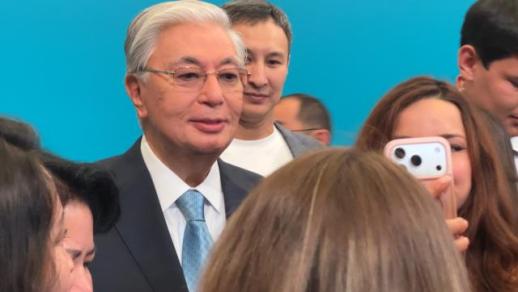 AJP On the Spot: Inside Astana's historic vote ASTANA, Aug. 23 (AJP) —"Today is undoubtedly a truly historic day for our country. For the first time, we are holding elections to the unicameral Kurultai," President Kassym-Jomart Tokayev said after casting his ballot Sunday. "We have achieved significant results. At the same time, much work remains to be done, and the goals before us are of particular importance. Today's elections are only the beginning of this major undertaking." Around him, dozens of cameras remained trained on the polling area inside Astana's Palace of Independence. Tokayev had entered the room before tightly packed television crews and photographers, approached a transparent ballot box and slowly placed his ballot inside. Camera shutters erupted. The act itself took only seconds. But it marked the first parliamentary election under a new Constitution that has redrawn Kazakhstan's political architecture three decades after the Central Asian country built its post-Soviet system around a powerful presidency. For international journalists behind the press line, reaching that moment had taken most of the morning. The journey began nearly five hours earlier, before Astana was properly awake. At 5:30 a.m., the hotel was almost completely silent. Outside, cold rain fell steadily onto an empty road. A white car pulled up. Two men assigned to escort AJP reporter entered the lobby and led the way outside. After brief greetings, the car set off through the rain toward Qazmedia Center, the 22-story broadcasting complex in central Astana that houses several of Kazakhstan's national television and radio outlets. By shortly after 6 a.m., the building was beginning to fill with journalists from the country's major news organizations, many of whom regularly cover Tokayev and attend presidential briefings. They arrived carrying cameras, tripods and microphones. Conversations were quiet. Credentials were checked and names counted. AJP was the only South Korean media outlet represented among the journalists assembled for the presidential vote. The bus pulled away into the rain. For about 15 minutes, it moved through the wet streets of the capital, passing the sprawling Hazret Sultan Mosque, one of Astana's best-known landmarks, before arriving at the Palace of Independence. Opened in 2008, the palace is one of the capital's main venues for state ceremonies, high-level meetings and international events. Reporters stepped off the bus and headed inside through the drizzle. Most were directed toward a press room. The AJP reporter, however, was stopped by a security officer and taken to a separate business conference room. Coffee, tea and small refreshments had been prepared inside. Several security personnel remained in the room, but there was no indication of when the next move would come. The wait continued for hours. The wait stretched for nearly three hours. The room remained quiet enough that every opening door and approaching footstep drew attention. At around 10 a.m., a senior security official entered. The officers in the room turned toward him almost in unison. He looked across the room, pointed toward the AJP reporter and signaled that it was time to move. The route led through the Palace of Independence toward the polling station on the first floor. The atmosphere changed immediately. Kazakh journalists were already packed into position behind a designated press line. Photographers had secured their angles. Television crews stood shoulder to shoulder with cameras trained on the polling area. After hours of travel, security screening and waiting, there was suddenly nothing left to do but stand still. A Kazakh family entered shortly before the president and cast their ballots. Then Tokayev walked in. Dozens of cameras turned toward him at once, filling the polling station with the rapid mechanical clatter of shutters. Photographers tracked Tokayev as he moved through the room and approached the ballot box. Another burst of shutters followed as he slowly placed his ballot inside. For a few seconds, a routine act being repeated by voters across Kazakhstan became the sole focus of the press line. Tokayev then moved to a nearby area set aside for the media. The significance of the vote goes well beyond a president putting a ballot into a box. Kazakhstan, Central Asia's largest economy and a major oil and minerals exporter, had spent most of its history since independence from the Soviet Union in 1991 under a political system dominated by its presidency. Nursultan Nazarbayev led the country from independence until 2019, when he stepped down and handed the presidency to Tokayev, a former prime minister, foreign minister and senior United Nations official whom Nazarbayev had chosen as his successor. Tokayev's early presidency was therefore initially viewed largely as a continuation of the political order established under Nazarbayev. That changed dramatically in January 2022. Protests over fuel prices spread into nationwide unrest and violent clashes that left more than 200 people dead. A Russian-led security force was briefly deployed at Tokayev's request. The crisis also marked Tokayev's decisive break with Nazarbayev and figures associated with the former president's political network. Tokayev has described the upheaval as an attempted coup involving Nazarbayev loyalists. What followed was a succession of political and constitutional changes that Tokayev presented as the construction of a "New Kazakhstan." A 2022 constitutional overhaul altered the presidency and introduced a single seven-year presidential term. Tokayev won that seven-year mandate later that year. The changes continued in 2026. In March, voters approved an entirely new Constitution in a nationwide referendum, with the Central Election Commission reporting 87.15 percent support on turnout of 73.12 percent. Tokayev described the overhaul as a move away from Kazakhstan's previous "super-presidential" model and toward a greater division of state powers, although critics have questioned whether the new system sufficiently constrains presidential authority. The Constitution took effect on July 1, simultaneously ending the 1995 Constitution and terminating the mandate of the former parliament. The Senate and lower-house Mazhilis that had formed Kazakhstan's bicameral legislature disappeared. In their place came the Kurultai. The new chamber has 145 deputies elected for five-year terms through party lists in a single nationwide constituency. The Constitution defines it as the country's highest representative body exercising legislative power. The changes extend beyond parliament. The new political framework also creates the office of vice president and restructures several state institutions, making Sunday's vote part of a broader reorganization of how Kazakhstan is governed. The election outcome itself is not expected to be in doubt. The pro-presidential Adilet party, formed this year through the merger of the longtime ruling Amanat party — previously known as Nur-Otan — with a smaller party of the same name, is widely predicted to win an overwhelming majority, with several other parties loyal to Tokayev also expected to enter the new legislature. The new constitutional order is also being closely watched for what it could mean for Tokayev's own political future, and for Kazakhstan's position between its two largest neighbors. Kazakhstan's Constitutional Court has ruled that Tokayev, who has served as president since 2019, may seek another seven-year term under the new Constitution — a legal maneuver that leaders in Russia, Belarus, Uzbekistan and Tajikistan have used in similar ways to extend their own time in power. Asked by reporters after voting Sunday whether he intended to run again, Tokayev said it was too early to say. Kazakhstan has continued its long-standing effort to balance ties with Moscow and Beijing while courting investment from the West. Tokayev met Russian President Vladimir Putin in Omsk in July for a regional cooperation forum, even as Kazakhstan signed billions of dollars in trade and investment deals with China at a summit in Shanghai the same month. Analysts have long described this approach — preserving close ties with both powers without fully aligning with either — as central to Kazakhstan's foreign policy since independence. Moreover, political stability in the country carries significance well beyond its population because of its energy resources, minerals and strategic location at the center of Eurasia. Still, the political meaning of the new system remains contested. Tokayev has cast the constitutional changes as a modernization of government and a departure from the highly centralized model inherited from the Nazarbayev era. Outside analysts nevertheless question whether the changes instead leave the presidency dominant while reorganizing the institutions around it. The morning also offered a glimpse of the machinery surrounding presidential coverage in Kazakhstan. What gave the scene its weight was everything around it — a country dismantling one parliamentary system and beginning another, a president who emerged from the old order but now presides over its restructuring, and an unresolved question over how long that president may remain at the center of the new one. 2026-08-24 07:39:23
 -
North Korea and Belarus to Sign Mutual Visa Exemption Agreement Soon Belarus and North Korea are set to sign a mutual visa exemption agreement for their citizens soon.On August 23, Belarusian state news agency BelTA reported that Foreign Minister Maksim Ryzhenkov discussed the visa exemption agreement and overall bilateral relations during a meeting with North Korean Foreign Minister Choe Son-hui.Ryzhenkov stated, "The draft agreement is already prepared, and only some details remain to be coordinated."This agreement is seen as a follow-up to a treaty on friendship and cooperation signed by Belarusian President Alexander Lukashenko and North Korean leader Kim Jong Un during Lukashenko's visit to Pyongyang in March. In April, Belarusian Prime Minister Alexander Turchin signed a resolution to establish an embassy in North Korea, further strengthening diplomatic ties between the two countries.North Korea has been enhancing its military and diplomatic ties with Russia, including sending troops to support Russia in the Ukraine war. As North Korea expands its relationship with Belarus, a key ally of Russia, cooperation among North Korea, Russia, and Belarus is expected to deepen.* This article has been translated by AI. 2026-08-24 07:32:00
-
Trump Drives 'The Beast' at Freedom 250 Grand Prix in Washington In a unique spectacle, race cars reached speeds of up to 200 miles per hour in Washington, D.C., on August 23, as the IndyCar Freedom 250 Grand Prix was held to commemorate the 250th anniversary of American independence.According to reports from Reuters and AFP, President Donald Trump participated in the event, taking a ceremonial lap around the circuit in his presidential limousine, 'The Beast,' and waving the starting flag.The race course, approximately 2.7 kilometers long, circled iconic landmarks around the National Mall, totaling 250 miles over 147 laps.In preparation for the high-speed event, 200 manhole covers were welded down, and the nearby National Gallery of Art took measures to protect its collections from vibrations. It is reported that Roger Penske, who owns IndyCar, covered the event's costs, estimated between $20 million and $30 million.With the usual speed limit in downtown Washington set at 35 miles per hour, around 300,000 spectators gathered along the course. A celebratory flyover featured a private jet gifted to Trump by Qatar and a U.S. B-2 stealth bomber.This event was part of a series of activities organized by Trump to celebrate the 250th anniversary of American independence, which also included large fireworks displays and a UFC event at the White House.While the event marked a significant national milestone, critics argue that Trump is using the occasion to bolster his political image. The Associated Press noted that Trump is commemorating 250 years of American history in a manner that he deems 'grand.' Reuters reported that the event comes as Trump's approval ratings have hit a low during his second term, amid ongoing tensions with Iran. 2026-08-24 07:12:00
-
Zelensky Opposes Elections During War, Warns of National Division Ukrainian President Volodymyr Zelensky has opposed holding elections amid the ongoing war with Russia, stating that it could lead to national division. According to AFP and Reuters, during a press conference on the 23rd, Zelensky said, "Holding elections in such a war situation could pose tremendous risks," adding, "If we were to hold elections now, it would create a tsunami that would divide Ukraine." He further stated, "If we want to destroy the country, we could move toward holding elections during wartime." Zelensky's remarks are seen as a direct rebuttal to the recent call for elections by former Defense Minister Mykhailo Fedorov, who was dismissed last month.On August 18, Fedorov released a video message urging the need for a "legal, safe, and realistic" plan to restore full democratic procedures despite the ongoing Russian invasion. He asserted, "Democracy should not be held hostage by Russia." Zelensky, who won the presidential election in May 2019, is currently serving a term that was originally set to expire in May 2024. However, elections have been suspended due to martial law following Russia's invasion in 2022.Fedorov's call for elections has added political pressure on Zelensky. He was abruptly dismissed last month after successfully leading a war strategy that utilized drones. Since then, protests demanding Fedorov's reinstatement have erupted in Ukraine, reflecting a growing discontent.There are speculations that Fedorov could emerge as a potential rival to Zelensky. In a recent trust survey conducted by the Sociis Center, Valerii Zaluzhnyi, Ukraine's Ambassador to the UK, ranked first in political trust, while Fedorov came in second. Zelensky ranked sixth.Meanwhile, during the press conference, Zelensky claimed that Russia appears to be planning to conscript an additional 300,000 troops after its elections in September, with a potential increase of 500,000 troops next year.Zelensky noted that while Ukraine requested 360 air defense missiles this year, only 264 are expected to be provided. In contrast, he stated that Russia aims to achieve a production capacity of up to 1,300 ballistic missiles annually.He also emphasized that Ukraine's defense spending in the first half of this year has exceeded expectations, necessitating an additional $27 billion.* This article has been translated by AI. 2026-08-24 06:36:00
-
K-Art Takes Center Stage with Major Exhibitions in Seoul It is now time for K-Art. As the global art community turns its attention to Seoul this fall, contemporary Korean art will be showcased throughout the city. Major figures in Korean contemporary art, including Park Seo-bo, Yoon Hyong-keun, and Lee Kang-so, alongside internationally recognized artists like Seongdo Ho and Koo Jeong A, will present exhibitions that highlight the strength of K-Art. The excitement ignited by museums and galleries is spilling out into the streets. At the Dongdaemun Design Plaza (DDP), works by Nam June Paik and Yoo Young-kuk will illuminate the night, while biennales in Gwangju, Busan, and Changwon will soon commence.Featuring 'That' ArtistOn September 2, the Kiaf Seoul and Frieze Seoul will open simultaneously, with galleries and museums across the city prominently featuring Korean artists.The National Museum of Modern and Contemporary Art (MMCA) will host the largest solo exhibition of renowned installation artist Seongdo Ho, starting August 27. This exhibition will showcase works from his student days to his current projects, exploring themes of space, memory, and identity. A significant number of his drawings, reflecting his thought process, will be unveiled for the first time in Korea, along with future-oriented insights centered around the 'Bridge Project.'At the Leeum Museum, Koo Jeong A's exhibition 'Koo Jeong A: Ousmos' will open on September 5. This will be the largest solo exhibition of her work in Korea, encapsulating over 30 years of her artistic journey. Key elements of her art, such as glow-in-the-dark materials, skate parks, magnets, and scents, will extend beyond the M2 exhibition hall into the lobby and the traditional art exhibition space, weaving together various layers of her 'Ous' universe.Returning to the scene are masters who laid the foundation for Korean contemporary art. This is a unique opportunity to witness the trajectories of artists who have explored diverse paths, from monochrome painting to experimental and people's art.On August 21, the Park Seo-bo Museum opened in Yeonhui-dong, Seoul, featuring the inaugural exhibition 'Park Seo-bo and Huong Do Dinh: Emptiness and Fullness.' This exhibition presents 42 paintings by the monochrome master Park Seo-bo and Vietnamese-born French artist Huong Do Dinh, highlighting their different materials and methods as they converge on the themes of 'emptiness' and 'fullness.'The International Gallery in Samcheong-dong will showcase a retrospective of Park Seo-bo's 50-year career, opening on August 24. The exhibition 'Changing, Unchanging' will feature 40 works, tracing the evolution of his techniques from the 1967 'Pencil Drawing Method' to the 'Zigzag Method' using hanji paper, and his later 'Newspaper Method.' Visitors will be able to see the artist's own words, stating, 'I will be remembered as an artist who changes without falling.'The Lotte Museum will present Lee Kang-so's solo exhibition 'Lee Kang-so: Emergence and Dissolution,' showcasing over 150 works that span more than five decades of experimentation. The exhibition will include new LED works based on his representative painting series 'Cheongmyeong,' along with over 30 'Throwing Sculptures' and 11 major series such as 'Cheongmyeong,' 'Untitled,' and 'From the Island,' as well as his first solo exhibition piece 'Dissolution.'PKM Gallery will open 'Reimagining Yoon Hyong-keun' on August 26, featuring over 40 large-scale paintings and hanji works representing the artist's career from the 1970s to the 2000s. On September 1, 'Yoon Hyong-keun's House,' a recreation of the space where the artist lived and worked, will also open.The Seoul City Archive will present the 'Oh Yoon Collection' to commemorate the 40th anniversary of the passing of Oh Yoon (1946-1986), a representative of people's art in the 1980s. This exhibition will shed light on his artistic world and creative process through the archive collected in 2024.DDP Illuminated by Nam June Paik and Yoo Young-kukFrom September 3 to 13, the DDP will be illuminated every evening from 7:30 PM to 10:30 PM with media art featuring works by Nam June Paik and Yoo Young-kuk.Nam June Paik's 'The Break Point' combines real-time media art with live performances by artist groups, where the light and visuals on the DDP facade will change in real-time to the beat of music. Yoo Young-kuk's 'Finding the Mountain Within Me' will showcase the 'mountain' he has contemplated throughout his life, projected onto the organic surface of the DDP. The vibrant colors and rhythms of nature will be transformed into a constantly evolving landscape within the digital space created by young media artist Kwon Ha-yoon.During Frieze Seoul, Frieze Week will unfold across the city, featuring exhibitions, performances, and various events at major museums and galleries, including the Leeum Museum, Song Eun, and Artsonje Center. The gallery-rich areas of Euljiro, Hannam, Cheongdam, and Samcheong will also host 'Neighborhood Night,' connecting domestic and international visitors with galleries, artists, and cultural figures.Biennales will also take place in various regions, including Gwangju and Busan. The 16th Gwangju Biennale will open on September 5 under the theme 'You Must Change Your Life,' running until November 15. This theme, drawn from the last line of Rainer Maria Rilke's poem 'The Torso of Apollo,' questions whether art can change lives. Singaporean installation artist Ho Tzu Nyen will serve as the artistic director, showcasing works from 45 teams across more than 20 countries.In Busan, Jeju, and Changwon, biennales will follow suit. The Busan Biennale, opening on September 29, will feature 46 teams from 22 countries under the theme 'Dissonant Chorus.' The Jeju Biennale, starting on August 25, will gather 69 teams from 20 countries around the keywords 'Exile, Myth, Stone.' The Changwon Sculpture Biennale, set to open on September 30, will showcase over 200 works from 74 teams across 14 countries, displayed throughout the city at venues such as Seongsan Art Hall, Jinhae Station, and Masan Fish Market. 2026-08-24 06:04:20
-
Vessel AI Aims for Unicorn Status in Five Years with GPU Rental Business Vessel AI, which offers GPU services similar to cloud computing, is targeting unicorn status—valued at over 1 trillion won—within five years by supplying services to major domestic corporations.On August 20, CEO An Jae-man of Vessel AI discussed the company's growth during a meeting at a shared office in Gangnam, Seoul. Founded five years ago, Vessel AI started with machine learning operations (MLOps) software for efficient GPU resource management. An noted, "Initially, we sold GPU management software to early-stage AI startups, but many asked, 'Why buy management software without GPUs?' This prompted us to launch a GPU cloud business, creating growth opportunities."The pivotal moment came at the end of last year. An stated, "Clients began requesting GPUs in quantities of 100 and 1,000 starting last year. Following customer demand, GPU cloud services have now become our main business."Currently, Vessel AI operates with approximately 7,000 GPUs. The company plans to expand this to about 10,000 by the end of this year and aims to increase it to 50,000 next year. An projected, "If we secure 50,000 GPUs, we could rank among the top 10 global neo-cloud providers."To acquire large-scale GPUs, Vessel AI collaborates with domestic companies. It is currently working with SK Telecom on a project utilizing over 1,000 B200-class GPUs. Discussions are also underway with various information and communication technology (ICT) firms, including KT, for data center and GPU business partnerships. The company is also pursuing participation in the NVIDIA Cloud Partner (NCP) program.In South Korea, Vessel AI provides cloud services to companies involved in independent AI foundation model projects, such as Upstage and Motif Technologies. It is also participating in the Ministry of Science and ICT's 'Everyone's AI' initiative as part of a consortium with KT, further expanding its connections with domestic firms.Recently, the company has been focusing on the U.S. market, targeting frontier AI companies that develop large-scale AI models. An revealed, "Currently, half of our total business revenue comes from the U.S., and we have about 20 local clients waiting for GPU supplies."The contract amount has also increased to approximately 130 billion won. An emphasized, "Depending on GPU availability, we could achieve a contract amount of 250 billion won by the end of this year, with a maximum target of 300 billion won."Beyond expanding its scale, Vessel AI aims to grow into a global infrastructure company that supports AI researchers in solving problems. An stated, "Rather than solving a single problem directly, we want to provide infrastructure to AI researchers worldwide to accelerate their research. Helping them solve problems more quickly is Vessel AI's role."* This article has been translated by AI. 2026-08-24 06:04:10
-
Students and Residents Participate in Ecosystem Survey of Endangered Species in the Seomjin River 그동안 4대강 중심의 대하천 생태계 조사에서 상대적으로 주목받지 못했던 섬진강의 생태계 조사가 본격화한다. 학생과 지역 주민, 시민단체는 전문가와 함께 섬진강 일대의 멸종위기 생물과 서식 환경을 직접 관찰하고 기록한다. 기후에너지환경부 소속 국립환경과학원은 24일부터 섬진강 일대에서 '국민 참여형 생태계 조사'를 시작한다고 밝혔다. 섬진강은 5대 수계 가운데 자연성이 특히 잘 보전된 곳으로 멸종위기종과 고유종이 다수 서식한다. 그러나 기존 대하천 생태계 조사가 한강·낙동강·금강·영산강 등 4대강을 중심으로 진행되면서 상대적으로 주목받지 못했다. 이번 조사는 지역을 잘 아는 주민의 경험과 전문가의 전문성을 결합해 섬진강 생태계 현황을 파악하기 위해 마련됐다. 참가자들은 하천과 수변공간을 직접 살피면서 멸종위기 생물 등의 출현 여부와 흔적, 서식 환경을 관찰하고 기록한다. 참가자는 지난달 학교와 시민사회를 대상으로 공개 모집했다. 조사 과정에는 수생태계와 육상생태계 분야별 전문가가 동행해 조사 방법을 교육하고 안전 관리를 맡는다. 1차 조사는 오는 28일까지 진행되며 2차 조사는 오는 10월 실시된다. 과학원은 기존 생물측정망에서 멸종위기 생물이 확인되지 않은 지역과 추가 발견 가능성이 있는 지역까지 조사 범위를 확대할 계획이다. 한강과 낙동강, 금강, 영산강 본류에서도 같은 방식의 국민 참여형 생태계 조사가 이달부터 10월까지 진행된다. 수집된 정보는 전문가 검증을 거쳐 공개하고 국내 대하천 생태계 보전·관리 정책을 위한 기초자료로 활용한다. 김경현 국립환경과학원 물환경연구부장은 "섬진강 수계는 5대 수계 중에서도 자연성이 특히 잘 보전돼 멸종위기종과 고유종의 서식이 다수 확인되는 생태계"라며 "지역 주민이 직접 관찰하고 기록한 자료가 섬진강 생태계의 우수성을 알리는 계기가 될 것으로 기대한다"고 밝혔다.* This article has been translated by AI. 2026-08-24 06:04:10