


Latest by
-
 Chojung-sik Advocates for Legislative Improvements Reflecting Voices of SMEs Chojung-sik, the Speaker of the National Assembly, met with Kim Ki-moon, President of the Korea Federation of Small and Medium Businesses, on September 16 to discuss key legislative issues affecting small and medium enterprises (SMEs).During the meeting, Speaker Chojung-sik noted, "Despite the challenging economic conditions this year, SME exports reached a record high of $64 billion in the first half of the year," expressing gratitude for the significant contributions of various sectors, including cosmetics and semiconductors, to the country's export growth.He pledged that the National Assembly would work harder to ensure that the voices of SMEs are adequately reflected in legislation and institutional improvements, stating, "We will also strive to enhance the system to establish a fair market order."Chojung-sik emphasized the need for active government support and urged SMEs to turn crises into opportunities, particularly in the context of the transition to artificial intelligence (AI) and the era of carbon neutrality.In response, Kim Ki-moon acknowledged the Speaker's deep commitment to supporting SMEs across various sectors, including legislation. He requested special attention to the serious issue of polarization among SMEs.* This article has been translated by AI. 2026-09-16 18:48:00
 -
Semiconductor Stocks Continue to Rise in Aftermarket; KOSDAQ Sees Surge Semiconductor stocks that showed strength during regular trading hours are continuing their upward trend in the aftermarket. Samsung Electronics and SK Hynix are both up by 1% to 3%, while the KOSDAQ market is seeing significant gains among high-volume stocks.According to the Korea Exchange, as of 6:24 PM, Samsung Electronics is trading at 253,000 won, up 4,500 won (1.81%) from the previous trading day. SK Hynix has risen by 6,400 won (3.79%) to 1,754,000 won. SK Square and Samsung SDI are also trading higher, up 1.80% and 4.10%, respectively, at 18,000 won and 54,000 won.These stocks also closed higher during regular trading. Samsung Electronics rose by 1.61%, while SK Hynix increased by 3.85%. SK Square and Samsung SDI saw gains of 1.80% and 4.33%, respectively.In contrast, major stocks in the KOSDAQ market are experiencing declines. Alteogen is trading at 256,500 won, down 3,500 won (1.35%). EcoPro and EcoPro BM have also fallen by 2.37% and 2.24%, trading at 82,400 won and 104,600 won, respectively.However, several stocks in the KOSDAQ market are seeing significant increases in trading volume. Daehan Optical Communication recorded the highest trading volume at 44.03 million shares, with its stock price rising by 14.43%. Other notable gainers include SRA Semiconductor (8.26 million shares), Seongho Electronics (5.01 million shares), LS Materials (4.21 million shares), and KM W (3.03 million shares), which saw increases of 3.02%, 10.59%, 4.18%, and 13.32%, respectively.On this day, the KOSPI closed at 6,717.97, up 90.71 points (1.37%) from the previous trading day. The index opened at 6,611.24, down 16.02 points (0.24%), but reversed course after fluctuating in early trading. It expanded its gains throughout the session, ultimately closing at 6,717.97.In the securities market, institutions made a net purchase of 1.4351 trillion won, while individuals and foreigners sold a net 1.6794 trillion won and 1.4130 trillion won, respectively. The KOSDAQ index closed at 815.98, up 3.57 points (0.44%) from the previous trading day.* This article has been translated by AI. 2026-09-16 18:40:10
-
Korean National Assembly Speaker Meets with Kazakhstan President to Discuss Energy and AI Cooperation Jong-sik Cho, the Speaker of the National Assembly, met with Kazakhstan President Kassym-Jomart Tokayev on September 16 to discuss strengthening cooperation between the two countries in areas such as energy supply chains and artificial intelligence (AI).During their meeting at the National Assembly, Cho expressed his pleasure that Tokayev's visit to South Korea would elevate the bilateral relationship to a future-oriented, comprehensive strategic partnership.He noted, "Kazakhstan was the first country to welcome ethnic Koreans who migrated to Central Asia, and currently, 120,000 Koreans reside in Kazakhstan." He also thanked the Kazakh government for its support in repatriating the remains of General Hong Beom-do to his homeland.In response, President Tokayev stated, "The Republic of Korea is one of Kazakhstan's most trusted and friendly partners," and expressed his satisfaction with the active cooperation between the two countries' parliaments.He added, "Currently, over 1,000 joint ventures involving Korean capital are operating in Kazakhstan, and our bilateral relations are developing in various fields. Next year marks the 90th anniversary of Koreans settling in Kazakhstan, and I hope we can celebrate this together."Additionally, President Tokayev requested an official visit from Cho to Kazakhstan and expressed his commitment to enhancing exchanges and cooperation between the two countries' parliaments.* This article has been translated by AI. 2026-09-16 18:40:00
-
Financial Authorities File Charges Against Four Companies for Insider Trading Financial authorities have taken legal action against four companies for allegedly profiting from insider information. The authorities also imposed fines on secondary information recipients for disrupting market order.The Financial Services Commission (FSC) and the Financial Supervisory Service (FSS) announced on September 16 that they had filed charges against the employees of a company planning a public offering, executives of a specialized venture capital firm, financial investors involved in acquiring shares and management rights of listed companies, and agents of bulk stock purchasers for violating the Capital Markets and Financial Investment Business Act.According to the FSC, insiders from Company A, which is set for a public offering, and its affiliate Company B, including five individuals, are accused of using non-public information obtained in the course of their duties to trade Company B's shares from June 2024 to June 2025, or passing it on to 11 first-level information recipients, resulting in illicit gains amounting to several hundred million won.During this process, five secondary information recipients also received non-public information and gained a total of 90 million won. Two executives from Company B, after being appointed, allegedly acquired and disposed of Company B's shares through accounts in their names or those of others, failing to report their ownership status as required.The CEO of a specialized venture capital firm has also been reported for allegedly using critical non-public information to avoid losses amounting to several billion won.Another financial investor from a different listed company is accused of passing on information obtained during the investment process to acquaintances for stock trading and avoiding losses upon learning of the impending contract cancellation.A representative from a manufacturing company has also been reported for using non-public information to gain illicit profits for themselves and their relatives through accounts under different names.The Capital Markets Act prohibits trading activities that utilize not only non-public important information but also non-public information regarding public offerings and bulk acquisitions or disposals, under separate regulations.As a result, insiders, including employees of public offering candidates and bulk acquirers or disposers, who use non-public information obtained in the course of their duties for trading or allow others to use it, can face criminal penalties of over one year in prison or fines up to six times the amount of illicit gains, as well as administrative fines of up to double the illicit gains.An FSC official stated, "Insiders and first-level information recipients, as well as those who receive non-public information from first-level recipients and trade based on it, can be subject to fines amounting to 1.5 times the illicit gains. Furthermore, executives and major shareholders of listed companies must report their ownership of company shares to the FSS within five days of becoming an executive or major shareholder, regardless of the name under which the shares are held. Failure to comply can result in criminal penalties of up to one year in prison or fines of up to 30 million won for violating the Capital Markets Act."* This article has been translated by AI. 2026-09-16 18:32:00
-
Broadcast Evaluation Standards to Improve Accuracy and Labor Conditions The Broadcast Media Commission is set to enhance evaluation criteria for broadcasters, focusing on preventing misinformation and improving working conditions for non-regular employees.During its 35th plenary meeting on September 16, the commission reported on proposed amendments to the rules governing broadcast evaluations aimed at strengthening public responsibility and increasing the effectiveness and fairness of evaluations.These amendments will take effect starting with the evaluation of broadcast performance in 2027.The commission will place greater emphasis on broadcasters' self-initiatives to enhance fairness and objectivity. Specific evaluation metrics will be established for the operation of internal committees related to fairness. Additionally, broadcasters will conduct self-assessments of audience perceptions regarding the fairness of their programs and channels. Efforts to verify facts to prevent misinformation will also receive bonus points.Improvements will also be made to the working conditions of non-regular employees. New evaluation criteria will be introduced to assess support systems for counseling and handling grievances, the conversion of non-regular positions to regular employment, and the proportion of non-regular workers.The proposed amendments will undergo administrative notice starting this month. By the end of the year, the commission will also gather feedback from stakeholders regarding detailed criteria and methods for data submission.Kim Jong-cheol, chair of the Broadcast Media Commission, stated, "This rule amendment will encourage broadcasters to fulfill their public responsibilities, such as enhancing fairness and objectivity, and will improve the effectiveness and fairness of broadcast evaluations."* This article has been translated by AI. 2026-09-16 18:32:00
-
Upcoming National Assembly Audit Highlights Issues in Retail Sector As the National Assembly audit approaches next month, the retail and food industries are closely watching developments in the legislature. This year, significant issues have arisen in the retail sector, including a clash between Coupang and the Fair Trade Commission (FTC), the Homeplus situation, price collusion on food raw materials, and industrial accidents. Additionally, controversies surrounding Starbucks Korea's marketing and regulatory changes regarding early morning deliveries at large supermarkets are expected to lead to numerous summonses in various committees.According to industry sources on September 16, the National Assembly audit will take place from October 6 to 27. While the list of witnesses and reference persons for each committee has not yet been finalized, companies are monitoring the situation closely.Coupang is viewed as the focal point of this year's audit. The FTC conducted an on-site investigation last month over allegations of violations of the Large-Scale Retail Business Act, but Coupang refused to cooperate, claiming there was no proper prior notification. This has led to ongoing disputes over the FTC's investigation procedures and authority, with concerns about data breaches and safety incidents at logistics centers also likely to be raised.The Homeplus situation is another major issue. The Seoul Bankruptcy Court approved a rehabilitation plan on October 2, averting immediate liquidation, but challenges remain regarding debt repayment and business normalization. The management responsibility of major shareholder MBK Partners and the protection of stakeholders, including partner companies and store owners, which were heavily scrutinized during last year's audit, may also resurface as contentious points.In the food industry, the issue of price collusion on raw materials is drawing attention. The FTC imposed a total fine of 671 billion won on seven flour manufacturing and sales companies for colluding on prices and quantities over six years. Additionally, four companies, including Daesang, Samyang Foods, and CJ CheilJedang, were fined 747.6 billion won for colluding on starch and starch syrup prices. Including previous fines for sugar collusion, the total fines for food raw material collusion this year have exceeded 1.8 trillion won. Given that flour and starch are used in various processed foods such as bread, snacks, and beverages, the issues of food prices and fair trade are likely to be discussed during the audit amid rising inflation.At Shinsegae Group, the controversy surrounding Starbucks Korea's 'Tank Day' remains unresolved. Following a promotional wording controversy in May, management changes and internal process overhauls were implemented, but a police investigation is ongoing. The decision-making process leading to the creation and public release of the marketing wording and the internal verification system may be points of contention.Industrial accidents are also a pressing concern for the food industry. This year, companies such as Maeil Dairies, Our Home, and Samlip have experienced worker fatalities and safety incidents at manufacturing sites, raising questions about the causes of these accidents, the primary contractor's safety management responsibilities, and measures to prevent recurrence. In particular, for workplaces where similar accidents have repeatedly occurred, the effectiveness of the company's safety management system is expected to be scrutinized.Additionally, discussions are underway in the National Assembly regarding lifting restrictions on late-night operations for large supermarkets' online orders and deliveries to allow early morning deliveries. As the retail market rapidly shifts toward online platforms, there is a clash between the retail industry's call for regulatory adjustments and the opposing view advocating for the protection of local businesses and workers, suggesting that related discussions will continue during the audit.An anonymous source from the food industry stated, "The witness list has not yet been finalized, so we have not entered the stage of formal responses. However, given the numerous pressing issues this year, we are watching the National Assembly's movements with concern." 2026-09-16 18:32:00
-
Seo Beom-soo Withdraws Appeal and Files Court Injunction Against Party Disciplinary Action Seo Beom-soo, a member of the People Power Party, withdrew his appeal against a 10-month suspension of party membership imposed by the party's Central Ethics Committee on September 16 and shifted to legal action. He criticized the disciplinary action as a means of "purging political rivals." On the same day, Seo submitted an application for an injunction to suspend the disciplinary action at the Seoul Southern District Court in Yangcheon-gu, along with a lawsuit seeking to confirm the nullification of the disciplinary action itself.After submitting the documents related to the injunction and the lawsuit, he told reporters, "Compared to the conclusion reached just two days after the disciplinary hearing, the appeal process is taking too long," adding, "This is an attempt to undermine the legally prescribed remedial procedures."Seo also pointed out procedural flaws in the party's disciplinary process, stating, "The Ethics Committee did not disclose the list of committee members, depriving me of the right to avoid certain members," and noted that the committee only sent the list after he filed the appeal.He further claimed that the disciplinary action was a political attack, saying, "On the day the disciplinary committee met, the victim of the Busan incident personally appeared before the Ethics Committee to plead for leniency," and asserted, "Despite the victim's wishes, the disciplinary action is being pushed forward for political purposes." Seo expressed concern that this could be seen as a purge of political rivals within the party, stating, "It is hard not to think this is a way to eliminate political opponents. Similar incidents within the party received public criticism, yet some faced swift disciplinary procedures while others did not even have proceedings initiated."Seo's legal response follows that of fellow party member Jin Jong-o, who also faced a two-year suspension of party membership but did not file an appeal and instead applied for an injunction on September 6.Meanwhile, the Ethics Committee reviewed Seo's appeal against the 10-month suspension on September 14 but did not reach a conclusion. The committee plans to discuss the matter again on September 30. Seo was reported to the Ethics Committee for making inappropriate remarks at a discussion attended by Kim Jin-joo (pseudonym), the victim of the Busan incident, on August 20.* This article has been translated by AI. 2026-09-16 18:28:00
-
Broadcasting and Media Commission Requests Police Investigation into Illegal Tracking Services The Broadcasting and Media Commission (BMC) has requested a police investigation into companies suspected of illegally providing portable tracking devices that have been misused in serious crimes such as stalking. The BMC stated that it referred three companies to the police for allegedly offering services that collect and utilize location information without proper registration as a location information business or notification as a location-based service provider, in violation of the 'Act on the Protection and Use of Location Information.'Under the relevant law, operating a location information business without registration can result in up to five years in prison or fines of up to 50 million won, while operating a location-based service without notification can lead to up to three years in prison or fines of up to 30 million won.Previously, the BMC conducted a survey of 49 companies that sell tracking devices, which are popular on major online shopping platforms.The BMC plans to continue monitoring compliance with relevant laws regarding the registration of location information businesses, notification of location-based services, and the implementation of location information protection measures.Kim Jong-cheol, chairman of the BMC, stated, "We will strengthen oversight to ensure that location information is not leaked or misused by unregistered and unreported businesses, creating a safe usage environment. We will also respond strictly by referring any violations to investigative authorities for further action."* This article has been translated by AI. 2026-09-16 18:16:00
-
 Cockpit seniority remains final stumbling block to Asiana-KAL merger SEOUL, September 16 (AJP) - The integration of Asiana Airlines under Korean Air's wing is on course for liftoff as a single national full-service carrier in December — except for one major piece of unfinished business in the cockpit. Asiana flight numbers are set to begin switching from the OZ code to Korean Air's KE code in November, while the long-delayed mileage integration plan has cleared its final regulatory hurdle. The two airlines, however, have yet to resolve one of the most sensitive personnel issues in the merger - combining pilot seniority lists built under markedly different recruitment and promotion systems. The dispute has already spilled into the streets, with Korean Air pilots holding rallies this week as their union presses the company to negotiate the rules for integrating seniority. Unlike promotions in many workplaces, pilot advancement depends heavily on position in a seniority queue. Each pilot is assigned a place on a seniority list that helps determine when he or she can enter training for a captain upgrade or move into a higher internal rank. Pilots higher on the list generally receive those opportunities earlier, while those further down must wait. Because advancement affects both career progression and pay, being pushed back even several months on a combined list can have consequences lasting years. New data provided to AJP by the Korean Air Pilots Union (KAPU) shows how differently the two airlines constructed those lists. The Korean Air data covers 1,371 pilots who have received or are awaiting regular employee numbers, including 702 with military flying backgrounds, 82 with previous low-cost carrier experience and 587 from other civilian flying backgrounds. Among them, 74 civilian-background pilots had yet to receive regular employee numbers, according to the data. A separate KAPU dataset covers 488 Asiana pilots, including 184 from military backgrounds and 304 from civilian backgrounds. One of the clearest differences lies in how the two carriers treated military and civilian experience. At Asiana, military-background pilots were historically placed roughly four years ahead of civilian-background pilots in the seniority structure, according to union data. The gap was far wider than at Korean Air, where the difference was about 10 months, making the treatment of military and civilian experience one of the most contentious issues in combining the lists. Under Asiana's system, a military-background pilot who received an employee number in 2016 could rank at roughly the same level as a civilian-background pilot from 2012. That four-year gap becomes sensitive in the merger because preserving Asiana's existing internal order could place some military-background Asiana pilots ahead of Korean Air pilots on the combined list, potentially delaying the latter's future captain upgrades. “The biggest problem is that the company won’t even discuss seniority integration as part of collective bargaining. We have our own proposals, but the company simply says it is a management issue and refuses to put it on the table,” said Park Sang-mo, KAPU’s vice chairman for external affairs. Park said pilot groups typically take the lead in negotiating how seniority lists should be combined rather than leaving management to determine the ranking unilaterally. The dispute is further complicated by how the seniority queue is determined. For Korean Air pilots, a regular employee number effectively sets their place in the seniority queue, but that number can differ from the employee number assigned when they first join the airline. Asiana pilots, meanwhile, are assigned their regular employee numbers upon joining. This creates another point of contention over whether seniority should be based on the initial joining date or the date the regular employee number was issued. “Normally, the pilot unions work out an integrated seniority list and bring it to the company,” Park said. “That is how the process is supposed to work, but in our case, the company came up with its own formula and simply presented it to us.” Park said the union has raised the issue in negotiations for about a year, but the company has continued to reject seniority integration itself as a bargaining item. KAPU also argues that the proposed approach could disadvantage some Korean Air pilots with previous civilian flying experience because their seniority would be calculated from the date they received a regular employee number rather than the date they first joined the airline. They say some Korean Air pilots could be placed about 10 months lower on the combined list than if their original entry dates were recognized. The issue is particularly sensitive because the two carriers historically recruited civilian pilots under different requirements. Korean Air required civilian applicants to have roughly 1,000 hours of flying experience, while Asiana's threshold was significantly lower, at around 300 hours. Korean Air says its merger formula would still leave its civilian-background pilots ahead in the promotion queue. The airline says the gap between military- and civilian-background pilots is about nine months at Korean Air, compared with roughly four years at Asiana. On that basis, Korean Air says its civilian pilots would remain about three years and three months ahead on average after the lists are combined. The effects are not uniform on the Asiana side either. An Asiana senior captain with four years in the rank, for example, could have expected to advance to the next captain grade in January 2028 under Asiana's existing timetable. Under the post-merger Korean Air schedule, that transition would instead come in September 2028, about nine months later. Until then, the pilot would see little immediate pay benefit from the merger. The example illustrates why individual pilots can view the same integration formula differently depending on their current rank and position in the promotion cycle. Some may benefit relatively quickly from Korean Air's pay structure, while others could wait longer for their next promotion. Choi Do-sung, chairman of the Asiana Pilots Union (APU), was reluctant to comment in detail on the dispute between Korean Air and its pilots, saying he did not want to add to tensions ahead of the merger. “Given that we are the airline being absorbed, we think the company’s plan is reasonable overall and does not create any major problems for pilots,” Choi said. APU does not plan separate collective action over the seniority integration. “The company explained it to both airlines and notified us without any negotiations or agreement over the seniority issue,” Park said. “That is the essence of the problem.” The two carriers are scheduled to formally merge on Dec. 17. “Pilots work as two people together in the cockpit,” Park said. “If they are carrying unresolved dissatisfaction with each other, how can there be genuine integration?” Korean Air says its proposal is designed to preserve each airline’s existing seniority structure while minimizing disruption for pilots on both sides. AJP Takeaways - Pilot seniority remains unresolved ahead of the Korean Air-Asiana merger. - Military-civilian ranking gaps differ sharply between the two airlines. - KAPU wants negotiations, while APU broadly accepts the company’s plan. 2026-09-16 18:15:47
 -
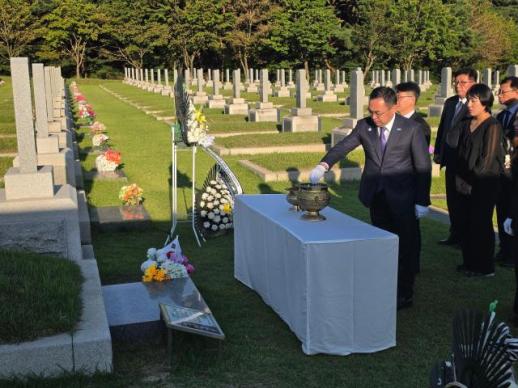 Kazakh minister honors independence hero Hong Beom-do SEOUL, September 16 (AJP) - Kazakhstan's culture minister burned incense on Wednesday at the grave of Hong Beom-do, the Korean independence commander who died in exile in Kazakhstan. The visit came a day after he signed an agreement with South Korea to preserve sites linked to the Korean independence movement. Arman Kyrykbayev, Kazakhstan's Minister of Culture and Information, signed the memorandum of understanding on Sept. 15 with Kwon Oh-eul, South Korea's Minister of Patriots and Veterans Affairs. The signing took place at Cheong Wa Dae in Seoul, with President Lee Jae Myung and Kazakh President Kassym-Jomart Tokayev looking on. At their summit the same day, Lee told President Tokayev that the return of Hong's remains in 2021 had deepened trust between the two countries. Kyrykbayev is in South Korea as part of President Tokayev's state visit. On arriving at Daejeon National Cemetery, about 160 kilometers south of Seoul, he went first to the Memorial Tower and burned incense. He then moved to Hong's grave in the cemetery's third section for independence patriots and burned incense there as well. At the grave, Na Chi-man, Deputy Minister for Patriots and Veterans Culture Policy at the Ministry of Patriots and Veterans Affairs, thanked Kazakhstan for its role in bringing Hong home. He said the ministry would keep caring for the grave and would also look after the Hong Beom-do Memorial Park in Kyzylorda, the Kazakh city where Hong had been buried. Na called Hong "a symbol of friendship between Kazakhstan and the Republic of Korea." "May the spirits of the ancestors be pleased," Kyrykbayev replied. He said Hong's heroic deeds should serve as an example of patriotism for "all the youth of the Korean people, and not only Koreans, but youth of other nations as well." He described the visit as part of President Tokayev's official program. "Within this framework, of course, we pay homage to such sacred figures," he said, and wished on behalf of President Tokayev and the Kazakh people that "the friendship and brotherhood between our two countries continue to flourish." Kyrykbayev spoke to AJP in Kazakh that Hong had fought for his homeland's freedom and later came to Kyzylorda along with many other Koreans, living and working there until his death. "On one hand, it is paying tribute to the past," he said of the return of Hong's remains. "On the other hand, it signifies how both Koreans and we Kazakhs love our history, our people, and our homeland." He then cited a Kazakh saying that calls for honoring the past. "Great historical figures like him will continue to further strengthen the friendship between our two countries," he said. Hong is one of the most revered figures in South Korea's struggle against Japanese colonial rule, which lasted from 1910 to 1945. In Kazakhstan, he became a symbol of identity for a Korean community that Soviet authorities had uprooted and sent to Central Asia. He was born into a poor family in 1868, in Pyongyang, by his own account, and lost both parents as a child. He joined the army in Pyongyang as a young man and later made his living as a hunter in the mountains of northern Korea. In September 1907, Japan issued a law to confiscate guns held by civilians, including hunting rifles. That November, Hong gathered fellow hunters into a militia and began attacking Japanese troops in guerrilla raids across the northern provinces. The fight cost him his family. Japanese authorities seized his wife to pressure him into surrendering, and she died in prison after torture. His eldest son was later killed in battle. After Japan annexed Korea in 1910, Hong moved his base to Manchuria and the Russian Far East. In June 1920, as commander of the Korean Independence Army, he led an ambush against a Japanese battalion at Fengwudong, known in Korean as Bongo-dong, in northeastern China. It was the first large-scale victory by Korean independence forces. That October, his troops fought alongside Kim Jwa-jin's units in the Battle of Qingshanli, another defeat for the Japanese army. Hong later settled in the Soviet Far East, where he led Korean farming communities, and joined the Soviet Communist Party in 1927. In 1937, Soviet leader Joseph Stalin ordered the forced relocation of 171,781 ethnic Koreans from the Far East to Central Asia. Hong, then 69, was among them and was sent to Kazakhstan. In Kyzylorda, he worked as a guard at the Korean Theater and later at a rice mill. He died there on Oct. 25, 1943, at age 75, two years before Korea won its independence. The deported Koreans and their descendants in the former Soviet Union call themselves Koryo-saram. For about 40 years, the Korean community in Kyzylorda tended Hong's grave and kept it as a place to honor him. After Kazakhstan gained independence in 1991, both South Korea and North Korea sought his remains. Pyongyang argued that he belonged in his birthplace. Seoul pressed the case at the presidential level, and Kazakhstan agreed. The remains arrived at Seoul Air Base on Aug. 15, 2021, South Korea's Liberation Day, escorted by six fighter jets. Two days later, Hong was posthumously awarded the Republic of Korea Medal, the highest grade of the Order of Merit for National Foundation, at a ceremony President Tokayev attended. President Tokayev also handed over Hong's death certificate and his letter of resignation from the Korean Theater. In November 2023, South Korea's veterans ministry opened a memorial park on the site of Hong's former grave in Kyzylorda. Hong was buried in Daejeon on Aug. 18, 2021, 78 years after his death. The funeral wreath combined carnations, Kazakhstan's flower of mourning, with chrysanthemums, South Korea's. Soil from his grave in Kyzylorda, which President Tokayev had brought to Seoul, was mixed with Korean soil and scattered over his coffin. AJP Takeaways - Kazakhstan's Minister of Culture and Information Arman Kyrykbayev burned incense at the Memorial Tower and at the grave of Korean independence hero Hong Beom-do at Daejeon National Cemetery on Sept. 16, a day after signing an agreement with South Korea to preserve independence movement sites. - Kwon Oh-eul, South Korea's Minister of Patriots and Veterans Affairs, signed that memorandum of understanding with Kyrykbayev at Cheong Wa Dae on Sept. 15, with President Lee Jae Myung and Kazakh President Kassym-Jomart Tokayev looking on. - Kyrykbayev said the return of Hong's remains in 2021 was both a tribute to the past and a sign that Koreans and Kazakhs love their history, their people and their homeland. He made the remarks in Kazakh at the grave in response to a question from AJP. 2026-09-16 18:15:16