


Latest by
-
 Kwon Min-soo, New Deputy Governor of the Bank of Korea, Calls for Cautious and Flexible Policy Decisions Kwon Min-soo, the newly appointed Deputy Governor of the Bank of Korea, stated on August 21, "The conditions facing our economy are challenging, and cautious and flexible policy decisions are necessary at this time."During his inauguration ceremony, Kwon noted, "While growth is improving more than expected due to strong semiconductor performance, inflation remains above target levels, and risks of financial imbalance continue, particularly concerning household debt and housing prices." He emphasized the need for careful and adaptable policy decisions, considering exchange rate volatility and geopolitical and trade risks.Kwon expressed his commitment to ensuring that the Bank of Korea fulfills its fundamental roles of price stability and financial stability. He stated, "I will enhance our macroeconomic analysis and economic judgment capabilities and continuously improve our monetary policy tools and market communication."He also indicated a focus on long-term challenges, including a soft landing for household debt, financial stability, growth potential, and balanced development across regions, sectors, and social classes.Kwon mentioned plans to enhance the Bank's response capabilities in financial and foreign exchange markets and to promote the internationalization of the Korean won. He aims to respond swiftly through advanced market analysis and open market operations while ensuring that financial stability is not compromised by improving the macroprudential framework.He added, "We will continue to build on our success in being included in the World Government Bond Index (WGBI) and focus on the next challenge of being included in the Morgan Stanley Capital International (MSCI) developed index. We will ensure the stable establishment of a 24-hour foreign exchange market and support the development of an offshore won payment system, digital currency, and payment infrastructure without disruption."Kwon also outlined a vision to strengthen domestic and international communication by proactively raising agendas and proposing solutions within international organizations and central bank cooperation frameworks. He stated, "I will strive to explain the Bank of Korea's decisions clearly and accurately to investors, policymakers, and the public, and to reflect market voices in our policies. We will also carefully develop statistics and public services in line with changes in the economic structure, such as the spread of artificial intelligence (AI)."Finally, he emphasized the importance of creating a Bank of Korea where the organization and its members grow together. Kwon remarked, "We will effectively utilize AI in our work to innovate our working methods and strengthen risk management in response to changes in the information technology (IT) environment and working infrastructure."* This article has been translated by AI. 2026-08-21 11:12:10
 -
Park Hong-keun: Future Response Fund to Serve as Strategic Investment Platform Park Hong-keun, Minister of the Office for Government Policy Coordination, announced plans to invest additional tax revenue from the semiconductor boom into future growth areas such as youth, artificial intelligence (AI), local development, and talent cultivation, rather than using it for temporary expenditures.On August 21, the Ministry held the first meeting of the Fiscal Management Strategy Council at the Government Seoul Complex, chaired by Minister Park, to discuss the implementation of the Future Response Fund and the reform of local education financial grants.Minister Park stated, "We aim to establish the Future Response Fund by accumulating rapidly increasing tax revenues, using it as a strategic investment platform to support potential growth rate recovery and as a financial stabilization mechanism to mitigate revenue volatility."He emphasized the need for bold and swift investments over the next two to three years to respond to the industrial transformation led by AI and the decline in potential growth rates. He also highlighted the necessity to change the existing fiscal management approach, which sees significant fluctuations in revenue and expenditure based on the semiconductor market."This additional tax revenue is a valuable resource for us at the forefront of the AI transformation, and we will ensure it is invested in essential areas," Park said. "The next two to three years will be a critical period for redesigning the national system in line with the full-scale spread of AI, providing an opportunity to reopen the growth potential of our economy."The Future Response Fund will accumulate domestic tax revenues that exceed the average trend over the past decade. The fund will focus on four areas: youth, growth drivers, local development, and education/talent, and will also support three major mega-projects, including frontier-level AI, physical AI, and AI data centers.If revenues decrease or if there is a shortfall during the year, the fund will use accumulated surplus funds to bolster fiscal capacity. If necessary, it will also be used for national debt repayment and will be invested in stocks and bonds through professional asset management firms to secure fund income.The calculation method for local education financial grants will change from the current structure, which is automatically linked to 20.79% of domestic tax, to a new method that reflects the previous year's grants, the average real growth rate over the last three years, and changes in the school-age population.The new grants will be calculated by applying the average real growth rate of the last three years to the previous year's grants and adding 35% of the average change in the school-age population over the last three years. To account for fixed costs such as personnel expenses, only a portion of the decrease in the school-age population will be applied.Under the new formula, if the grants decrease compared to the previous year, the government will cover the shortfall. The difference between 20.79% of domestic tax revenue, excluding additional tax revenue, and the newly calculated grants will be allocated to the education and talent account within the Future Response Fund for use in early childhood and higher education, as well as talent attraction.While the school-age population has decreased from 8.8 million in 2010 to 5.91 million in 2025, a 32.8% drop, grants have increased by 117.6% from 32.3 trillion won to 70.3 trillion won during the same period. The government aims to reduce fiscal volatility due to changes in tax revenue and the school-age population while addressing investment imbalances in the education sector.The government plans to prepare legislation necessary for the establishment of the Future Response Fund and the reform of local education financial grants, with a submission to the National Assembly scheduled for early September alongside the 2027 budget proposal.* This article has been translated by AI. 2026-08-21 11:12:00
-
South Korea to Allocate Surplus Tax Revenue to Future Response Fund The South Korean government will not separately calculate the increase in corporate tax from semiconductor companies but will instead allocate the total domestic tax revenue exceeding the long-term trend of the past decade to the Future Response Fund. This initiative aims to create a "fiscal reservoir" that accumulates resources during tax revenue booms for future industry investments and can be tapped into when revenues decline.On August 21, the government held the first meeting of the Fiscal Management Strategy Council at the Government Seoul Office, where it announced the "Future Response Fund Implementation Plan."The core funding source for the fund is "additional tax revenue." If the domestic tax revenue budget for the following year exceeds the growth trend of the past decade, the difference will be transferred from the general account to the fund.Additional tax revenue will be calculated based on total domestic tax revenue without isolating the actual tax payments or corporate tax increases from the semiconductor sector. However, taxes such as liquor tax, rural special tax, and education, comprehensive real estate, and transportation taxes that are earmarked for specific purposes will be excluded from this calculation.The long-term trend will be determined by applying the average growth rate over the past decade to the domestic tax revenue from two years prior. For instance, the trend for 2027 will be based on the 2025 revenue figures adjusted by the average growth rate from 2015 to 2025.The government chose a 10-year period to encompass both the booms and busts of the semiconductor industry, which typically fluctuates every 3 to 5 years. This approach aims to ensure sustainability by using tax revenues that exceed the long-term average from the overall industrial and macroeconomic cycles, rather than relying on single-year revenue estimates.Any "excess tax revenue" generated when actual revenue surpasses expectations will be accumulated separately from additional tax revenue. If the revised domestic tax revenue forecast in September exceeds the initial budget, the difference will be added to the fund through off-budget methods.While additional tax revenue reflects long-term trends due to structural economic changes or significant economic fluctuations, excess tax revenue is attributed to short-term economic variations or estimation errors. The government plans to use excess tax revenue as supplementary funding while primarily relying on additional tax revenue for the fund's main income source.The exact amount of additional tax revenue, which will help gauge the fund's initial size, has not yet been disclosed as next year's revenue projections are still pending. The government is expected to announce the additional tax revenue figures alongside the 2027 budget and national fiscal management plan at the end of this month.A Ministry of Strategy and Finance official stated, "The Ministry of Economy and Finance will announce the revised tax revenue estimates at the end of September, including the excess tax revenue at that time. The remaining funds from the surplus will not be substantial, but the exact figures will be confirmed after the settlement is completed."The surplus funds will be allocated to the Future Response Fund after accounting for local allocation tax adjustments, public fund repayments, and national debt repayments. The fund's surplus will also generate income through investments in bonds and stocks.If the revenue budget falls below the long-term trend or if a revenue shortfall occurs, funds will be redirected from the accumulated surplus in the fund to bolster the general account. This mechanism aims to mitigate the impact of economic fluctuations, allowing for increased spending during revenue booms and reducing expenditures during downturns.The fund will consist of a general account and four project accounts focused on youth, growth drivers, local development, and education. Resources will be allocated to youth employment, housing, artificial intelligence (AI), major projects, future technologies, improving local living conditions, and higher and lifelong education.The Ministry of Strategy and Finance will manage the entire fund, while relevant ministries will execute their respective projects. The plan is to utilize external asset management firms to manage surplus funds without creating a separate public institution or direct government investment.The government will announce a package of legislative proposals, including the Future Response Fund Act and the National Fiscal Act, from August 24 to 28. Following a Cabinet meeting on September 1, the related bills will be submitted to the National Assembly along with next year's budget on September 3.* This article has been translated by AI. 2026-08-21 11:12:00
-
People Power Party to Review Financial Policies of Lee Jae-myung Administration The People Power Party announced plans to assess the appropriateness of the financial expansion policies of the Lee Jae-myung administration during the 2025 fiscal year settlement review. This includes verifying the details of special activity expenses and the budget related to the relocation of the presidential office.On August 21, members of the Budget Settlement Committee from the People Power Party held a press conference at the National Assembly to outline key issues and the direction of the 2025 fiscal year settlement review. A primary focus will be on the appropriateness of the financial expansion policies, which increased the national budget from 673.3 trillion won to 703.3 trillion won through two supplementary budgets, raising national debt from 1,273.3 trillion won to 1,301.9 trillion won.They stated, "We selected 100 key issues related to the 2025 fiscal year settlement based on the principle that 'correct settlements create correct budgets,' focusing on projects that violated the National Finance Act, such as new initiatives pursued without National Assembly approval."Specifically, they will analyze the execution rates of supplementary budget projects to hold accountable for unnecessary deficit bond issuance due to excessive supplementary budgets. They also criticized the Democratic Party for changing its stance on the disclosure of special activity expenses, which it had previously demanded while in opposition, and for refusing to provide detailed documents regarding the budget for the presidential office relocation.Notably, they highlighted the use of special activity funds, including 4.1 billion won for the presidential office, 6.6 billion won for the Special Prosecutor Jo Eun-seok, 9.1 billion won for the Special Prosecutor Min Jung-ki, and 5.5 billion won for the Special Prosecutor Lee Myung-hun, as well as the budget details related to the presidential office relocation. They criticized, "While in opposition, they demanded transparency and cut funding, but now that they are in power, they refuse to disclose the details." This also includes 16.2 billion won for facility improvement projects at the presidential office, 9.8 billion won for security infrastructure by the Presidential Security Service, and 4.5 billion won related to the police's return to the presidential office.Additionally, they pointed out issues with projects in the supplementary budget, such as the Small and Medium Business Administration's fund for small businesses, which reflected 300 billion won but had no actual corporate investment, and the Ministry of Science and ICT's AI innovation fund, which had an increase of 105 billion won but resulted in 382.1 billion won in unused funds for the zero-emission vehicle supply project. They also noted that the Ministry of Culture, Sports and Tourism's new technology convergence content industry support had a 210 billion won increase in the second supplementary budget but only a 9% execution rate (19 billion won), and the Ministry of Land, Infrastructure and Transport's general national road construction project had 1.846 trillion won carried over or unused, which is 2.1 times the supplementary budget of 860 billion won. Furthermore, the Ministry of National Defense's basic support facility project had an increase of 527 billion won, with 402 billion won used for other projects and 311 billion won left unused.They concluded, "The 2025 fiscal year settlement review is not merely a formality but a serious inquiry into the accountability of individual problem projects. At the same time, we will demand bold structural adjustments for projects that lack results or are repeatedly criticized for annual carryovers, and we will strive to ensure that the settlement results serve as the basis for next year's budget proposal." 2026-08-21 11:08:10
-
Korea Technology Guarantee Fund Facilitates $245 Million M&A Deal The Korea Technology Guarantee Fund announced on August 21 that it has facilitated a merger and acquisition (M&A) deal worth 24.5 billion won (approximately $245 million).The M&A platform, developed by the fund in collaboration with investment institutions, aims to support small and medium-sized enterprises (SMEs) in their M&A endeavors. APS Innovation, a company specializing in secondary battery equipment, signed a contract earlier this month to acquire 100% of the shares of IRE Engineering for 24.5 billion won, with assistance from the Korea Technology Guarantee Fund and Intercapital Partners.APS Innovation registered as a potential buyer on the M&A platform to expand into new business areas, leveraging its technological expertise accumulated in the secondary battery and display equipment sectors. The Korea Technology Guarantee Fund connected APS Innovation with Intercapital Partners, which provided brokerage and specialized advisory services for the M&A.Through this acquisition, APS Innovation aims to diversify its business by combining IRE's automated equipment technology for cosmetics filling and packaging with its own precision machinery control and manufacturing capabilities. The company also expects to enhance its sales network and global competitiveness by utilizing the overseas business infrastructure it has established in the United States, Canada, and China.Previously, the Korea Technology Guarantee Fund established a comprehensive support system for M&A based on public-private cooperation in March of last year.“This M&A demonstrates that our platform is making a tangible contribution to the growth and innovation ecosystem of technology-based SMEs,” said Kwon Hyung-taek, chairman of the Korea Technology Guarantee Fund. “We will continue to expand our collaboration with private institutions to actively discover and support technology-driven M&As.”* This article has been translated by AI. 2026-08-21 11:08:00
-
Prosecutors Conduct Raids on Former President Roh Tae-woo's Family Over Hidden Slush Fund Allegations Prosecutors have launched a surprise investigation into allegations of hidden slush funds and tax evasion involving the family of the late former President Roh Tae-woo.According to legal sources on August 21, the Seoul Central District Prosecutors' Office's Criminal Proceeds Recovery Division, led by Chief Prosecutor So Jeong-soo, dispatched prosecutors and investigators to secure financial documents and accounting records from Roh's residence in Yeonhui-dong, Seoul, where his wife, Kim Ok-sook, resides, as well as from related individuals and foundation offices.The search targets include not only Kim's residence but also the East Asia Culture Foundation, where Roh's son, Ambassador Roh Jae-hun, serves as chairman, and the Roh Tae-woo Center.Additionally, prosecutors are reportedly conducting searches at the homes of former secretaries who are suspected of providing accounts for the creation and management of slush funds during Roh's administration, collecting relevant financial transaction records.This investigation was prompted by revelations of previously undisclosed slush fund evidence during the appeals process of a divorce lawsuit between Roh's daughter, Roh So-young, director of the Art Center Nabi, and Choi Tae-won, chairman of SK Group.During the proceedings, Roh's side submitted photographs of six promissory notes worth 5 billion won along with a so-called 'Kim Ok-sook memo' to prove her mother's contribution to the formation of SK Group's assets.The memo reportedly details a financial flow of 90.4 billion won and its recipients. Roh's side claims that 30 billion won from Roh Tae-woo was transferred to Choi Jong-hyun, the former chairman of SK Group, and that this money played a crucial role in major management activities and business expansions of the SK Group, formerly known as the Sunkyong Group.As these slush fund details emerged during the trial, civic groups such as the May 18 Memorial Foundation and the Military Regime Crimes Recovery Committee expressed strong opposition.These organizations stated, 'The hidden criminal proceeds that were overlooked during the past confiscation process must be immediately recovered by the state, and a thorough investigation into money laundering and tax evasion allegations is necessary.' They filed a complaint against Kim, Roh, and Ambassador Roh for violations of the Act on the Regulation of Concealment of Criminal Proceeds and tax evasion.Following the complaint, prosecutors have been reviewing foundational materials and relevant legal principles, and with the commencement of this search, they plan to thoroughly investigate the authenticity of the 'Kim Ok-sook memo,' the timing of its creation, the actual sources and distribution of the funds, and any tax omissions.Once the analysis of the seized items is completed, prosecutors will sequentially summon members of Roh's family and key individuals involved in the creation and management of the slush funds to investigate the nature and circumstances of the funds.* This article has been translated by AI. 2026-08-21 11:00:10
-
China Delivers 300,000-Ton Super Large Oil Tanker China has delivered a 300,000-ton super large crude oil carrier (VLCC) designed independently by the country.The vessel, named 'Front Fraser,' was handed over to the Norwegian shipping company Siem Tankers on August 19 in Dalian, Liaoning Province, by Dalian Shipbuilding Industry Company (DSIC), a subsidiary of the state-owned China Shipbuilding Group (CSSC), in collaboration with China Shipbuilding Trading, according to a report by Xinhua on August 21.Designed and developed independently by DSIC, the ship measures 333 meters in length, 60 meters in width, and 30 meters in depth, with a deck area exceeding 18,000 square meters, equivalent to about 2.8 soccer fields. The vessel features optimized hull lines and is equipped with exhaust gas desulfurization systems, significantly enhancing energy efficiency and environmental performance. It is expected to save approximately 35 million yuan (about $5 million) in annual fuel costs.DSIC stated that the ship is designed to be suitable for various ports and waterways. With a design draft of 20.5 meters, it can carry over 2 million barrels of crude oil and navigate through shallower sections of the Malacca Strait.Meanwhile, in the first half of this year, China's shipbuilding industry saw increases in new orders, completed constructions, and order backlogs by 105.2%, 34.8%, and 37.1%, respectively, compared to the same period last year. These three indicators maintain China's position as the world's leader, with market shares of 73.9%, 55.4%, and 63.3%.* This article has been translated by AI. 2026-08-21 11:00:00
-
Uiwang City Council Inspects Emergency Response Capabilities During Eulji Training On August 20, the Uiwang City Council in Gyeonggi Province assessed the local emergency response capabilities and encouraged participants in the Eulji training exercise. According to the council, members visited the site of the '2026 Eulji Training' set up in the city hall conference room to review the training progress and emergency preparedness. All seven council members, including Chair Seo Chang-soo, attended the visit. The '2026 Eulji Training' is an emergency preparedness drill aimed at enhancing the response capabilities of government, local authorities, military, and police in the event of a national crisis. Uiwang City is using this training to evaluate its emergency response system, including procedures for transitioning to wartime conditions. After receiving briefings from training officials on the current status and emergency response systems, the council members encouraged public officials and military and police personnel participating in the exercise according to their respective roles. In particular, they expressed gratitude to the workers engaged in long hours of training under the hot weather and provided them with gifts. They also urged the participants to carry out their duties effectively to protect citizens' lives and safety during actual crisis situations. As the Eulji training progresses, the local community is increasingly focused on the importance of preparedness for emergencies and citizen safety. Recently, the need for a rapid response system to disasters and various social crises has gained prominence, prompting not only administrative agencies but also citizens to recognize the necessity of emergency preparedness. Citizens hope that the Eulji training will strengthen the safety net in their community, as it allows administrative bodies and related agencies to simulate real situations and review their roles and response procedures. Additionally, there are calls for the training to lead to effective initial responses, citizen guidance, and information sharing among agencies in the event of an actual emergency, rather than being a one-time event. Chair Seo Chang-soo emphasized that the '2026 Eulji Training' is crucial for citizen safety and national security, stating, 'Peace must be maintained through preparation and effort.' He expressed gratitude for the dedication of the workers participating in the training despite the heat and added, 'I hope this training establishes Uiwang City's integrated defense posture to respond quickly and accurately to emergencies.' Meanwhile, the city council plans to continue monitoring key sites related to citizen safety and to enhance the local emergency response capabilities and safety net through its legislative activities.* This article has been translated by AI. 2026-08-21 10:52:00
-
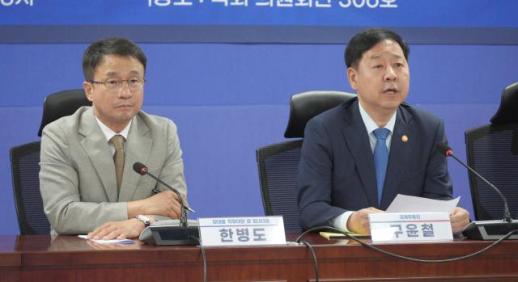 Financial authorities to offer more support for borrowers amid rising global yields SEOUL, August 21 (AJP) - South Korea will prepare additional support for vulnerable groups as rising long-term global bond yields threaten to raise borrowing costs for households and businesses, the Ministry of Economy and Finance (MOEF) said on Friday. Finance Minister and Deputy Prime Minister Koo Yun-cheol convened a joint meeting in Seoul with Financial Services Commission Chairman Lee Eog-weon, Financial Supervisory Service Governor Lee Chan-jin and Bank of Korea Deputy Governor Park Jong-woo. Officials said long-term yields in major economies had risen amid Middle East uncertainty, increased sovereign issuance and heavier corporate bond sales by global artificial intelligence companies, with the pressure concentrated at the ultra-long end of the curve. The government will monitor the impact on South Korea's bond market, corporate and household borrowing costs and the broader economy while preparing measures to ease financial burdens on small businesses and other vulnerable borrowers. The planned package will include expanded debt restructuring for distressed small businesses and individuals as well as additional financing for small and medium-sized companies and vulnerable borrowers. "Long-term government bond yields in the U.S., Japan and Europe have risen to their highest levels in decades," Koo said, adding that Korea had also seen yields climb at ultra-long maturities. Officials also reviewed the won's sharp recent appreciation. The currency returned to the 1,300-per-dollar range on Aug. 19 for the first time in 11 months, after weakening beyond 1,550 in early July, helped by a record current-account surplus and easing foreign investor equity rebalancing, the ministry said. The won traded at 1,390 per dollar on Aug. 19 and 1,393 on Thursday, compared with 1,529 in the first week of July. Authorities said they would remain alert as geopolitical tensions in the Middle East and monetary policy in major economies continued to pose risks in both directions for the currency. The government meanwhile said South Korea's external financial position remained sound despite a sharp decline in net international investment assets in the second quarter. Officials attributed the drop largely to higher valuations of South Korean equities held by overseas investors, while net external claims increased by $2.3 billion to $367.8 billion and the current-account surplus reached a record $191 billion in the first half. Household credit has exceeded 2,000 trillion won, but the household debt-to-GDP ratio fell to 85.3 percent in the first quarter from 89.1 percent a year earlier, according to the ministry. Officials said they would continue managing household debt risks while ensuring that genuine borrowers do not face unnecessary financing constraints. Koo said authorities would maintain an integrated monitoring framework covering financial, foreign-exchange, government bond and property markets and respond promptly if risks intensified. 2026-08-21 10:43:42
 -
 Viet Nam's Gen Z protests without gathering SEOUL, August 21 (AJP) - The flowers under the tree outside No. 55 Nguyen Huy Tu Street arrived one at a time, which is why the police had nothing to break up. Over roughly a week in August, young Vietnamese walked to the spot in central Hanoi, left a bouquet, photographed it and went home. By the time the pile was large enough to be a problem, no crowd had ever formed. The tree marks the place where a car crossed into oncoming traffic on May 30, 2025, and struck a motorbike carrying a father and his 18-year-old daughter. The teenager, Do Ngoc Phuong Thuy, suffered a severe injury to her right leg and died on June 8, days before her high school graduation examination. Her father, Do Viet Hung, was seriously hurt. Vietnamese newspapers reported the crash once, on May 31, identifying the driver only by his initials, and then stopped. The driver was Nguyen Sy Cuong, 64 at the time, a National Assembly deputy across two terms from 2011 to 2021 and a former deputy chair of the legislature's Foreign Affairs Committee. His wife, Lam Thi Phuong Thanh, was appointed minister of culture, sports and tourism in April. That silence held for more than a year. It broke this month after the culture ministry banned more than a dozen songs by the rapper MCK, which pointed public anger at the minister and, through her, at her husband. By the afternoon of Aug. 12, more than a million posts on Threads had mentioned the case. On Aug. 17, state broadcaster Vietnam Television devoted six minutes of its flagship current affairs program to the crash. In a country where more than 10,000 people die on the roads each year, a traffic case from the previous spring does not normally receive that treatment, and the timing put it two weeks ahead of National Day on Sept. 2. Colonel Nguyen Duc Long, deputy chief of the Hanoi police, said investigators found that Nguyen Sy Cuong had driven in the wrong lane and violated traffic regulations. He tested negative for alcohol and admitted responsibility, Long said, and met the conditions for exemption from criminal liability after the victim's family withdrew its complaint. It was the first official acknowledgment that he was the driver. Do Viet Hung appeared in the broadcast with his face obscured. He thanked people online for their concern and said the family had no complaints about the investigation. The matter, he said, "is now in the past." A spokesperson for the Ministry of Public Security used the same program to accuse "hostile and reactionary forces" of stringing together unrelated incidents to manipulate young people and students. Nothing in the case has been established about the allegation that drove most of the online anger. Users across Threads and Facebook asserted the driver had been drunk. The only official statement on the point is the negative alcohol test, and no evidence has been produced either way. What makes the episode unusual is not the anger but the shape it took. Protesters renamed the tree the justice tree and created a listing for it on Google Maps under the label Cay BMW NSC 30525, which collected more than 230 reviews. They checked in at the location the way people check in at restaurants. They wrote poems. They filed a petition. They generated images of the victim with artificial intelligence and circulated them. After the flowers were cleared on Aug. 14 and plainclothes officers were posted at the site, some young people began tying white ribbons to their backpacks. Every one of those actions is deniable. A person laying a bouquet is not an assembly. A ribbon on a backpack is not a banner. A Google Maps review is not a leaflet. Vietnamese law gives police wide latitude to disperse gatherings and prosecute organizers, and this campaign has produced neither a gathering nor an organizer. The state's response was to clear a place and watch it, because there was no crowd to address. The contrast with the rest of the region is sharp. Youth-led movements have swept South and Southeast Asia over the past two years, and most of them took the street. In Nepal, protests that began on Sept. 8, 2025, over corruption and a social media ban brought down Prime Minister K.P. Sharma Oli within days and left at least 76 people dead in the first 48 hours, with parliament and the presidential residence burned. Indonesian protesters forced President Prabowo Subianto to cut lawmakers' housing allowances last August after police killed a 21-year-old delivery driver during demonstrations. In the Philippines, tens of thousands turned out over graft in flood control projects. In India, thousands marched on Parliament in New Delhi in July over education reform. The obvious explanation is that Viet Nam is a one-party communist state and the others are not, but that does not survive contact with the facts. Oli led the Communist Party of Nepal (Unified Marxist-Leninist), and his government fell in five days. The difference lies in enforcement rather than ideology. Viet Nam has had street protests, and it has taught its young people what follows them. Weekly anti-China demonstrations ran for three months in the summer of 2011 outside the Chinese embassy in Hanoi and the consulate in Ho Chi Minh City before security forces began clearing them in late August and detained 47 people. Mass protests against a proposed cybersecurity law and a special economic zone bill in 2018 ended with organizers in prison, among them Huynh Truong Ca, who served five years. Article 331 of the penal code, which criminalizes infringing on state interests, carries sentences of up to seven years and has been applied to ordinary people for posts about local officials. A generation that watched those outcomes did not conclude that protest was impossible. It concluded that the assembly was the vulnerable part, and removed it. The pressure has not disappeared. Threads users posted screenshots on Aug. 13 showing notices that their posts had been restricted inside Viet Nam at the culture ministry's request, citing local law. Others said their accounts were limited. The petition demanding an investigation continues to collect signatures from outside the country, where it cannot be blocked. At the tree on Nguyen Huy Tu, only scattered petals remain. The plainclothes officers are still there, watching from across the street. 2026-08-21 10:40:24