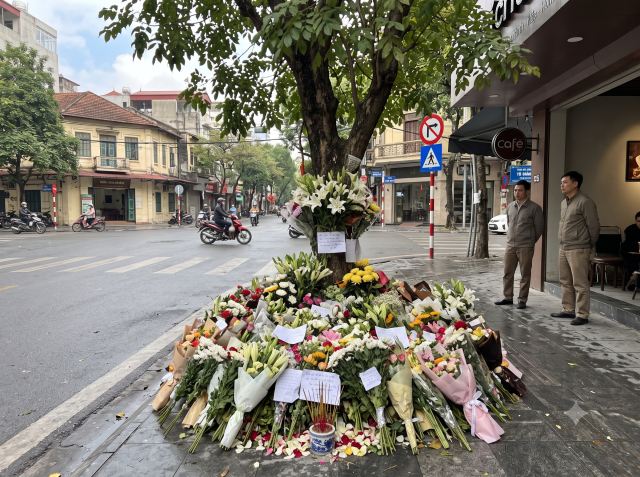
SEOUL, August 21 (AJP) - The flowers under the tree outside No. 55 Nguyen Huy Tu Street arrived one at a time, which is why the police had nothing to break up. Over roughly a week in August, young Vietnamese walked to the spot in central Hanoi, left a bouquet, photographed it and went home. By the time the pile was large enough to be a problem, no crowd had ever formed.
The tree marks the place where a car crossed into oncoming traffic on May 30, 2025, and struck a motorbike carrying a father and his 18-year-old daughter. The teenager, Do Ngoc Phuong Thuy, suffered a severe injury to her right leg and died on June 8, days before her high school graduation examination. Her father, Do Viet Hung, was seriously hurt. Vietnamese newspapers reported the crash once, on May 31, identifying the driver only by his initials, and then stopped. The driver was Nguyen Sy Cuong, 64 at the time, a National Assembly deputy across two terms from 2011 to 2021 and a former deputy chair of the legislature's Foreign Affairs Committee. His wife, Lam Thi Phuong Thanh, was appointed minister of culture, sports and tourism in April.
That silence held for more than a year. It broke this month after the culture ministry banned more than a dozen songs by the rapper MCK, which pointed public anger at the minister and, through her, at her husband. By the afternoon of Aug. 12, more than a million posts on Threads had mentioned the case.
On Aug. 17, state broadcaster Vietnam Television devoted six minutes of its flagship current affairs program to the crash. In a country where more than 10,000 people die on the roads each year, a traffic case from the previous spring does not normally receive that treatment, and the timing put it two weeks ahead of National Day on Sept. 2. Colonel Nguyen Duc Long, deputy chief of the Hanoi police, said investigators found that Nguyen Sy Cuong had driven in the wrong lane and violated traffic regulations. He tested negative for alcohol and admitted responsibility, Long said, and met the conditions for exemption from criminal liability after the victim's family withdrew its complaint. It was the first official acknowledgment that he was the driver.
Do Viet Hung appeared in the broadcast with his face obscured. He thanked people online for their concern and said the family had no complaints about the investigation. The matter, he said, "is now in the past." A spokesperson for the Ministry of Public Security used the same program to accuse "hostile and reactionary forces" of stringing together unrelated incidents to manipulate young people and students.
Nothing in the case has been established about the allegation that drove most of the online anger. Users across Threads and Facebook asserted the driver had been drunk. The only official statement on the point is the negative alcohol test, and no evidence has been produced either way.
What makes the episode unusual is not the anger but the shape it took. Protesters renamed the tree the justice tree and created a listing for it on Google Maps under the label Cay BMW NSC 30525, which collected more than 230 reviews. They checked in at the location the way people check in at restaurants. They wrote poems. They filed a petition. They generated images of the victim with artificial intelligence and circulated them. After the flowers were cleared on Aug. 14 and plainclothes officers were posted at the site, some young people began tying white ribbons to their backpacks.
Every one of those actions is deniable. A person laying a bouquet is not an assembly. A ribbon on a backpack is not a banner. A Google Maps review is not a leaflet. Vietnamese law gives police wide latitude to disperse gatherings and prosecute organizers, and this campaign has produced neither a gathering nor an organizer. The state's response was to clear a place and watch it, because there was no crowd to address.
The contrast with the rest of the region is sharp. Youth-led movements have swept South and Southeast Asia over the past two years, and most of them took the street. In Nepal, protests that began on Sept. 8, 2025, over corruption and a social media ban brought down Prime Minister K.P. Sharma Oli within days and left at least 76 people dead in the first 48 hours, with parliament and the presidential residence burned. Indonesian protesters forced President Prabowo Subianto to cut lawmakers' housing allowances last August after police killed a 21-year-old delivery driver during demonstrations. In the Philippines, tens of thousands turned out over graft in flood control projects. In India, thousands marched on Parliament in New Delhi in July over education reform.
The obvious explanation is that Viet Nam is a one-party communist state and the others are not, but that does not survive contact with the facts. Oli led the Communist Party of Nepal (Unified Marxist-Leninist), and his government fell in five days. The difference lies in enforcement rather than ideology.
Viet Nam has had street protests, and it has taught its young people what follows them. Weekly anti-China demonstrations ran for three months in the summer of 2011 outside the Chinese embassy in Hanoi and the consulate in Ho Chi Minh City before security forces began clearing them in late August and detained 47 people. Mass protests against a proposed cybersecurity law and a special economic zone bill in 2018 ended with organizers in prison, among them Huynh Truong Ca, who served five years. Article 331 of the penal code, which criminalizes infringing on state interests, carries sentences of up to seven years and has been applied to ordinary people for posts about local officials.
A generation that watched those outcomes did not conclude that protest was impossible. It concluded that the assembly was the vulnerable part, and removed it.
The pressure has not disappeared. Threads users posted screenshots on Aug. 13 showing notices that their posts had been restricted inside Viet Nam at the culture ministry's request, citing local law. Others said their accounts were limited. The petition demanding an investigation continues to collect signatures from outside the country, where it cannot be blocked.
At the tree on Nguyen Huy Tu, only scattered petals remain. The plainclothes officers are still there, watching from across the street.

Copyright ⓒ Aju Press All rights reserved.