
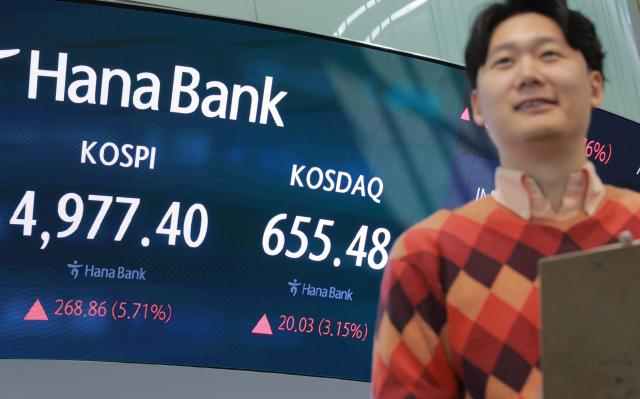
The KOSPI closed 6.32 percent higher Tuesday to reclaim the 5,000 mark, while the KOSDAQ gained nearly 5 percent. Foreign investors bought a net 725.2 billion won of KOSPI shares and local institutions added 870.6 billion won. Individuals sold a net 2.04 trillion won.
The split captured the mood of a market where battered retail investors may greet a recovery as an opportunity to recover their money.
“I've never seen anything like this,” said 29-year-old Park J., who was awakened around midnight by a smartphone alert about Nvidia’s share-price movement following Huang’s reinstatement.
Others were less impressed.
“How can those swings make any sense, whether they're going up or down? This is gambling,” said Pyo H.J., a Seoul-based engineer in his 30s.
Nvidia shares soared 31.48 percent Monday after the AI chipmaker announced Huang’s return as chief executive. The S&P 500 advanced 4.73 percent and the Nasdaq Composite climbed 6.51 percent. Between Huang’s resignation announcement on Nov. 12 and Friday’s close, Nvidia had lost roughly 25 percent and the S&P 500 more than 9 percent.
His return removed one immediate source of uncertainty. But sustaining the rebound in Korea will require buyers with both the confidence and the cash to stay in the market.
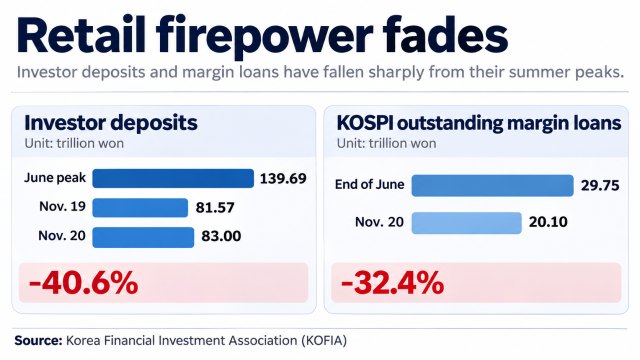
Investor deposits — cash held in brokerage accounts for future stock purchases — fell to 81.57 trillion won on Nov. 19, their lowest in more than a year, before edging up to around 83 trillion won Friday, according to the Korea Financial Investment Association. That remained more than 40 percent below June’s record of 139.69 trillion won.
Outstanding margin loans on the KOSPI also fell from 29.75 trillion won at the end of June to around 20.1 trillion won Friday.
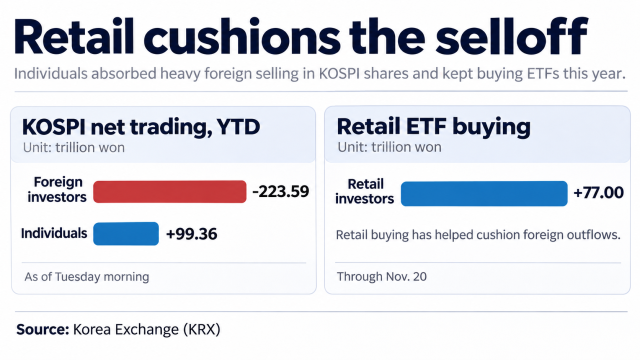
The retreat follows months in which individuals absorbed heavy foreign selling. Overseas investors had sold a net 223.59 trillion won of KOSPI shares this year as of Tuesday morning, while individuals had bought a net 99.36 trillion won, according to Korea Exchange data. Retail investors separately purchased a net 77 trillion won in exchange-traded funds through Nov. 20.
“With their ability to raise cash considerably weakened, retail investors may struggle to absorb further foreign selling,” said Kim Dae-jong, a professor of business administration at Sejong University.
A rebound could also turn some persistent buyers into sellers.
“If stock prices recover, individual investors may start selling to cut their losses or recover their initial investments,” he said.
Korean equities face competition for investors’ remaining cash. Some are moving into money-market ETFs that invest in short-term debt, while others are looking overseas. Korean investors bought a net 5.11 billion dollars of U.S. stocks this month through Monday, according to Korea Securities Depository settlement data analyzed by AJP.
That leaves foreign investors central to the durability of Korea’s recovery.
The scale of their retreat stands out even among Asian markets hit by the AI selloff. Foreign net selling in Taiwan reached 3.24 trillion Taiwan dollars, or 101.25 billion U.S. dollars, through Nov. 23, according to Taiwan Stock Exchange data analyzed by AJP — roughly 60 percent of the amount recorded in Korea.
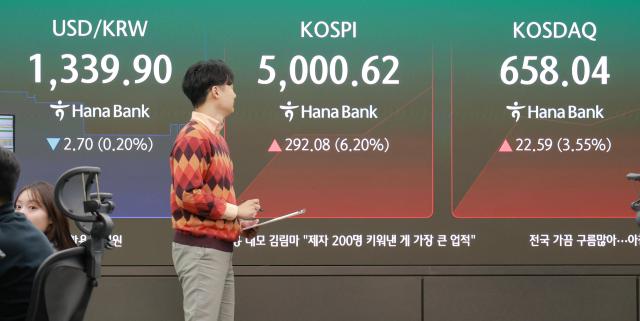
Tuesday’s foreign buying offered some relief. It followed a moderation in selling Monday, when overseas investors unloaded a net 138.2 billion won of KOSPI shares despite the sharp market decline.
“Even without new buyers entering the market, an easing of panic selling alone can help limit losses,” an analyst at Yuanta Securities said.
Kim Sang-bong, an economics professor at Hansung University, cautioned against treating the bounce as a turning point.
“What was lost over two days was simply regained in one. It's temporary,” he said.
Sejong’s Kim was more optimistic about AI’s long-term prospects but said the cost of infrastructure and its financing remained unresolved.
“A sustained recovery will depend on earnings at Nvidia and other tech giants and whether AI investment translates into actual profits.”
The completion of major index rebalancing could ease foreign selling pressure. A possible resumption of large-scale Samsung Electronics share buybacks early next year could also provide support.
U.S. inflation and employment data will meanwhile shape interest-rate expectations ahead of the Federal Reserve’s December meeting, with implications for the cost of financing the AI buildout.
For now, Huang has revived enthusiasm for AI. For Korean investors worn down by the selloff, the more modest dream is to break even — and leave.

Ryu Yuna
Yuna Ryu covers finance, capital markets and Southeast Asian affairs.
She is drawn to the questions that numbers raise and the stories that data alone cannot answer.
Prior to journalism, she worked at Hyundai Motor Company and the Singapore Chamber of Commerce, focusing on business strategy and international affairs. She has also hosted diplomatic receptions and international conferences as an MC.
Ryu holds a master's degree in Media and Communication from Korea University, where her research focused on neuroscience-based studies of media effects.
Copyright ⓒ Aju Press All rights reserved.
Related News
-
 NVIDIA CEO Jensen Huang's Return Sparks 6.32% Surge in KOSPI
Jensen Huang, CEO of NVIDIA, returned to the company, reviving investor sentiment in artificial intelligence (AI) and leading a sharp rebound in the domestic stock market. Foreign and institutional investors engaged in net buying, allowing the KOSPI to reclaim the 5000 mark.On November 24, the Korea Exchange reported that the KOSPI closed at 5006.03, up 297.49 points (6.32%) from the previous trading day. The index opened at 4880.16, up 171.62 points (3.64%) from the last session, and continued to rise.In the securities market, foreign and institutional investors net bought 739.2 billion won (KRW) and 869.3 billion won (KRW), respectively, driving the index higher. Individuals, however, net sold 2.04 trillion won (KRW).All ten of the KOSPI's largest market capitalization stocks rose. Samsung Electronics (6.70%) and SK Hynix (6.73%) led the gains, along with Samsung Electronics Preferred (6.53%), SK Square (5.15%), LG Energy Solution (7.89%), Samsung Electro-Mechanics (10.28%), Samsung Biologics (0.16%), Hyundai Motor (11.11%), KB Financial (5.36%), and Samsung Life Insurance (9.78%).The surge in AI-related stocks in the U.S. market, following Jensen Huang's return, positively influenced the domestic stock market. NVIDIA soared 31.5%, while Micron (19.0%), CoreWeave (22.3%), and Oracle (12.3%) also saw significant increases.Concerns over the potential damage to the AI investment ecosystem that arose after Jensen Huang's resignation have eased, leading to renewed buying interest in domestic technology stocks, including semiconductors, which had recently experienced significant declines.The KOSDAQ index closed at 665.88, up 30.43 points (4.79%) from the previous trading day. In the KOSDAQ market, foreign and institutional investors net bought 118.6 billion won (KRW) and 206.4 billion won (KRW), respectively, while individuals net sold 307.7 billion won (KRW).Among the top KOSDAQ stocks by market capitalization, EcoPro BM (11.34%), EcoPro (10.44%), Rainbow Robotics (17.41%), Juseong Engineering (5.72%), Simtech (6.76%), Robotis (19.51%), EO Technics (6.54%), Rino Industrial (8.50%), and HLB (3.55%) all rose. In contrast, Alteogen (-5.22%) saw a decline.* This article has been translated by AI.
-
KOSPI closes back above 5,000 on Huang's return
SEOUL, November 24 (AJP) - South Korean stocks closed sharply higher Tuesday, with the Kospi soaring 6.32 percent to end above 5,000 for the first time in three sessions as chipmakers rallied on Nvidia's reinstatement of Jensen Huang as chief executive. The Kospi rose 297.49 points to 5,006.03, recovering more than two-thirds of its two-day slide. Foreign and institutional investors net bought 730.4 billion won and 743.9 billion won, while retail investors sold a net 1.92 trillion won. SK hynix rose 6.73 percent to 1,158,000 won and Samsung Electronics 6.70 percent to 189,400 won. Samsung SDI jumped 13.64 percent, Hyundai Motor Company 11.11 percent and Samsung Electro-Mechanics 10.28 percent. The Kosdaq gained 30.42 points, or 4.79 percent, to 665.87, as robot maker Robotis surged 19.51 percent to 294,000 won. The won strengthened 0.10 won to 1,342.40 per dollar. Tags: KOSPI, Kosdaq, 5,000, SK hynix, Samsung Electronics, Samsung SDI, Hyundai Motor, Robotis
-
LG Electronics Shares Surge 16% Following Jensen Huang's Return as NVIDIA CEO
LG Electronics is experiencing a surge in its stock price following the news of Jensen Huang's return as CEO of NVIDIA. The improvement in investor sentiment is attributed to the easing of uncertainties surrounding new business collaborations, including robot and artificial intelligence (AI) data centers, with NVIDIA.According to the Korea Exchange, as of 1:54 PM on the 24th, LG Electronics shares were trading at 143,500 won (KRW), up 16.10% (19,900 won) from the previous trading day.Earlier, LG Group decided in June to expand its long-term collaboration with NVIDIA in the fields of robotics, AI data centers, and autonomous driving. In August, LG Group Chairman Koo Kwang-mo visited NVIDIA's headquarters and signed a memorandum of understanding (MOU) with CEO Jensen Huang to enhance business cooperation.LG plans to unveil a bipedal humanoid robot based on NVIDIA's robot AI model, 'Isaac Groot,' in the first quarter of next year. This robot will be equipped with LG Electronics' drive systems, LG Innotek's sensors, and LG Energy Solution's batteries.The companies are also strengthening their collaboration in the AI data center cooling business. In September, LG Electronics was selected as NVIDIA's official partner in the power and cooling sector, and it is set to launch a dedicated AI data center cooling division next month.Concerns had been raised about potential disruptions to their collaborative projects due to increased management uncertainties at NVIDIA following CEO Jensen Huang's resignation. However, the NVIDIA board unanimously decided on the 23rd (local time) to reinstate Jensen Huang as CEO, which appears to have reflected positively on the stock price, with expectations for accelerated progress in key new business initiatives.* This article has been translated by AI.