
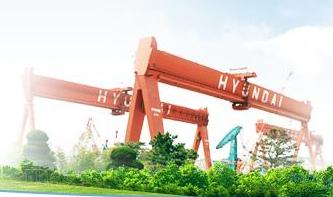
The measure comes after the global shipbuilding market shrank sharply last year.
According to international market researcher Clarkson Research Service, orders won by South Korean shipbuilders plunged 36.4 percent in 2014 from the previous year. Shipbuilding orders issued worldwide dropped 34.7 percent on-year in 2014, Clarkson said, amid growing concerns about the global economy and falling international oil prices.
Employees, who were born during the 1960s or older, are eligible to apply for the retirement program, the sources said. Those who apply for the program will be given up to 40 months of salary in addition to severance money, they said.
Under the early retirement program, part of its restructuring plan, the HHI seeks to lay off 1,500 workers, or 5.4 percent of its workforce, they said.
Copyright ⓒ Aju Press All rights reserved.
Related News
-
 Korean Shipbuilders Expand Non-Shipping Ventures Amid Boom
Korean shipbuilders are expanding their non-shipping ventures, including engines, special vessels, and offshore plants, capitalizing on the current boom in the shipping industry. Learning from past experiences of oversupply during previous supercycles, they are investing profits from this boom into diversifying their business portfolios to prepare for the next downturn.According to Korea Credit Rating on September 17, major shipbuilders such as HD Hyundai Heavy Industries, Hanwha Ocean, and Samsung Heavy Industries have secured more than three years' worth of orders. Given their order backlogs, analysts believe that this strong performance is likely to continue in the medium term.During the last shipbuilding supercycle, increased production capacity led to oversupply after a sharp decline in ship orders following the 2008 global financial crisis. This time, industry insiders report that shipbuilders are focusing on strengthening their non-shipping businesses rather than aggressively expanding production capacity, aiming to reduce reliance on high-value ship types like liquefied natural gas (LNG) carriers.HD Hyundai Heavy Industries is building a relatively balanced portfolio that encompasses engine machinery, special vessels, and offshore plants. Notably, in the engine machinery sector, the company recently signed two contracts to supply engines for data centers in the United States, totaling 1.58 trillion won. Unlike previous demand, which was closely tied to new ship orders, the market for engines is now expanding beyond shipping.Hanwha Ocean is leading the way in business restructuring among the three shipbuilders, focusing on special vessels and local production in the U.S. Following its acquisition of a shipyard in the U.S., the company is also pursuing a 100% acquisition of the U.S. division of Australian shipbuilding and defense firm Austal.Samsung Heavy Industries is positioning offshore plants as another growth pillar. Leveraging its experience in constructing some of the world's largest floating liquefied natural gas (FLNG) facilities, the company is enhancing its high-value offshore plant business. This year, it secured orders for two FLNG units, bringing its total offshore sector revenue to $4.4 billion, which accounts for about 40% of its total orders of $11.7 billion.The key question is whether the non-shipping ventures can generate stable profits and cash flow during future downturns in the shipping market. Special vessels are less correlated with shipping market conditions due to their ties to defense budgets and security policies, but they also face uncertainties in overseas orders and upfront investment burdens. Offshore plants, while large in scale, carry risks related to design changes and cost fluctuations.Engines are seeing some demand from non-shipping markets, such as data centers, but their overall contribution to total demand remains limited. Ultimately, the success of diversifying into non-shipping ventures will depend on the ability to maintain stable profits and cash flow even amid a slowdown in the shipping market.An industry insider stated, "Given that the share of shipping in major shipbuilders' revenues is high, it can be seen as an investment for the future during a profitable period. Based on the lessons learned from the difficulties faced after past booms, they are pursuing diversification in special vessels, U.S. operations, and offshore plant technology development."* This article has been translated by AI.
-
 Fed hike stalls KOSPI as shipbuilders outrun chipmakers
Graphics by AJP Song Ji-yoon SEOUL, Sept. 17 (AJP) — Investors in Seoul rotated out of chipmakers and into shipbuilders on Thursday after the U.S. Federal Reserve raised interest rates for the first time since 2023, leaving the KOSPI flat as foreigners sold for a seventh straight session. Foreign investors dumped a net 2.3 trillion won ($1.6 billion) of shares, lifting their seven-session total above 13 trillion won, as SK hynix and Samsung Electronics slipped and HD Hyundai Heavy Industries jumped 6.6 percent. The same split ran across the region. Chip stocks lagged in Tokyo even as the Nikkei 225 edged higher. Gold miners dragged on Chinese shares. The Korea Composite Stock Price Index (KOSPI), the main board of the Korea Exchange, slipped 2.6 points to 6,715.4. It had been up as much as 1.2 percent before foreign selling deepened and erased the gain. Institutions bought a net 158.6 billion won ($114.8 million) and individuals 413.8 billion won ($299.4 million). The Fed, America's central bank, lifted its benchmark rate by a quarter point to a range of 3.75 to 4 percent in a unanimous vote on Wednesday and signaled another increase could come before year-end. Chipmakers took the brunt of the selling. SK hynix fell 0.8 percent to 1,745,000 won ($1,262.6). Samsung Electronics lost a smaller 0.4 percent to 252,500 won ($182.7). Components maker Samsung Electro-Mechanics sank 3.7 percent to 1,330,000 won ($962.3). HD Hyundai Heavy Industries climbed to 469,500 won ($339.7), with local reports tying the rebound to its steep earlier losses and new growth prospects. Kang Jin-hyuk, a senior researcher at Shinhan Securities, said during the session that industrials and financials were propping up the index while chips paused to digest the hawkish Fed. Gainers outnumbered decliners 453 to 398, a sign the flat close hid wider buying beneath the chip heavyweights. The tech-heavy KOSDAQ, South Korea's secondary market, rose 6.2 points to 822.2. The 0.8 percent rise marked its third straight gain. The won weakened 4.6 won to 1,382.1 per dollar. In Tokyo, the Nikkei 225 rose 0.3 percent to 64,136.3 for a second straight session. Chip-testing equipment maker Advantest fell 1.5 percent to 30,240 yen. Fast Retailing and SoftBank Group each gained 1.0 percent, to 67,700 yen and 6,247 yen. The Bank of Japan opened a two-day policy meeting, with its decision due Friday. In Shanghai, the composite index traded lower as metals producers led losses. Shandong Gold slid more than 6 percent, a drop Chinese market reports linked to the Fed's move. Han Ji-young, an analyst at Kiwoom Securities, argued the post-Fed swings are a chance to buy rather than cut exposure, citing intact earnings momentum. That case rests on foreigners returning. Until they do, a market leaning on shipbuilders rather than chips has little room to absorb another hawkish surprise. AJP Takeaways - After the U.S. Federal Reserve raised interest rates for the first time since 2023, investors in Seoul rotated out of chipmakers and into shipbuilders, leaving the KOSPI flat. - Foreign investors sold a net 2.3 trillion won ($1.6 billion) of shares, extending their selling streak to a seventh straight session. - The split ran across the region: chip stocks lagged in Tokyo even as the Nikkei 225 rose 0.3 percent, and gold miners dragged on Chinese shares. Entity tags: Federal Reserve, Bank of Japan, KOSPI, KOSDAQ, Korea Exchange, Nikkei 225, SK hynix, Samsung Electronics, Samsung Electro-Mechanics, HD Hyundai Heavy Industries, Advantest, Fast Retailing, SoftBank Group, Shandong Gold, Shinhan Securities, Kiwoom Securities, Kang Jin-hyuk, Han Ji-young
-
Korean Shipbuilders Showcase Future Technologies at Gastech 2026
Three major South Korean shipbuilders are set to showcase next-generation eco-friendly vessels and marine technologies at the world's largest gas exhibition. Their strategy focuses on targeting global shipowners with technologies aimed at future markets, including liquefied natural gas (LNG), ammonia, and liquefied carbon dioxide (LCO2) carriers, as well as floating data centers.According to industry sources, HD Hyundai Heavy Industries, Hanwha Ocean, and Samsung Heavy Industries will participate in Gastech 2026, taking place from September 14 to 17 in Bangkok, Thailand, to highlight their advancements in eco-friendly ship technology.Now in its 37th year, Gastech is the largest exhibition focusing on natural gas and LNG, covering low-carbon solutions, hydrogen, shipping and marine, and artificial intelligence (AI).This year, top executives from the three shipbuilders will attend, including Jeong Gi-seon, chairman of HD Hyundai, Choi Sung-an, vice chairman of Samsung Heavy Industries, and Son Young-chang, vice president of Hanwha Ocean's product strategy technology division, to seek collaboration and order opportunities with global shipowners and classification societies.HD Hyundai will set up a joint booth featuring five subsidiaries, including HD Korean Shipbuilding and HD Hyundai Heavy Industries. The booth will display models of next-generation LNG carriers, floating storage and regasification units (FSRUs), and LCO2 carriers.During the exhibition, HD Hyundai plans to conduct 30 official events, including technology certifications from global classification societies and memorandums of understanding (MOUs) with major companies. A highlight will be their future LNG carrier technology, which features crew accommodations at the front of the vessel and a wind-assisted propulsion system, currently undergoing design evaluation by Lloyd's Register (LR).Hanwha Ocean will unveil a new business model that extends shipbuilding technology to data centers. This marks the first time the company will present its self-developed 60MW floating data center (FDC) in a physical model to global clients.The FDC is designed to address the surging demand for data centers driven by AI expansion, aiming to overcome the limitations of land-based data centers in terms of power supply, land acquisition, and cooling efficiency.In the eco-friendly ship sector, Hanwha Ocean will showcase a 174,000 cubic meter zero-emission LNG carrier, which is being developed with an electric propulsion system based on ammonia gas turbines, targeting a fully zero-emission technology that does not use pilot oil during the ignition process.Samsung Heavy Industries will focus on floating liquefied natural gas production facilities (FLNGs) and products for the next-generation LNG value chain, further solidifying its position in the offshore plant market after securing a large FLNG contract in June.The three shipbuilders plan to leverage Gastech as an opportunity to expand their connections with global shipowners and classification societies while promoting their next-generation technological capabilities. Their strategy includes broadening their business scope beyond LNG to encompass ammonia, LCO2, and AI-based marine infrastructure, aiming to maintain leadership in the future shipbuilding and marine market.An industry insider noted, "Gastech is a crucial venue for domestic shipbuilders to showcase their next-generation technologies and seek new order opportunities, as it gathers major global shipowners and classification societies in one place. As the shipbuilding and marine market rapidly expands with eco-friendly fuels and AI, competition for technological leadership in future markets will intensify."* This article has been translated by AI.