

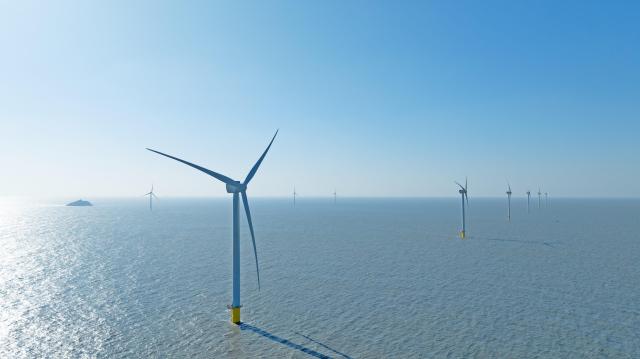
According to the shipbuilding industry on the 27th, Hanwha Ocean has been among the most aggressive. The company said it held a board meeting that day and disclosed plans to participate in a paid-in capital increase at its wholly owned unit, Ocean E&I, by subscribing to 25,439,900 common shares.
Ocean E&I is a Hanwha Ocean subsidiary set up for businesses related to operating a wind turbine installation vessel, or WTIV. A WTIV is a specialized ship used to install offshore wind turbines and is considered essential equipment for placing large turbines at sea.
By funding the WTIV operating unit, Hanwha Ocean plans to expand beyond ship construction into installation and operations. Since December 2024, it has broadened its footprint by taking over wind power operations from Hanwha Corp. and carrying out work from project development to engineering and construction for onshore and offshore wind projects.
In a 400-megawatt offshore wind project, the company said it directly handled site identification, power-generation permits and related approvals to build development capabilities. Last year, it also signed an EPC contract for the Shinan Ui offshore wind project to build a 390-megawatt offshore wind complex in waters southeast of Uido, Ui Island, in Sinan County, South Jeolla Province.
HD Hyundai is focusing on producing floating platforms, or substructures, and offshore substations, and supplying power equipment. It has obtained certification for 15- and 18-megawatt floating platforms and developed a 500-megawatt large-scale offshore substation model, aiming to secure an early lead in Korea’s floating offshore wind market and take an active role in large complex development through 2030.
Samsung Heavy Industries is concentrating on floating offshore wind, centered on semi-submersible substructure technology. The company said it obtained approvals in principle last year for a 15-megawatt large model, positioning it to compete in the sector.
It is also strengthening exclusive supply cooperation on large floating wind complexes, including the Ulsan Firefly project, with global energy companies such as Equinor, as it seeks to bolster competitiveness in renewable energy.
Shipbuilders say offshore wind is attractive because it closely aligns with their core capabilities. Shipyards already have design and manufacturing expertise for large structures, giving them an edge in producing offshore wind components. Strong cash flow from a boom in orders for liquefied natural gas carriers and ultra-large container ships has also supported investment in new businesses.
The offshore wind market is widely seen as having strong growth potential as decarbonization drives large project orders, particularly in the United States and Europe. The International Energy Agency projects the global offshore wind market will grow about 13% annually to roughly 1,335 trillion won by 2040. South Korea’s offshore wind market is also expected to expand to as much as 200 trillion won by 2035.
But industry participants say investment and policy updates are not keeping up with project timelines. A key constraint is a lack of grid capacity. Even after securing generation permits, projects often face delays connecting to the grid because of limited transmission capacity.
Port infrastructure is another bottleneck. Wind towers, blades and substructures are oversized and extremely heavy, requiring dedicated berths and nearby space for storage and assembly. Many major domestic ports are still geared toward container and bulk cargo, leaving limited offshore wind-specific capability. Industry officials warn that if multiple large projects move forward at once, logistics bottlenecks could become a real risk.
As a result, calls are growing to draw lessons from leading offshore wind countries such as Taiwan and the United Kingdom. Those countries have improved investment predictability by laying out long-term auction road maps and sharply streamlining permitting procedures.
By contrast, uncertainty over policy direction and project schedules remains in South Korea. Developers say they need clear auction volumes and timelines, as well as grid-connection plans, to justify equipment investments that can run into the hundreds of billions of won, but predictability is still low.
“Domestic shipbuilders have extensive experience in offshore plants and manufacturing large structures, so they are highly competitive in offshore wind as well,” an industry official said. “But the industry will not grow automatically just because companies invest first. A predictable policy environment must be put in place for the market to expand in earnest.”
* This article has been translated by AI.
Copyright ⓒ Aju Press All rights reserved.