


SEOUL, April 27 (AJP) - South Korea is moving to lock in a tourism windfall as shifting regional travel patterns and stronger visitor spending drive a surge in foreign arrivals ahead of a holiday-packed May.
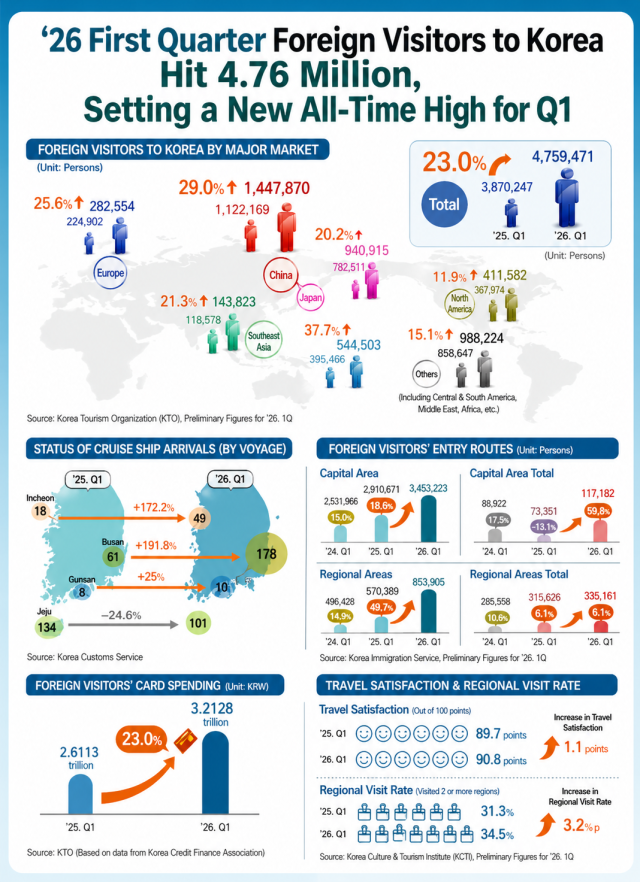
The country welcomed a record 4.76 million foreign visitors in the first quarter, up 23 percent from a year earlier, with 2.06 million arriving in March alone, according to the Ministry of Culture, Sports and Tourism.
The March spike was partly driven by the full-member comeback performance of BTS in Gwanghwamun, which drew global fans and boosted visits to nearby cultural sites such as Gyeongbokgung Palace.
Beyond headline numbers, officials say the recovery is becoming more structural.
Arrivals through regional airports rose nearly 50 percent in the first quarter, while 34.5 percent of visitors traveled outside Seoul — signaling a broader geographic spread in tourism demand.
Visitors are also staying longer and spending more. Overnight stays in non-capital regions rose 36.2 percent, while foreign card spending increased 23 percent to 3.21 trillion won. Overall visitor satisfaction reached 90.8 points.
Booking data reinforces the trend. Trip.com ranked Seoul as the world’s top destination for spring flight bookings, with reservations up 83 percent from a year earlier, outpacing Tokyo and Osaka.
The spillover is increasingly visible beyond the capital. Cheongju, about 120 kilometers south of Seoul, recorded a 962 percent jump in visitors, followed by Busan with 131 percent and Jeju with 129 percent.
Local governments are moving quickly to extend the momentum.
Busan has launched a rail-linked tourism campaign with Korail, offering discounts of up to 50 percent on high-speed KTX fares through September. The promotion bundles transport with major events such as the Haeundae Sand Festival in May, the Busan Port Festival in June, and large-scale exhibitions including G-STAR 2026.
Officials say the goal is to spread demand beyond peak seasons and encourage longer stays.
Growth has been broad-based across major markets.
China remained the largest source of visitors, with arrivals rising 29 percent to 1.45 million, followed by Japan at 940,915 visitors, up 20.2 percent. Taiwan posted the fastest growth at 37.7 percent, while arrivals from the Americas and Europe rose 17.1 percent.
Cruise traffic also rebounded, with calls at ports including Jeju, Busan and Incheon reaching 338, up 52.9 percent from a year earlier.
Momentum is expected to continue into the second quarter.
Japan’s Golden Week and China’s May Day holiday are likely to bring another wave of visitors, with H.I.S. ranking Seoul as the top overseas destination for the period.
Data from Airbnb showed South Korea ranked first in global destination searches for the May Day holiday, with interest rising fivefold from a year earlier.
Part of the surge may reflect shifting regional travel dynamics.
China’s Global Times reported that about 45 percent of scheduled flights from mainland China to Japan during the five-day holiday period had been canceled. Data from the Japan National Tourism Organization showed Chinese arrivals to Japan fell 55.9 percent in March, marking a fourth straight monthly decline.
The shift is increasingly redirecting demand toward Korea, reinforcing its position as a key alternative destination in Northeast Asia.

Copyright ⓒ Aju Press All rights reserved.
