

SEOUL, April 27 (AJP)- South Korea’s 1.7% first-quarter growth didn’t just beat expectations; it likely hit the ceiling.
According to OECD estimates, the surprise performance suggests the economy is already running at full capacity, signaling that the nation’s structural growth potential has effectively reached its limit.
Gross domestic product rose 1.7 percent in the January–March period from the previous quarter, nearly double the Bank of Korea’s earlier forecast of 0.9 percent.
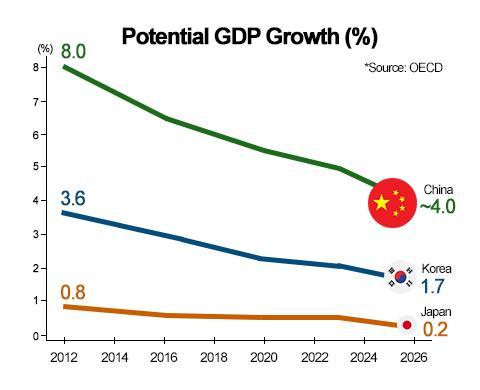
Yet the OECD now sees Korea’s potential growth rate falling to 1.71 percent this year and further to 1.57 percent next year, down sharply from 2.50 percent in 2021. It is projected to stagnate at around 1.52 percent by late 2027.
While most advanced economies face a slowdown this year due to elevated oil prices and supply disruptions linked to Middle East tensions, Korea’s decline has been notably steeper.
From 3.6 percent in 2012, the country’s potential growth rate has dropped by nearly 1.9 percentage points over the past 14 years — implying that more than half of its growth capacity has eroded.
By comparison, U.S. potential growth has held relatively stable at around 2 percent, while China’s has slowed from about 8 percent to roughly 4.5 percent. Japan has seen a more gradual decline, from 0.8 percent in 2012 to around 0.2 percent this year.
A weakening currency is emerging as a key pressure point.
A softer won raises import costs, compresses corporate margins and public finances, and adds inflationary pressure that can constrain sustainable growth.
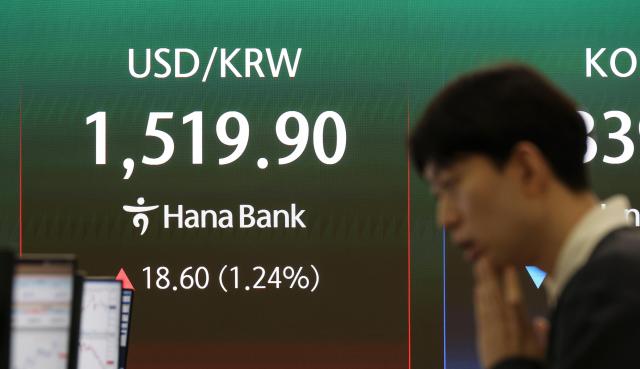
The Korean won has depreciated by more than 30 percent against the U.S. dollar, weakening from around 1,130 per dollar in 2012 to below 1,480 this month. Over the same period, the Chinese yuan declined by about 14 percent, while the Japanese yen fell more sharply.
In real effective terms, the weakness is more pronounced. According to the Bank for International Settlements, Korea’s real effective exchange rate stood at 85.44 (2020=100) at end-March — its lowest level in 17 years and among the weakest globally.
Economists point to sustained capital outflows and excess liquidity as key drivers.
In January alone, residents’ overseas securities investment rose by $13.46 billion, the highest monthly figure on record. For 2025 as a whole, outbound investment exceeded $110 billion, nearly triple the previous year’s level.
At the same time, money supply growth has remained elevated. Bank of Korea data show M2 rose 8.75 percent year-on-year in February. Even excluding exchange-traded funds, liquidity expanded 4.9 percent — still outpacing U.S. growth.
“One of the main reasons for the won’s depreciation is that Korea’s liquidity supply is expanding faster than that of the U.S.,” said Kim Kwang-seok, head of economic research at the Institute for Korean Economic & Industry.
Policymakers have also flagged inflation risks tied to the currency.
At his final Monetary Policy Committee meeting on April 10, outgoing BOK Governor Rhee Chang-yong warned that “inflationary uncertainties linked to the weak won remain high” amid geopolitical tensions in the Middle East.
Demographics add a deeper structural drag.
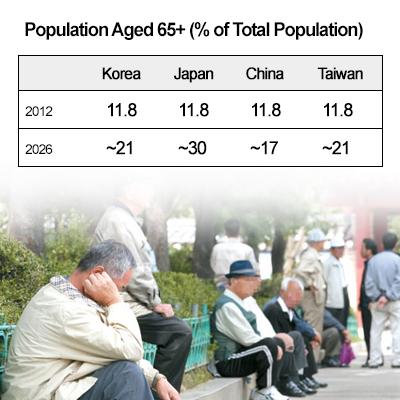
South Korea’s fertility rate fell to 0.8 in 2025, the lowest in the world, while the share of the population aged 65 or older has risen from below 12 percent in 2012 to more than 20 percent today.
The working-age population has declined from 73 percent to about 69 percent over the same period, while manufacturing employment fell from a peak of 4.6 million in 2018 to 4.2 million in 2025.
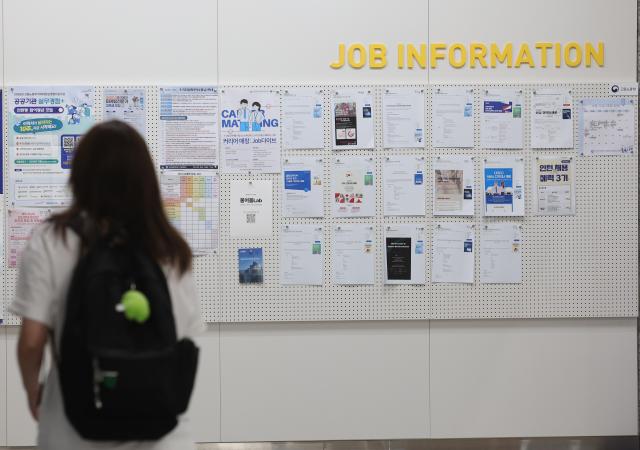
The Korea Employment Information Service expects job growth to slow sharply, with total employment projected to increase by only about 65,000 over the next decade.
Experts say structural reform is now unavoidable.
“The economy is showing a K-shaped growth pattern heavily reliant on semiconductors,” Kim said, calling for broader industrial diversification.
“To sustain growth, labor must be reallocated to sectors with rising demand,” said Lee Chang-soo, head of KEIS. “As demand for low-skilled jobs declines and the need for high-skilled workers increases, comprehensive retraining programs will be necessary.”
The won closed at 1,472.5 per dollar on Monday, up 12 won on the day. Despite a third consecutive session of gains, it remains about 2 percent weaker than the 1,442.5 level at the start of the year.

Copyright ⓒ Aju Press All rights reserved.
