
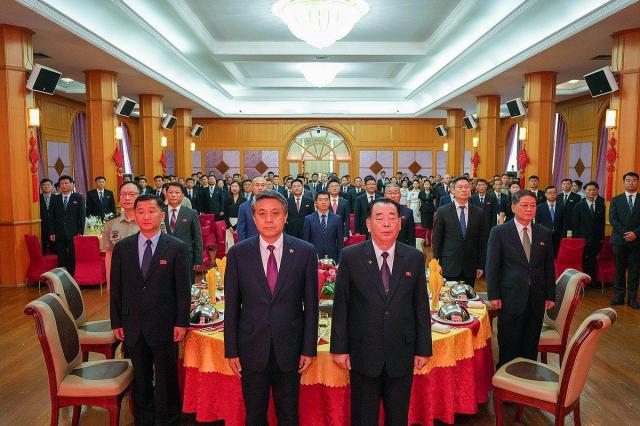
Coinciding with the 64th anniversary of the treaty signed on July 11, 1961, by North Korean regime founder Kim Il-sung and then-Chinese Premier Zhou Enlai, the daily hailed the treaty for laying the groundwork to strengthen "strategic cooperation" between Pyongyang and Beijing and to protect them from "hostile forces' reckless military adventurism," which it claimed "threatens global peace and security."
Like North Korea's recent military pact with Russia signed during Russian President Vladimir Putin's visit to Pyongyang in June last year, the treaty also includes a similar clause pledging both countries to provide each other with immediate military assistance in the event of an armed attack.
Friday's news coverage fuels speculation that Pyongyang may be attempting to mend ties with its traditional ally after a recent rift, especially given that state media from both sides remained silent about the anniversary last year.

Kim Hee-su
Kim Hee-su is a bilingual reporter at AJU Press, covering defense and foreign affairs. Before joining AJP in 2025, she worked at The Korea Times, where she wrote interview stories, including a profile of North Korean defector Kim Gum-hyok, and produced digital content. She also previously worked as a researcher for KBS News 9’s International News Department, supporting correspondents in 10 countries around the world. She graduated from the University of Toronto in Canada with a double major in Book and Media Studies and East Asian Studies.
Copyright ⓒ Aju Press All rights reserved.
Related News
-
 North Korea's Military Provocation Ahead of APEC in China
As the Asia-Pacific Economic Cooperation (APEC) summit opens in Shenzhen, China, on November 18, attention is focused on whether North Korea will engage in military displays. The first day of the summit coincides with North Korea's 'Missile Industry Day,' and there is a precedent for the country launching intercontinental ballistic missiles (ICBMs) during APEC meetings. However, given North Korea's recent strengthening of ties with China and Russia, there is speculation that it may opt for restraint and observe the diplomatic activities of neighboring countries instead of provoking further tensions.The APEC summit will be held from November 18 to 19, chaired by President Xi Jinping. North Korea designated November 18 as Missile Industry Day to commemorate its test launch of the Hwasong-17 ICBM on the same date in 2022.During the APEC summit in Bangkok in 2022, North Korea launched a Hwasong-17 missile on the first day of the meeting. Leaders from six countries, including the United States, South Korea, and Japan, convened an emergency meeting to condemn North Korea's actions, highlighting the nuclear and missile issues as significant security concerns on the international diplomatic stage.There have been instances of North Korea conducting military displays during international events hosted by China. In September 2016, during the G20 summit in Hangzhou, North Korea fired three ballistic missiles, and in September 2017, it conducted its sixth nuclear test on the opening day of the BRICS summit in Xiamen. This history raises doubts about the likelihood of North Korea refraining from provocations simply because China is the host.However, analysts suggest that North Korea may choose to exercise restraint this time, given its recent cooperation with China and Russia. Engaging in high-profile provocations could create diplomatic burdens for North Korea, especially during a period of strengthening ties with its allies.Chinese Foreign Minister Wang Yi and North Korean Foreign Minister Choe Son-hui met in Pyongyang in April to reaffirm their commitment to strategic communication, high-level exchanges, and multilateral cooperation. Additionally, Kim Jong Un visited Dandong in Liaoning Province, China, on October 24, where he met with Wang Huning, chairman of the Chinese People's Political Consultative Conference. Kim expressed his intention to uphold the traditional friendship between North Korea and China and to expand practical cooperation.High-level exchanges between North Korea and Russia are also ongoing. On November 15, North Korea announced the visit of a delegation led by Jo Yong-won, a secretary of the Workers' Party, to Russia. With the restoration of relations between North Korea and China and the expansion of cooperation with Russia, there is a possibility that North Korea will prioritize collaboration with its allies over further military provocations.The recent series of missile launches by North Korea has already conveyed a military message, which may reduce the likelihood of additional provocations. The Joint Chiefs of Staff reported that multiple missiles were launched into the East Sea from the Suncheon area in South Hamgyong Province on November 4, coinciding with the U.S. midterm elections on November 3.Given that North Korea has already demonstrated its military capabilities through recent tests and drills, there are expectations that it may refrain from further launches during the APEC summit and instead monitor the diplomatic movements of major countries. However, if the recent launches are part of a continuous testing program aimed at weapon system enhancement, the possibility of additional launches cannot be entirely ruled out.A diplomatic and security expert, speaking on condition of anonymity, stated, "It is difficult to predict future developments, but unlike in the past, North Korea, China, and Russia are maintaining friendly relations. With the potential for dialogue between North Korea and the U.S. opening up after APEC, it is likely that North Korea will focus more on diplomatic issues than provocations this time."* This article has been translated by AI.
-
Prospects for South Korea-China Summit Rise Amid North Korea-Russia Ties
As the Asia-Pacific Economic Cooperation (APEC) summit approaches, the likelihood of a South Korea-China summit is increasing, while North Korea continues to strengthen its ties with Russia. With the U.S.-China-Russia summit set for November 19, there are concerns that South Korea may be excluded from discussions regarding the Korean Peninsula. The prospects for both South Korea-U.S. and North Korea-U.S. summits remain uncertain.On November 15, the Korean Central News Agency reported that a North Korean delegation led by Jo Yong-won, a secretary of the Workers' Party of Korea, visited Russia the previous day. This visit was made at the invitation of the ruling United Russia party.In contrast, discussions are underway for a summit between South Korean President Lee Jae-myung and Chinese President Xi Jinping. South Korean Foreign Minister Park Jin stated during a press briefing at the South Korean embassy in China that "the Chinese side fundamentally focuses on economic cooperation rather than political relations with North Korea," adding that he had in-depth discussions with Chinese Foreign Minister Wang Yi regarding the potential for a North Korea-U.S. summit.He emphasized the importance of preparing for changes that the citizens of both countries can feel, especially as they approach the 35th anniversary of diplomatic relations next year, during the APEC summit.However, it is unlikely that the South Korea-U.S. and North Korea-U.S. summits will take place during this APEC meeting. A foreign ministry official refrained from commenting on the possibility of a South Korea-U.S. summit. Speculation has also arisen that U.S. President Donald Trump will not meet with North Korean leader Kim Jong-un during his trip to Asia.Amid these developments, there are concerns that the Korean Peninsula issue may be addressed at the U.S.-China-Russia summit without the involvement of South Korea and North Korea. A senior official from the South Korean foreign ministry conveyed to the U.S. and China that the upcoming summit should not resemble a second Yalta Conference, referring to the 1945 meeting where the leaders of the U.S., the U.K., and the Soviet Union discussed post-war arrangements and the reorganization of international order.Kang Jun-young, a professor at the Graduate School of International and Area Studies at Hankuk University of Foreign Studies, stated in a conversation with Aju Economy that it is crucial for South Korea not to be excluded if the Korean Peninsula issue is discussed at the U.S.-China-Russia summit. He also noted that the South Korea-China summit should focus on practical issues such as supply chain cooperation between the two countries.* This article has been translated by AI.
-
North Korea's Kim Song-nam Meets China's Liu Haixing Amid Ongoing High-Level Talks
Kim Song-nam, the International Secretary of North Korea's Workers' Party, met with Liu Haixing, head of the International Liaison Department of the Communist Party of China, during his official visit to China. This marks the third high-level meeting with Chinese officials during his trip, following discussions with Foreign Minister Wang Yi and Politburo Standing Committee member Zhai Zhigang.According to North Korea's state-run Korean Central News Agency, Kim met Liu at the Diaoyutai State Guesthouse in Beijing to discuss the development of bilateral relations and ways to expand cooperation.Liu emphasized that Chinese President Xi Jinping and the Central Committee of the Communist Party regard the visit of the North Korean delegation as significant, stating, "This visit holds important meaning for the development of China-North Korea relations."Kim also shared achievements in the construction and activities of the Workers' Party, highlighting the focus on meeting the goals set in the first year of the five-year plan introduced at the 9th Party Congress.The two sides confirmed mutual support for socialist construction and foreign policy. They agreed to faithfully implement the agreements between their top leaders and to enhance cooperation in foreign affairs to promote the development of China-North Korea relations and regional peace and prosperity.On the same day, Kim met with Zhai Zhigang, who is the fifth-ranking official in the Chinese Communist Party and serves as the Secretary of the Central Secretariat.During this meeting, Kim stressed that the friendship and strategic guidance between the top leaders of both countries form the foundation of the China-North Korea relationship, asserting, "Our party's firm stance is to continuously elevate and develop the China-North Korea relationship centered on socialism."Zhai responded, "Even if the international situation changes, China's position on valuing traditional China-North Korea friendship will not change. Our determination to support the socialist system led by Kim Jong-un and to safeguard our mutual interests remains steadfast."Earlier, Kim visited Beijing on November 3 at the invitation of the Central Committee of the Communist Party of China. On November 5, he met with Wang Yi to reaffirm their commitment to developing China-North Korea relations.* This article has been translated by AI.