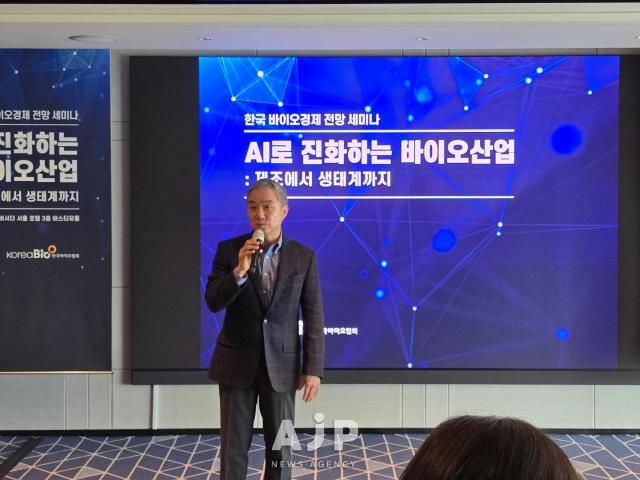
"AI is set to play a pivotal role in our sector, and its impact on the industry will be profound," said Lee Seung-kyu, vice chairman of Korea Bio. "Compared to the vague expectations we had last year, we are now better prepared for what AI can bring to the bio industry."
The forum comes as global life-science executives pile into AI despite geopolitical turbulence. A Samjong KPMG survey of 1,350 CEOs across 12 industries in 11 countries found that 71 percent ranked AI as their top investment priority, while 68 percent remained optimistic about economic growth.
"Some 83 percent of companies plan to allocate more than 10 percent of their budgets to AI, and 67 percent of CEOs expect to generate returns within one to three years," said Park Sang-hoon, a partner who leads KPMG's pharmaceutical and bio practice. "This marks a seven-percentage-point increase from last year."
The urgency stems from structural pressures in traditional drug development. Patent cliffs are arriving faster, clinical trial success rates are falling, and R&D costs continue to rise, often outstripping topline growth.
"AI is essential for accelerating drug development, reducing costs and identifying failures faster," said Yoon Hee-jung, head of the bio-innovation strategy team at the Korea Institute of S&T Evaluation and Planning. She pointed to breakthroughs such as AlphaFold's protein-structure predictions and Insilico Medicine advancing AI-discovered candidates into clinical trials.
She also noted that global tech giants like Nvidia, Microsoft and Amazon now offer bio-focused AI platforms, while Korean firms are quickly joining the race—Naver through targeted healthcare acquisitions and medical LLM development, and LG via a research partnership with Seoul National University.
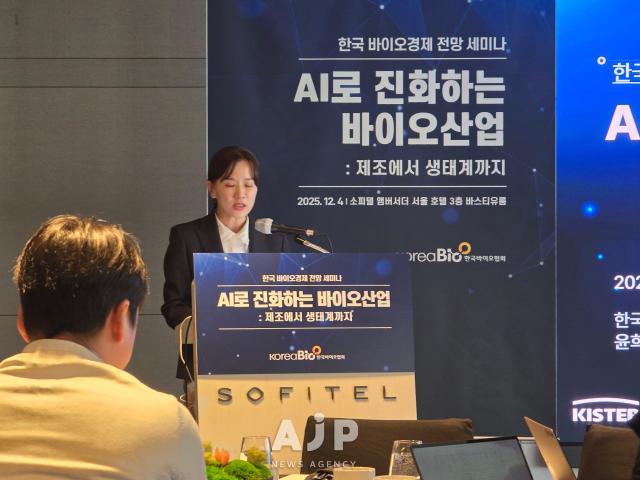
"Without AI, the astronomical number of genetic combinations makes optimization nearly impossible," Sung said. "Bio foundries running on AI can standardize processes and accelerate development that would otherwise take decades."
But regulatory systems are struggling to keep pace. Sung called for clearer rules on AI-generated intellectual property, broader data-sharing frameworks and stronger government support. Park warned that rapid technological shifts risk widening gaps between companies and deepening generational divides in workforce skills.
Even with geopolitical uncertainty clouding global markets, Korea's bio sector continues to expand. According to Korea Bio data presented at the forum, the industry's workforce grew 1.5 percent year-on-year, with a five-year average of 5.9 percent. Investment jumped 46.1 percent to 5.48 trillion won ($3.72 billion), with facility investment soaring 145 percent. Exports rose 17.1 percent to 13.7 trillion won.
Oh Ki-hwan, head of Korea Bio's research center, said executives cited biosecurity tariffs and the escalating U.S.–China rivalry as top concerns for 2025. He noted rising momentum to phase out animal testing in favor of AI-powered digital twins and in-silico trials.
"The digital bio sector is strongly calling on the government to establish dedicated AI drug development funds and develop sovereign AI capabilities," Oh said.
A government policy framework on AI in bio is expected later this month, with officials signaling a supportive stance, Yoon said.
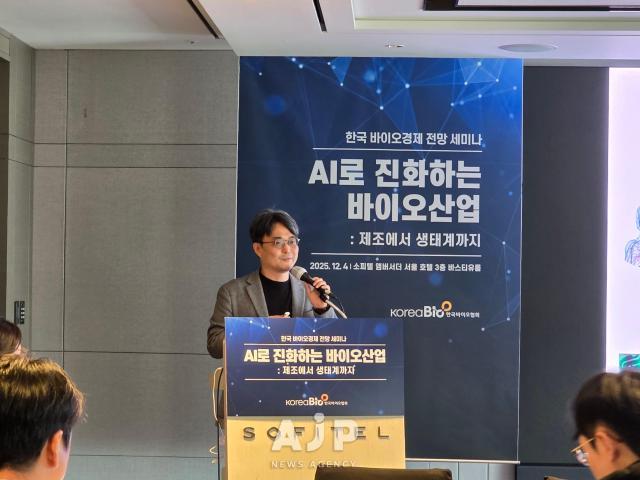
Lee Dong-yup, a professor at Sungkyunkwan University, said digital twin technology—combining AI modeling with virtual cell simulations—is still in its early stages in bio-manufacturing but could pave the way for personalized medicine and real-time production oversight.
"The future will be about turning data into value," Lee said. "AI in bio-manufacturing is still in its infancy, but the potential is enormous."
Copyright ⓒ Aju Press All rights reserved.