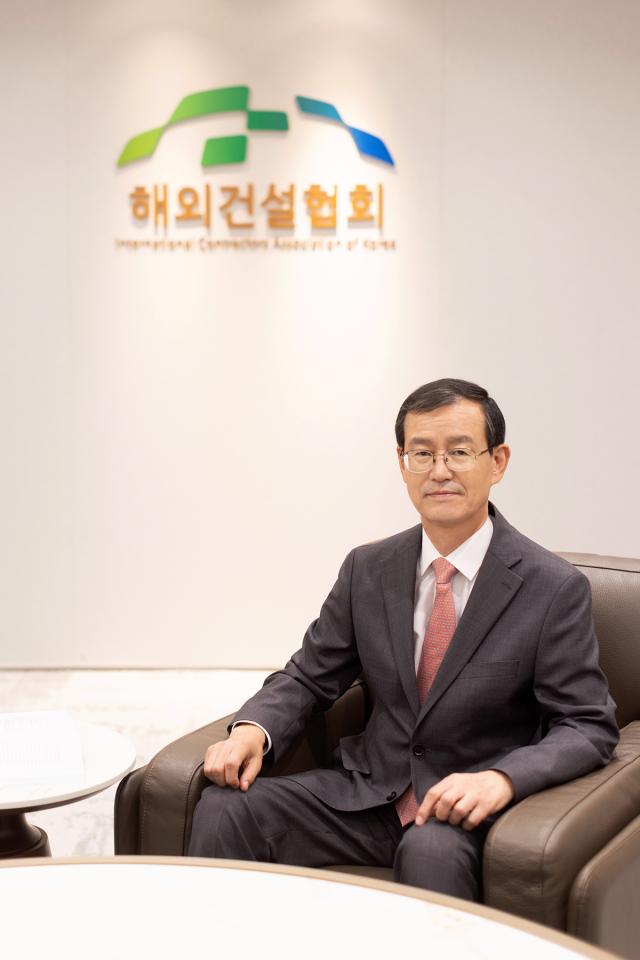
SEOUL, December 09 (AJP) - South Korean construction companies must move beyond traditional building roles and reposition themselves as comprehensive value creators to remain competitive globally, said Han Man-hee, chairman of the International Contractors Association of Korea (ICAK).
In an interview, Han said international clients are increasingly seeking partners capable of improving quality of life through integrated urban and infrastructure solutions, rather than firms focused solely on construction.
“Clients now want partners who can deliver long-term value, not just physical structures,” Han said. “Korean companies should fully leverage their strengths in engineering, procurement and construction (EPC) and expand into development, operation and investment.”
Han said global construction demand is being reshaped by carbon-neutral policies, digitalization and the rapid adoption of artificial intelligence, creating new opportunities in data centers, power infrastructure and nuclear power plants.
He called on the South Korean government to expand policy-based financial support, strengthen training for public-private partnership (PPP) specialists and reinforce so-called “sales diplomacy” to help domestic firms secure overseas contracts.
According to Han, the global construction market is shifting toward low-carbon development, digital construction and diversified supply chains.
“Korean builders must incorporate eco-friendly technologies from the earliest project stages,” he said, pointing to the growing importance of smart construction tools such as building information modeling (BIM), artificial intelligence, drones and big data.
He also stressed the need to reduce reliance on single-country supply chains and to work more closely with technology-driven partners to improve competitiveness in international bids.
Han identified data centers, power grids and nuclear power as key growth engines, driven by surging global demand for AI-related infrastructure. Global electricity consumption by data centers is expected to reach about 1,000 terawatt-hours as early as next year, he said.
Korean firms are increasingly exporting domestic experience in cooling efficiency, modular construction and eco-friendly digital infrastructure that combines renewable energy with data center development. Han also said a global “nuclear renaissance” could open doors to Korean nuclear technology in North America and Europe.
To support overseas expansion, ICAK has launched the “Convergence K-City Platform,” a framework designed to promote joint international projects across construction, engineering, culture, healthcare, logistics, information technology and energy.
Urbanization and infrastructure demand are rising sharply in the Middle East and Southeast Asia, creating opportunities for Korean companies to export integrated city development models, Han said.
Han said smaller construction companies face growing barriers due to the increasing size and complexity of overseas projects, particularly in financing.
ICAK provides market research support, invites potential foreign clients to Korea and subsidizes feasibility analysis costs. It also offers legal and tax advisory services through partnerships with law and accounting firms and supports on-site training programs to ease labor shortages.
The association additionally provides training subsidies to small and medium-sized firms to lower hiring costs.
Han said the industry must move toward high-value PPP projects for sustainable growth, which requires stronger institutional support.
He called for expanded capital injections into policy finance institutions, higher credit limits and enhanced tax incentives to reduce early-stage investment risks. He also urged faster guarantee approvals for urgent international bids and expanded tax benefits for overseas workers to prevent talent outflows.
Support for small and mid-sized companies in recruiting global talent should also be strengthened, he added.
During his term, Han said ICAK plans to institutionalize the Convergence K-City Platform and expand it into sectors such as railways and airports through proposed “K-Rail” and “K-Airport” initiatives.
He also said the association is strengthening global networks by signing memoranda of understanding with construction associations worldwide and expanding ties with foreign officials trained in South Korea.
“We aim to restore overseas construction as a core engine of Korea’s economic growth,” Han said.
* This article, published by Aju Business Daily, was translated by AI and edited by AJP.
Copyright ⓒ Aju Press All rights reserved.