

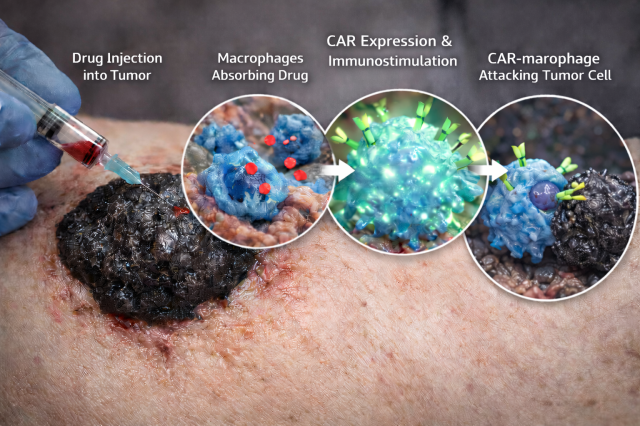
SEOUL, December 30 (AJP) - Scientists at the Korea Advanced Institute of Science and Technology have developed a way to turn a patient's own "sleeping" immune cells into cancer-killing machines. Instead of expensive and complicated laboratory processes, the new treatment works by injecting a special medicine directly into a tumor to reprogram cells from the inside.
The Korea Advanced Institute of Science and Technology (KAIST) announced on December 30 that a research team led by Professor Park Ji-ho from the Department of Bio and Brain Engineering has created an "in-situ" cell therapy. This method turns local immune cells into "CAR-macrophages," which are advanced cells genetically programmed to hunt and eat cancer.
Solid tumors, such as those found in the liver, lungs, or stomach, are very hard to treat because they act like fortresses. They are physically tough to enter and use chemical signals to put nearby immune cells to sleep. Current "CAR" therapies usually require doctors to take blood out of a patient, change the cells in a lab for weeks, and then put them back in. This is very expensive, and often the new cells cannot even get inside the tough tumor fortress once they are returned to the body.
The KAIST team decided to use the cells that are already inside the tumor. They created tiny lipid nanoparticles—microscopic bubbles—that contain a set of instructions called mRNA and a chemical alarm. The mRNA tells the cell how to build a "cancer-seeking radar," while the alarm wakes the cell up and makes it aggressive toward the cancer. When this mixture is injected into the tumor, the resident immune cells swallow the bubbles and read the instructions. They immediately begin building the radar and start attacking the tumor from the inside out.
In tests on animals with melanoma, a dangerous skin cancer, the treatment stopped tumors from growing. Because the "radar" cells were created right where they were needed, they were much more effective than laboratory-made versions. The researchers also found that once these cells were "awake," they sent out signals to the rest of the body's immune system, helping it fight cancer everywhere, not just where the injection happened.
Professor Park Ji-ho stated that this is a new way to make the body create its own medicine. He noted that it solves the biggest problems of current treatments, specifically how to get the medicine into the tumor and how to keep it working once it is there. The study, with Han Jun-hee as the lead author, was published in the journal ACS Nano.
(Paper information)
Journal: ACS Nano Title: In Situ Chimeric Antigen Receptor Macrophage Therapy via Co-Delivery of mRNA and Immunostimulant DOI: https://doi.org/10.1021/acsnano.5c09138
Copyright ⓒ Aju Press All rights reserved.
