

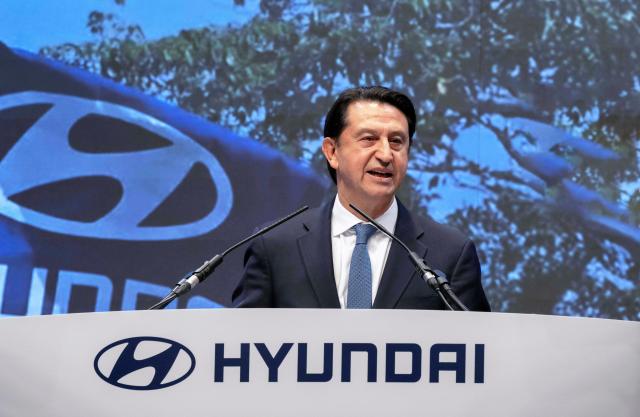
In an email to employees on Monday titled “Our Goals and Direction for 2026,” Munoz said Hyundai Motor will invest 125.2 trillion won in South Korea over the next five years, its largest-ever domestic investment plan, and about 35 trillion won in North America, or $26 billion.
He added that the company is preparing to expand production capacity in India and restructure its China business, a strategy aimed at strengthening growth in South Korea and the U.S. while pursuing opportunities in India and China.
For this year, Munoz set targets of global sales of 4.16 million vehicles, revenue growth of 1% to 2% and an operating profit margin of 6.3% to 7.3%. He said Hyundai Motor plans to sustain momentum with the launch of a Genesis hybrid and a range-extended electric vehicle, or EREV, slated for next year.
“South Korea delivered stable growth on the back of the successful launches of the Palisade and Ioniq 9, and North America posted record-high sales for five straight years,” Munoz said.
He said Europe accelerated its shift to electrification despite a tough regulatory environment, India’s EV sales grew by more than 750%, and Hyundai Motor is strengthening its strategy in China to match intense competition.
Munoz attributed Hyundai Motor’s recent share-price gains to its “vision for physical AI and robotics” presented at CES, as well as revenue performance, strong execution and steady results.
He said the company can achieve its 2030 strategy using the same PM² approach that drove last year’s results: moving quickly, preparing early, responding nimbly to change and working as “one global team.”
Hyundai Motor also reaffirmed its long-term targets: global sales of 5.55 million vehicles by 2030, including 3.3 million eco-friendly vehicles, or 60% of the total. It set an operating profit margin goal of 8% to 9% and said it plans to expand its hybrid lineup to at least 18 models.
* This article has been translated by AI.
Copyright ⓒ Aju Press All rights reserved.