
*Editor’s Note — As BTS prepares to return as a full seven-member act with a new album set for March 20 and an open-stage performance at Gwanghwamun on March 21, following a near four-year hiatus for rotational military service, AJP revisits the group’s 13-year trajectory. This series reexamines BTS’s history, music, performance identity and enduring appeal. The Third installment traces the BTS member SUGA's roots and growth.
SEOUL, February 12 (AJP) - “Butter” by BTS recently crossed 4 million cumulative points on Japan’s Oricon Weekly Combined Single Ranking. At first glance, the milestone looked like another routine addition to the group’s sprawling archive of records ahead of its comeback.
But the number tells a deeper story.
Unlike charts based solely on physical sales, Oricon’s Weekly Combined Single Ranking converts multiple consumption formats into a unified score. One physical single sold equals one point, as does one full-track digital download, while streaming figures are converted according to Oricon’s weighted formula.
Points are accumulated weekly, meaning the 4 million threshold reflects sustained, long-term consumption rather than a short-lived surge. In Japan’s domestic market — where local artists typically dominate cumulative rankings — surpassing 4 million points is widely regarded as a marker of durable purchasing power.
Released on May 21, 2021, “Butter” spent 10 weeks atop the Billboard Hot 100. Crossing the 4 million-point mark on Oricon made it the first such achievement by an overseas act and only the second overall — a reminder that BTS’s commercial gravity has not faded during its members’ staggered military service.

At the structural core of that trajectory stands rapper and producer Suga (Min Yoon-gi, born March 9, 1993).
Unlike many idol rappers whose roles remain performance-centered, Suga’s influence extends into composition, arrangement, and conceptual direction. More than 100 songs are registered under his name at the Korea Music Copyright Association.
He has contributed to defining BTS tracks such as “I Need U,” “Spring Day,” and “Life Goes On,” the latter becoming the first Korean-language song to debut at No. 1 on the Billboard Hot 100 in December 2020.
His solo career operates under a different logic.
Performing as Agust D — a name derived from reversing “DT SUGA,” with “DT” referring to “Daegu Town” — he foregrounds authorship and locality within a global pop framework. His 2016 mixtape Agust D reached No. 3 on Billboard’s World Albums chart. D-2, released in 2020, entered the Billboard 200 at No. 11.
The title track “Daechwita” accumulated 17 million views within 24 hours of release and has since surpassed 500 million views on YouTube.
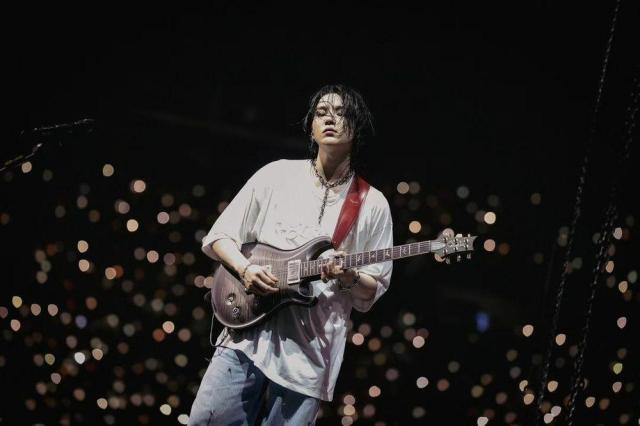
By the time D-DAY debuted at No. 2 on the Billboard 200 in 2023, the arc was unmistakable: a transition from group rapper to independently touring artist. His world tour, which began on April 26, 2023, spanned 10 cities and 28 performances, drawing more than 290,000 attendees — figures usually reserved for established solo acts rather than first-time headliners.
Collaboration has served as another extension of his authorship. He produced and featured on “Eight” with IU, co-produced and appeared on “That That” with PSY, and partnered with Halsey on “Lilith.” Each project expanded his reach beyond BTS’s immediate ecosystem.
Behind the numbers lies a long record of physical and emotional endurance.
During his trainee years, Suga sustained a serious shoulder injury in a traffic accident while working a delivery job. He later revealed on tvN’s You Quiz on the Block that he performed for years while receiving injections, before eventually undergoing surgery in November 2020.
The injury later influenced his assignment during mandatory military service. He was discharged on June 21, 2025.
In Daegu, murals near Myeongdeok Station now mark the neighborhood where his early studio once stood. Global chart dominance has translated into a physical landmark — an unusual trajectory for a rapper who once operated in the underground under the name “Gloss.”
Four million Oricon points. Ten weeks atop the Billboard Hot 100. A No. 2 debut on the Billboard 200. More than 100 registered copyrights. Over 500 million YouTube views. A 290,000-attendance world tour.
Individually, each figure signals scale. Taken together, they outline something more enduring: a producer who has built parallel credibility inside and outside one of the world’s largest music groups.
Major chart records, hundreds of millions of views, global touring power, and years of performing through injury — these are not merely statistics. They trace a career constructed on both expansion and resilience.
The next installment will track RM.

Copyright ⓒ Aju Press All rights reserved.