

MyData services have taken a step forward. What once mainly gathered scattered personal information in one place is increasingly being used to deliver practical financial benefits.
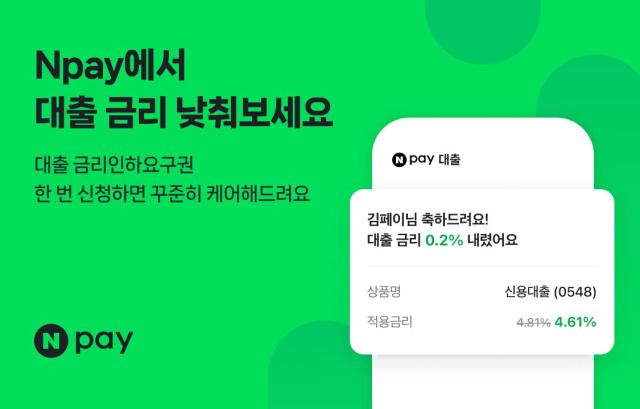
The Financial Services Commission said on the 27th that a service launched on the 26th will automatically file requests for loan rate cuts without requiring customers to visit bank branches each time. Under the system, a MyData-based artificial intelligence agent asks lenders for a rate reduction on behalf of borrowers. Users can sign up through MyData operators such as Naver Pay and Kakao Pay, as well as MyData services offered by banks, insurers and card companies, and then consent to automatic filing.
Korea’s rate-cut request right allows borrowers to ask a financial company to lower loan interest when their credit standing improves, such as through higher assets or income. Until now, many consumers failed to use it because they had to track credit changes themselves and apply separately to each lender.
With a one-time consent, the right can now be used automatically. Signals of improved credit — including financial assets, income gains, reduced debt and changes in credit scores collected through MyData — are analyzed in real time, and the system submits a request when conditions appear most favorable.
Requests can be filed regularly up to once a month, and can also be submitted at other times when there is a clear reason such as higher income or an improved credit score. If a request is rejected, the AI identifies the specific reason and advises what needs to be improved.
MyData can also be used to raise credit scores. Fintech firms such as BankSalad and Finda help “thin-file” consumers — those with little financial history or no current income — by reflecting nonfinancial and public data in ways intended to improve scores.
Among mid- to low-credit users with scores of 850 or below on the KCB scale who used a credit-score-boosting service over the past three months, one case showed a score rising 226 points, from 692 to 918. The user moved into a prime-credit range, and based on pre-screened loan approval data, the expected interest rate fell to 5.6% from 10.2%, a drop of 4.6 percentage points.
On average, mid- to low-credit users saw scores rise by 20 points. BankSalad’s interest-rate prediction model estimates that a 20-point increase can translate into an average rate reduction of 1.3 percentage points.
MyData is also being used more broadly for personal finance. Consolidating insurance contracts spread across multiple insurers can help cut unnecessary coverage, such as overlapping benefits or excessive riders, and support policy redesign. Card-optimization tools can recommend cards that offer higher discounts based on an individual’s spending patterns.
* This article has been translated by AI.
Copyright ⓒ Aju Press All rights reserved.