

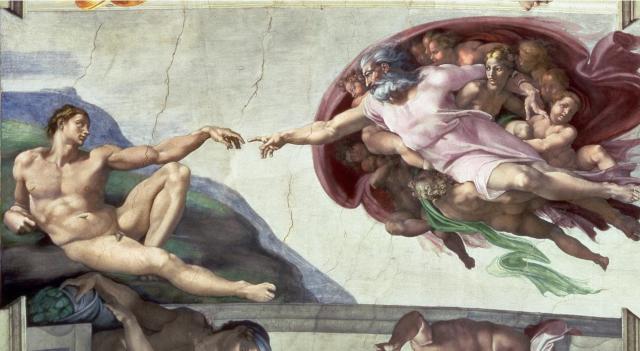
“Before it even touches Adam’s finger.” From “The Story of Art” (Yekyung), p. 310.
Michelangelo (1475-1564) captured the split second before God’s and Adam’s index fingers meet to suggest the moment of creation. In the Sistine Chapel ceiling fresco “The Creation of Adam,” an all-powerful God reaches toward the first man, as if passing on a “spark of life” through a fingertip.
Art historian E.H. Gombrich wrote in “The Story of Art” that the painting’s way of making God’s omnipotence visible is “one of the greatest miracles of art” (p. 310).
Hands have long carried meaning — care and comfort, trust and power, violence and control. People build tools, write and draw with their fingers; they also seal solidarity with a handshake or signal conflict with a fist. In the Middle Ages, some believed a king’s touch could heal. The article notes that people even crossed from the New World to Britain to receive the touch of Britain’s Charles II.
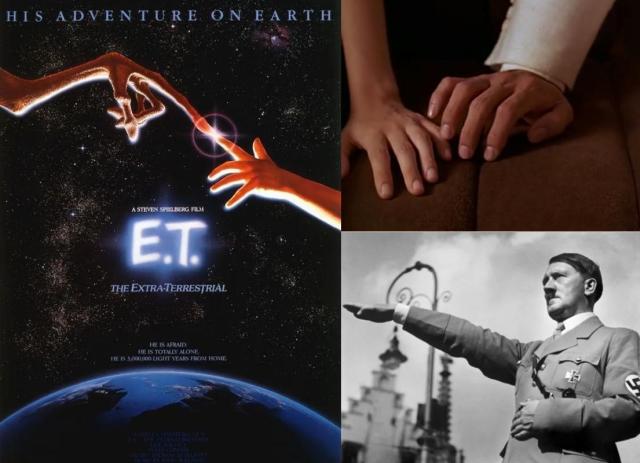
In “E.T.,” an alien and a boy touch fingers to form a bond. In director Jean-Jacques Annaud’s film “The Lover,” a fingertip touch signals the start of a dangerous romance. If the Buddha’s open palm is associated with peace and compassion, Hitler’s palm-down Nazi salute became a symbol of totalitarian fear.
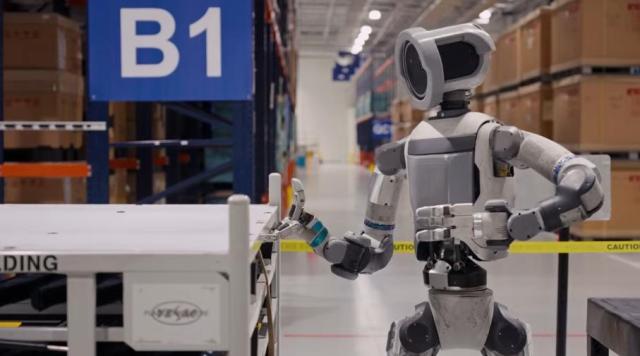
Now, the article argues, humans are trying to pass that dexterity to humanoid robots. It says major U.S. tech companies, as well as South Korean firms including Samsung, Hyundai Motor and LG, are working on robot hands — a modern echo of “The Creation of Adam.”
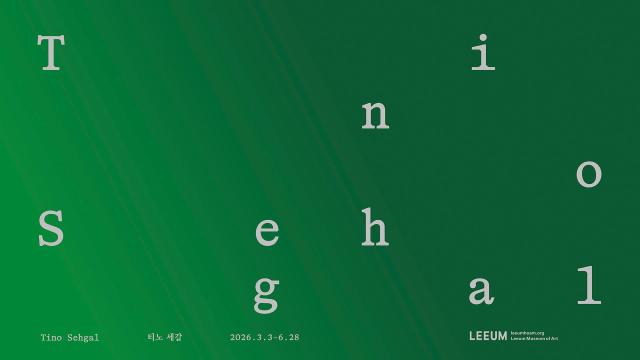
Against that backdrop, two exhibitions running through June 28 — Tino Sehgal at the Leeum Museum of Art and “Kim Yunshin: Habi Habil, Bun-i Bun-il” at the Ho-Am Museum of Art — turn attention back to human touch. Sehgal centers exchange between people; Kim focuses on life shaped by hands working in unity with nature.
Like a bird on a branch
At Leeum’s lobby, there is no actual forest. Yet visitors can be invited to “touch” a tree and hear birdsong. Performers — described as interpreters — blend into the crowd, then approach a visitor with a gesture. Interpreter and visitor share the motion by touching fingertips.
In Sehgal’s work, hands are not tools for taking photos or video. They become a living link between people. The exchange is meant to remain in the body and memory, not on social media.
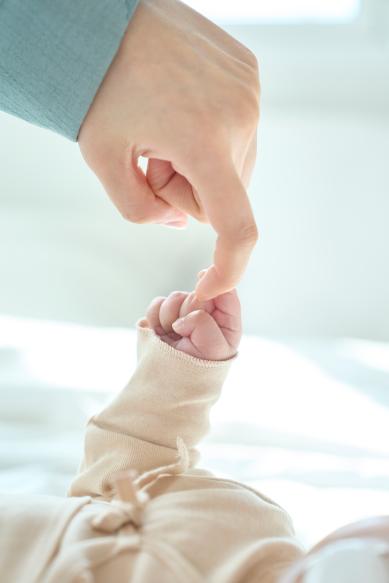
Sehgal has long asked how art can exist without a physical object. He leaves no sculpture or painting behind, building what he calls “constructed situations” through the human body, language and social interaction. Visitors become part of the exhibition and carry it forward through gesture, speech and recollection.
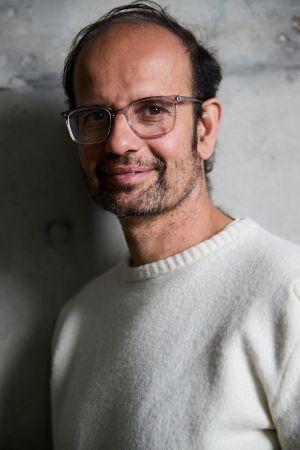
At a recent news conference at Leeum, Sehgal said, “Art is a game we play together,” and “art is the continuation of the game.” He added, “I’m interested in real experience. The artist’s intention is only a kind of help — what matters is how you feel the work.”
The exhibition also includes a live work referencing Rodin’s “The Kiss,” owned by Leeum, and other kiss scenes from art history. Two interpreters — a man and a woman — hold each other and move slowly.
“My work connects to the past but also has something new,” Sehgal said. “Kissing appears in many works in art history. I thought about how to continue what’s in art history through my work.”
Asked whether his “Kiss” can be passed on like baseball, he said transmission happens between people. “When you teach baseball to a 5-year-old, you don’t hand them a book — you teach with words and the body,” he said. “Showing objects (as museums do) is actually the exception in human history.”
Adding and dividing into one — the tree keeps branching
“My hands and my emotions connect as one with the tree. The moment I let go and stand the finished piece upright, I discover I have embodied, in a totem-like way, my dream of reaching the sky.” — Kim Yunshin, “The Soul of Wood,” Art in Culture, April 2023The book “A Cultural History of Form” (Hangilsa) describes civilization — including humans, environments, artifacts and cultural phenomena — as following a branching structure like a tree. As limbs and fingers branch from a body, the article notes, similar patterns appear in neurons, lung airways, river deltas and lightning. Material culture, too, spread into countless branches through trial, error and innovation.
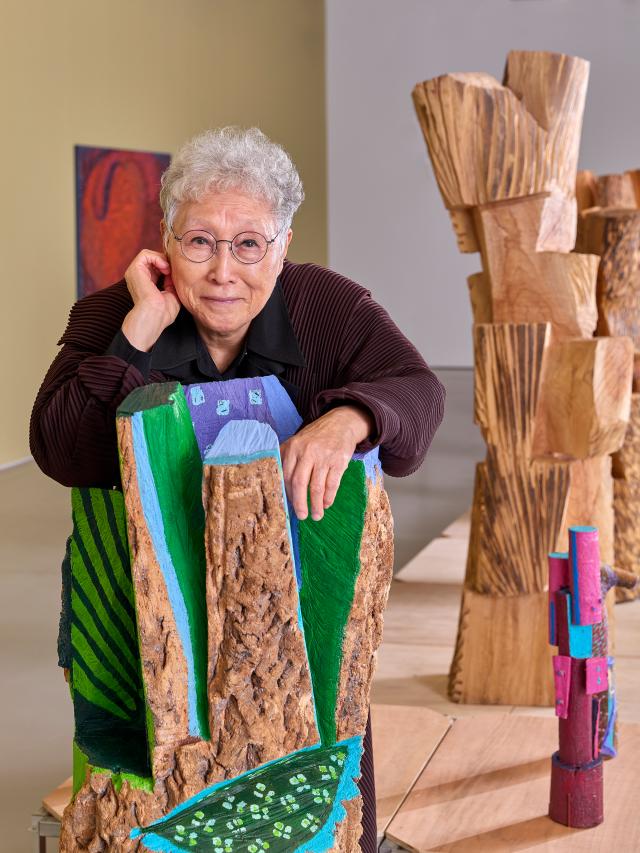
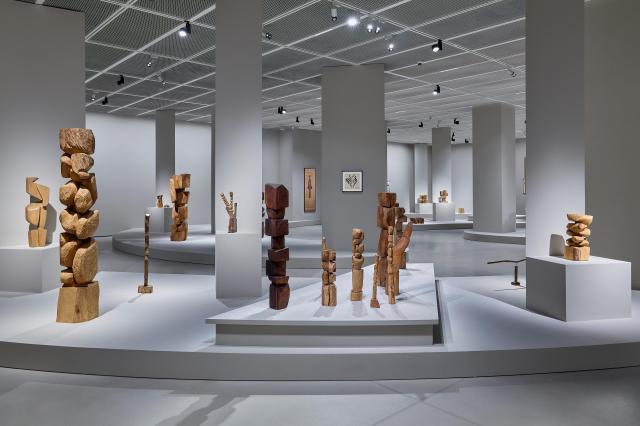
At Ho-Am, Kim’s retrospective is built around her guiding idea, “Habi Habil, Bun-i Bun-il (合二合一 分二分一).” The article explains it as a process in which artist and material become one (合), and then a new work is born (分) — a movement between convergence and dispersal. Kim has said she gained insight by studying wood over time and carving it away with a chainsaw.
Her sculptures, the article says, gather many strands: stacked stone towers; the lines of hanbok sleeves and the eaves of traditional Korean houses; Catholic and shamanistic beliefs; and the grandeur of South American nature and its vivid cultures.
At a news conference on the 11th, Kim said, “The tree is me.” She added, “Since I was young, I lived with nature in the countryside, at the foot of a mountain. That’s me. I am nature.”
Both exhibitions run through June 28.
* This article has been translated by AI.
Copyright ⓒ Aju Press All rights reserved.