

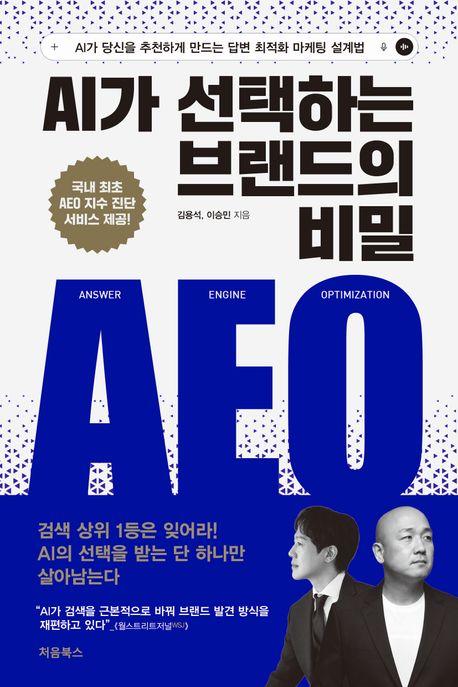
AEO: The Secret of Brands AI Chooses=Kim Yongseok·Lee Seungmin, Cheoeum Books.
"An era has arrived in which AI’s choice becomes the consumer’s choice." (p. 48)
A branding specialist and an AI specialist argue that the AI era will intensify a winner-take-all market, with the brand selected in AI-generated answers rising to No. 1. They say marketing is rapidly shifting from SEO, or search engine optimization, to AEO, or answer engine optimization. Where ranking at the top of a search results page once mattered most, they write, consumers increasingly accept the hyper-personalized “right answer” presented by AI. Companies that stick to older playbooks risk turning their websites into deserted islands no one visits.
The book’s focus is summed up in its subtitle, “A blueprint for answer-optimization marketing that makes AI recommend you.” Beyond forecasting change, the authors lay out practical steps in plain language. They stress becoming “the one brand AI chooses first,” and offer survival strategies designed to stand out to AI systems.
The authors analyze the kinds of sources AI commonly draws on to produce answers, including YouTube, video captions and NamuWiki. They also note that major platforms such as Gemini, ChatGPT and Perplexity favor different types of content, and they outline ways to tailor visibility strategies to each platform.
The book is packed with actionable guidance, including: “You have to be the perfect answer for people with needs in a specific context,” “It favors raw, unfiltered voices in communities and reviews,” and “If you don’t stand out sharply, you won’t even get the chance to pass AI filtering and reach customers.”
Written for easy reading, it explains technical terms briefly but concretely. A fictional commerce agent called “KapGPT” is used to show, at a glance, how AI arrives at answers. Sections such as “Three rules of writing that captivates both humans and AI” aim to deliver the essentials without filler.
“You must provide information in a structure that is easy for AI to learn. A vague adjective like ‘Our product is good’ is meaningless to AI. Instead, you should connect specific specs and the problem they solve in a clear relationship, like: ‘Our running shoes have a 0.8-centimeter difference between heel and forefoot height and ample toe space, helping runners with wide feet and forefoot pressure prevent plantar fasciitis.’ AI prefers this kind of problem-solution structure, and it is much easier to match to a user’s question.” (p. 95)
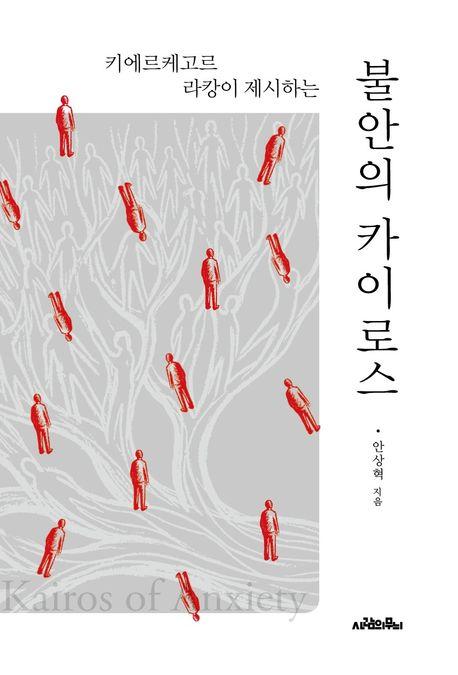
Ahn, a professor in the Department of Film, TV and Multimedia at Sungkyunkwan University, examines anxiety from an anthropological perspective after years of research on the subject. He argues that anxiety is not simply a negative emotion. Instead, he writes, it challenges the identity of the self and can push people beyond an outdated knowledge system toward becoming a new subject. He suggests that anxiety felt by people facing the waves of the AI era can be seen as a paradoxical mechanism of hope that helps reveal the self’s possibilities.
Drawing on the works and theories of philosophers Søren Kierkegaard and Jacques Lacan, Ahn takes a layered look at modern inner life. He reinterprets anxiety not as something to eliminate, but as a time for creative decision-making to discover a new self — a “kairos.”
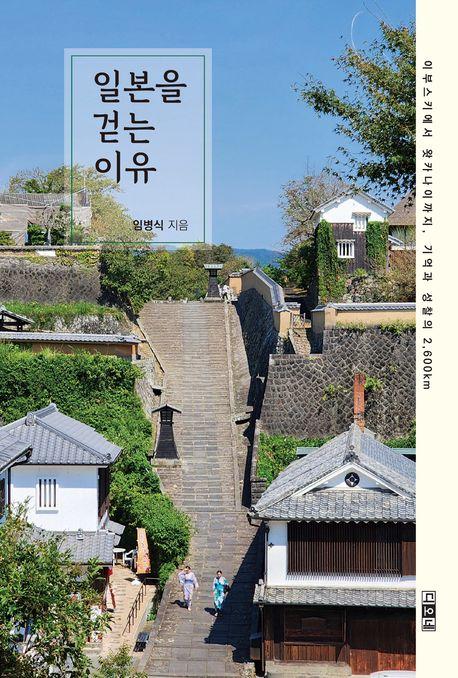
Why Walk Japan=Lim Byeongsik, Dione.
Lim, a former journalist, spent two years walking from Ibusuki in Japan’s far south to Wakkanai in the far north, visiting sites tied to historical disputes. Along the way, he writes, he encountered multiple faces of Japan at once: a Japan that distorts history, a Japan that stays silent about war crimes, a Japan that reflects on wrongdoing, and a Japan that moves to correct past errors. Avoiding a simple black-and-white frame of perpetrator and victim, he describes what he saw by walking each place and meeting a range of people.
The book visits locations marked by heavy history, including Fukuoka, where the tragic deaths of Yun Dong-ju and Song Mong-gyu remain; the ruins of Hizen Nagoya Castle, described as a starting point for the invasion of Korea; and Ibusuki and Chiran, where traces remain of the fanaticism surrounding kamikaze suicide units. Through the life of Japanese lawyer Fuse Tatsuji, who defended Koreans, Lim raises questions about responsibility and reconciliation.