SEOUL, March 30 (AJP) - South Korean stocks are holding up — still more than 20 percent above year-end — but the won and bonds are taking a far heavier hit as capital flees amid the Middle East crisis, with little relief in sight unless Gulf shipping routes reopen.
Seoul markets opened the week under pressure as the war in the Persian Gulf dragged into a second month with widening fronts and no clear resolution.
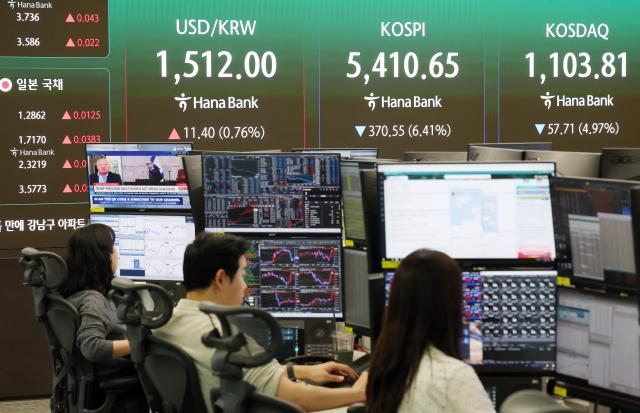
Both the KOSPI and KOSDAQ fell about 3 percent Monday after Yemen’s Houthi rebels joined the Iranian-led front with attacks on Israel, prolonging disruptions in the Strait of Hormuz — a critical artery for global energy flows.
The KOSPI has now shed nearly 6 percent over the past week, as shipments of Korea-bound crude — accounting for roughly 70 percent of imports — remain stranded.
Still, equities have fared better than other key financial assets.
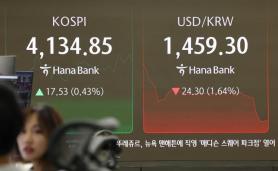
The Korean won has weakened to its lowest level since March 2009, during the global financial crisis. The dollar has gained about 5 percent against the won this year, compared with just 2.3 percent versus the yen.
On Monday, the dollar closed at 1,515.7 won, up 5.3 percent from end-February when the U.S. military campaign in Iran began — roughly double the 2.6 percent rise in the dollar index over the same period.
The average exchange rate for March approached 1,490 won per dollar, dealing as the fourth-steepest monthly depreciation on record for the won. With the top three occurring during the 1997–98 Asian financial crisis, the current slide ranks as the second-most severe in practical terms.
Capital flight has been a key driver. Foreign investors sold a net 36.4 trillion won worth of local equities in March alone, bringing total outflows for the first quarter to a record 65 trillion won.
Bond markets are also flashing stress signals.
The three-year government bond yield rose to 3.542 percent on Monday, up 50 basis points from a month earlier and nearly 60 basis points from year-end. The 10-year yield eased slightly to 3.89 percent after breaching 3.9 percent — levels last seen during the peak of the post-pandemic tightening cycle in late 2023.
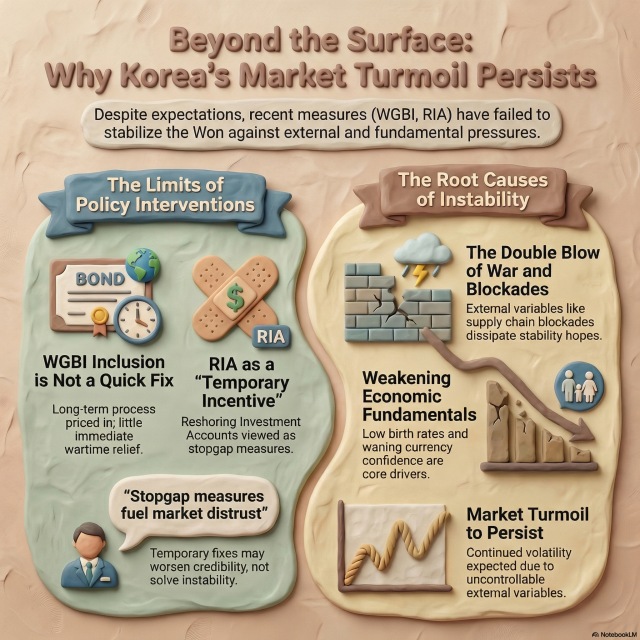
Expectations that Korea’s inclusion in the World Government Bond Index (WGBI) from April would help stabilize markets have largely faded amid the twin shocks of war and supply disruptions.
“WGBI inclusion is a process that unfolds over several months, not something that delivers immediate impact,” said Lee Seok-jin, a manager at Hana Bank’s FX Platform Division. “In a wartime scenario like the current one, it is difficult to expect meaningful short-term effects.”
Moon Hong-cheol, a researcher at DB Financial Investment, said the benefits of WGBI inclusion had already been priced in, with external shocks now dominating market movements.
Even policy efforts are struggling to shift sentiment.
Brokerages have rolled out Reshoring Investment Accounts (RIA) ahead of the expected passage of the government’s “Three FX Stability Acts” on March 31, but analysts remain skeptical.
“The RIA is merely a temporary incentive,” Moon said. “The instability in the Korean market and the won ultimately stems from structural fundamentals, including demographic decline and weakening confidence in the currency.”
“Stopgap measures risk undermining trust rather than restoring it.”

Copyright ⓒ Aju Press All rights reserved.