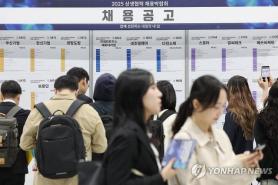
SEOUL, April 17 (AJP) - It takes a village to raise a child — and in Mungok-ri, a mountain-ringed hamlet in northeastern South Korea, it took a village just to welcome one.
For the first time in 20 years, the community of barely 100 residents heard the cry of a newborn. Banners lined the narrow roads to celebrate Seo-yoon, the second child of Kim Hyun-dong and Chang Yoo-jin. Gifts poured in from neighbors and local groups. Even the provincial governor sent his congratulations.
In a country confronting demographic decline, the birth felt less like a private milestone than a communal event — a rare interruption in a long silence.
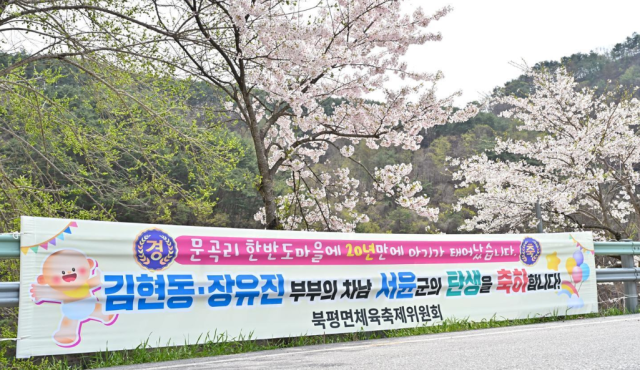
It was not entirely by chance.
Jeongseon County, where Mungok-ri is located, provides monthly subsidies of 100,000 won ($74) for up to two children in their first year, with payments extended to age 12 from the third child onward.
Across South Korea, local governments are deploying increasingly aggressive incentives to slow population decline and revive shrinking communities.
Some are pushing further. South Jeolla Province offers a monthly child allowance of 200,000 won starting a year after birth. The province recorded a fertility rate of around 1.1 — the highest in the country — even as the national rate remains well below one.
In Incheon, combined central and local government support can exceed 100 million won per child born since 2024, including transport subsidies, childcare allowances and other benefits. Housing has become another lever. Jeonnam’s “10,000-won housing” program offers subsidized rental units for young couples at a fraction of market rates.
The competition is intensifying — and becoming more expensive.
Yet the results remain uneven.
South Korea’s total fertility rate rose slightly to 0.80 in 2025 from 0.75 a year earlier, with births increasing 6.8 percent to 254,457. It marked the first uptick in nearly a decade, but the country still holds the lowest fertility rate in the OECD.
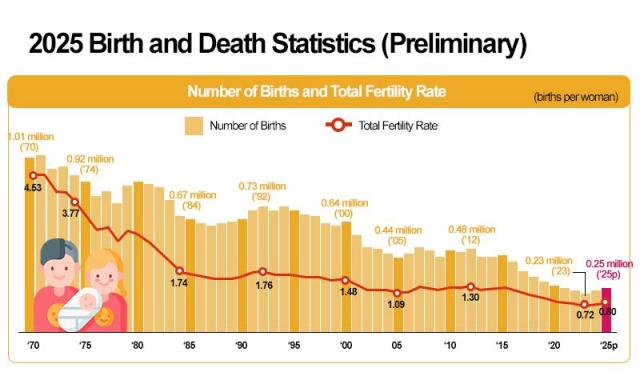
The longer-term trend is stark. Annual births have collapsed from over 1 million in 1970 to around 250,000 today, while fertility has fallen from 4.53 to below one. Since 2006, more than 380 trillion won has been spent on pro-natal policies.
The return, so far, has been marginal.
Recent regional data offers some optimism. Several provinces — including Jeonnam, Sejong and Gangwon — have recorded fertility rates above the national average.
But much of the increase reflects delayed marriages rebounding after the pandemic and the temporary demographic boost from the “echo boom” generation entering peak childbearing years, while the underlying trajectory remains unchanged.
Japan offers a useful, if cautionary, comparison.
Tokyo has rolled out a far more comprehensive policy mix: higher childbirth grants, expanded child allowances, stronger parental leave benefits and workplace reforms aimed at improving work-life balance. It has also moved to reduce the cost of childbirth and expand housing and education support for families.
Despite this, Japan’s fertility rate remains stuck around 1.1 to 1.2, with births continuing to decline.
The lesson is clear: policy alone has limits.
In South Korea, the growing reliance on local incentives raises additional concerns. While subsidies may lift birth rates in specific regions, they risk shifting population rather than increasing it.
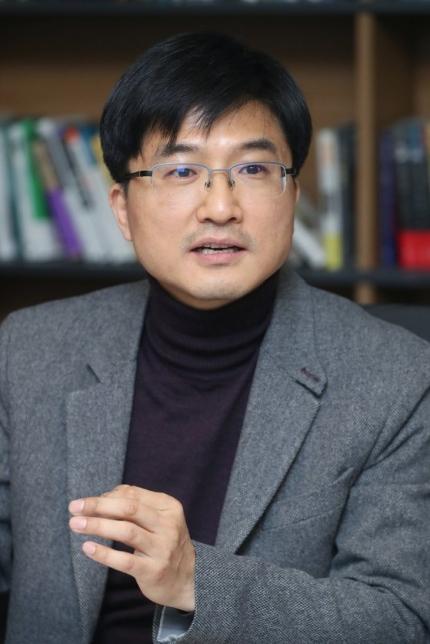
“Local governments may see higher births, but often because women move into those areas or delay leaving,” said Yang Jae-jin, a professor at Yonsei University. “At the national level, the impact is limited.”
Financial support, experts say, addresses only part of the problem.
“To increase births, parents need better pay during parental leave, more flexible working hours and reliable childcare,” Yang said.
At a deeper level, the issue is structural.
“For many young people, avoiding marriage and childbirth has become a rational choice,” said Yee Jae-yeol, a sociology professor at Seoul National University.
Employment insecurity, high housing costs and intense competition have reshaped life decisions.
In Seoul, marriage itself has become a financial burden.
“For younger generations, marriage is no longer a step toward stability, but a decision that may lower their quality of life,” Yee said.

The labor market offers little relief. Compared with countries such as the Netherlands or Denmark, where flexible and part-time work is more common, Korea’s rigid employment structure makes it harder to balance work and family.
Geography compounds the challenge.
Jobs remain heavily concentrated in the capital region, which houses more than half the population on just 12 percent of the land. Young people continue to migrate to Seoul, intensifying competition, driving up housing costs and raising barriers to both marriage and parenthood.
A Bank of Korea study found between 2015 and 2021, youth inflows accounted for 78.5 percent of population growth in and around Seoul, while youth outflows made up 75.3 percent, 87.8 percent and 77.2 percent of population decline in the southeast, southwest and Daegu–Gyeongbuk regions, respectively.
The trend is even more pronounced among the highly educated, who are disproportionately drawn to the capital.
Across all regions, the share of college graduates is higher among those leaving than in the overall youth population. The capital region stands out as the only area where the proportion is higher among inbound migrants, reflecting a stronger tendency for highly educated individuals to remain in or move to Seoul.
Rural incentives alone are unlikely to reverse the broader decline. “Providing financial support without addressing the broader context misses the point,” Yee said.
Back in Mungok-ri, the village is celebrating — and holding on to a rare moment of hope. But one baby, however cherished, does not change the math.

Copyright ⓒ Aju Press All rights reserved.