

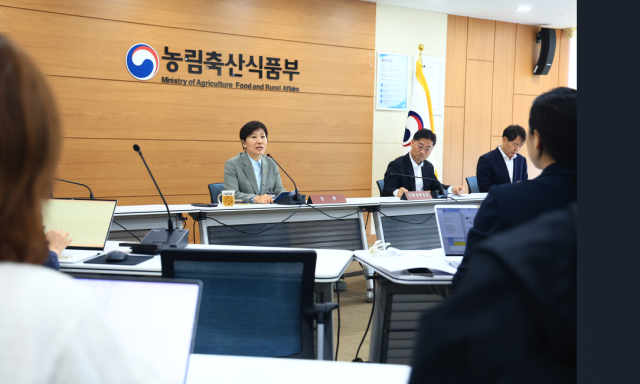
Agriculture Minister Song Mi-ryeong speaks at a reporters’ briefing on April 27. (Ministry of Agriculture, Food and Rural Affairs)
Song Mi-ryeong, South Korea’s minister of agriculture, food and rural affairs, said April 27 the government will launch an agriculture and rural “energy transition” task force this week to prepare for a prolonged war in the Middle East. She also underscored the need for reform at NongHyup, citing survey results showing broad support for a government-led overhaul.
Speaking at a briefing for reporters at the government complex in Sejong, Song said that if the conflict continues, “leaving the energy issue unattended or responding only with the existing fossil-fuel system” could threaten the country’s food security.
She said agricultural waste could be converted into energy through solid-fuel production and biogas, and then used as “meaningful fertilizer,” turning what is discarded into a resource. She added that farmland could also become a key asset because solar panels can be installed there.
On NongHyup reform, Song said the ministry has continued to gather views in the field amid criticism that input was insufficient. She said a second reform package, including measures to revitalize its economic businesses, will be announced in June, and that needed legislation will be processed quickly.
A Korea Rural Economic Institute survey released that day found 94.5% of cooperative members and 95.1% of the general public supported the need for NongHyup reform. The most common reason cited was the need to eradicate misconduct by executives, including the chairman and local cooperative heads.
Addressing opposition, Song said she was aware of concerns that direct elections by members could strengthen the central chairman’s authority and that expanded government oversight could undermine autonomy. She said giving members voting rights while expanding government supervisory authority would help NongHyup secure democratic legitimacy while correcting problems.
On worries about farm input supplies due to the Middle East war, Song said the latest assessment showed the country has secured enough raw materials for urea to avoid disruptions in fertilizer supply through the end of August. She said raw materials for plastic film have been secured through June, and the government is working to increase supply to some areas facing shortages.
Song also said there has been some misunderstanding about the recent jump in rice prices. She said that compared with other prices over the past 20 years, the rise in rice prices has not been large, and that balancing producers and consumers is important. Rice is currently about 62,000 won per 20 kilograms, about 15% higher than a year earlier.
On rising egg and broiler chicken prices, Song pointed to increased imports of hatching eggs as a response. She said livestock infectious diseases have affected not only laying hens but also broilers, raising concerns ahead of Chobok, and that imports are being expanded in anticipation of higher broiler demand during Chobok and Jungbok.
* This article has been translated by AI.
Copyright ⓒ Aju Press All rights reserved.