

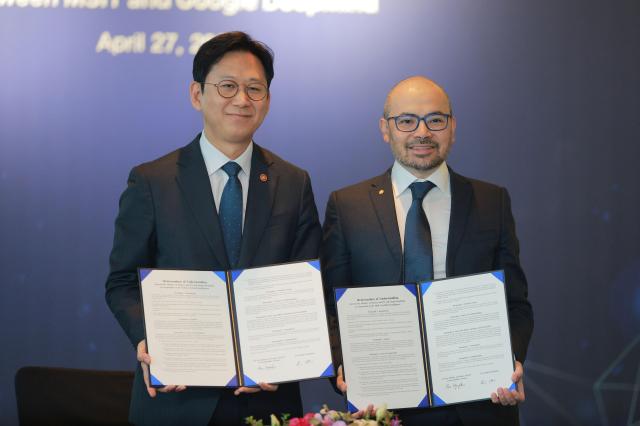
South Korea’s Ministry of Science and ICT said it will expand cooperation with Google DeepMind as it pushes the “K-Moonshot” project, a national strategy to apply artificial intelligence across research and development to tackle major science and technology challenges.
The ministry said it signed a memorandum of understanding with Google DeepMind on April 27 at the Four Seasons Hotel in central Seoul. The agreement focuses on joint AI research, talent development and the spread of responsible AI.
The hotel is the site of the 2016 match in which AlphaGo defeated top South Korean Go player Lee Sedol, an event widely seen as a milestone for modern AI.
Bae Kyung-hoon, deputy prime minister and minister of science and ICT, said AlphaFold’s results have helped drive innovation in medicine and biotechnology. “The science field can definitely create innovation with AI,” he said.
Bae added that AI has already penetrated areas including science and security, and said the government will work to ensure more people can use AI.
DeepMind CEO Demis Hassabis said the AlphaGo-Lee match “was a signal flare that marked the beginning of modern AI.” He said the era of artificial general intelligence has moved up by five years and that the scale and speed of progress will be 10 times that of past industrial revolutions.
Hassabis said South Korea has a strong position “as an AI powerhouse, from semiconductors,” and said he would expand partnerships during his visit with Samsung Electronics, SK hynix, Hyundai Motor, and LG Electronics.
The visit is his first to South Korea in 10 years since the 2016 match, according to the article. Hassabis co-founded Google DeepMind and has been a leading researcher in applying AI to scientific work.
DeepMind developed AlphaFold, an AI system for predicting protein structures. Hassabis said he shared the 2024 Nobel Prize in chemistry with John Jumper and David Baker for AlphaFold-related research.
The ministry said it will use the MOU to build broader cooperation across technology, infrastructure and researcher exchanges. Hassabis said the partnership will rest on three pillars — model research, talent development and safety cooperation — and said DeepMind will share models with leading research institutions to advance scientific progress.
The ministry said the cooperation will be linked to the K-Moonshot project. Under the plan, the ministry aims to double research productivity by 2030 and, by 2035, achieve 12 national missions across eight areas including advanced biotechnology, future energy, space, quantum, semiconductors and humanoids.
On talent development, the ministry said it will seek internship opportunities so South Korean AI talent can experience DeepMind’s research environment.
DeepMind also plans to overhaul the Google Startup Campus in Seoul’s Gangnam district into an AI-focused collaboration base. The campus will serve as an “AI for Science” hub tied to K-Moonshot, supporting researcher exchanges and joint research. Programs are to include joint projects with domestic researchers and startups, as well as hackathons and technical workshops.
The two sides said they will pursue AI-based joint research in areas including life sciences and weather and climate. They also plan to expand researcher exchanges centered on the National Science AI Research Center, which is scheduled to launch in May.
Other cooperation tasks include developing and validating AI models and tools, using scientific data, and building a bio-innovation research base.
They also said they will cooperate on AI safety and governance, including joint research on frameworks and safeguards to secure model safety. The ministry and DeepMind said they will work with AI safety research institutes to develop testing methodologies and standards.
* This article has been translated by AI.
Copyright ⓒ Aju Press All rights reserved.