

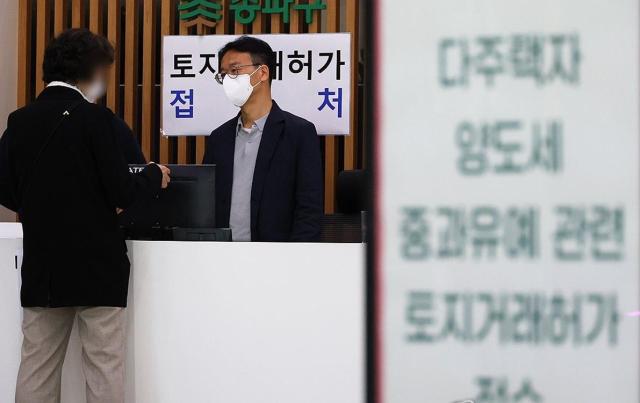
The South Korean government has ended a temporary exemption on capital gains tax for multi-homeowners, effective today. Starting now, multi-homeowners selling properties in regulated areas will face increased tax rates.
According to relevant authorities, the exemption on the capital gains tax ended on May 9, and from today, those selling homes in regulated areas will be subject to the new, higher tax rates, as reported by Yonhap News.
The capital gains tax system imposes an additional tax on multi-homeowners selling properties in regulated areas, applying a basic tax rate of 6% to 45% plus an additional rate.
Homeowners with two properties will see a 20 percentage point increase in their tax rate, while those with three or more properties will face a 30 percentage point increase. Including local income tax, the effective tax rate for those with three or more homes can reach as high as 82.5%.
The actual tax burden is expected to rise significantly.
A simulation conducted by Yonhap News showed that if a homeowner sells a property in a regulated area that was purchased six years ago for 1.5 billion won and sold for 2.5 billion won, resulting in a capital gain of 1 billion won, a single-homeowner would pay approximately 333 million won in capital gains tax after applying the long-term holding exemption.
In contrast, a multi-homeowner with two properties would not qualify for the long-term holding exemption, resulting in a capital gains tax of about 574 million won, which is approximately 241 million won (72.4%) more than a single-homeowner.
For those with three properties, the tax burden would increase to around 687 million won, more than double (106%) that of a single-homeowner.
The government had temporarily suspended the capital gains tax for multi-homeowners since May 2022 to alleviate a slowdown in real estate transactions and a decrease in available listings. However, measures have been put in place to avoid the increased tax under certain conditions.
In principle, homeowners must complete the sale process by May 9 to benefit from the exemption, but those who have applied for land transaction approval can avoid the increased tax if they complete the transaction within the designated timeframe.
Finance Minister Koo Yun-cheol stated at an economic and real estate ministerial meeting on May 8, "There are concerns about a slowdown in listings after May 9, but with loan regulations and land transaction approvals in place, speculative buying is being curtailed. We will create an environment where transactions focused on actual residence can proceed smoothly."
* This article has been translated by AI.
Copyright ⓒ Aju Press All rights reserved.