

As rising exchange rates and surging import prices exert cumulative cost pressures, concerns are growing about consumer inflation in the second half of the year. While the government has implemented measures such as reducing fuel taxes to stabilize prices in the short term, analysts warn that the accumulated burden of import costs is likely to be passed on to consumer prices starting later this year.
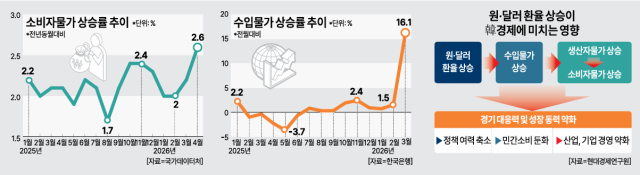
According to relevant government departments, consumer prices rose 2.6% in April compared to the same month last year, marking the highest increase since July 2024. The government noted that excluding petroleum products, the inflation rate remains stable at around 1.8%.
Market observers believe that the reduction in fuel taxes and policies aimed at stabilizing oil prices are acting as a temporary barrier against inflationary pressures. The government is working with the refining industry to absorb some of the price increases, effectively blocking the immediate impact of rising international oil prices on consumer prices.
However, the key issue is that the cost pressures accumulated at the import stage are likely to be transferred to consumer prices with a time lag. Import prices are calculated based on contract dates and typically reflect in producer and consumer prices one to three months later.
The Bank of Korea reported that the import price index surged 16.1% in March compared to the previous month, reaching 169.38, the largest increase in 28 years since January 1998 (17.8%). This spike is attributed to rising exchange rates and soaring prices of crude oil, gas, grains, and industrial raw materials. Specifically, naphtha prices rose by 46.1%, jet fuel by 67.1%, and butadiene by 70.6% within a month.
Notably, companies are still absorbing the rising costs of raw materials internally. Manufacturers are refraining from raising product prices due to concerns about economic slowdown, but prolonged deterioration in profitability could ultimately lead to higher consumer prices.
Exchange rate instability also poses a burden. Although the won-dollar exchange rate, which hovered around 1,500 won earlier last month, has recently dropped to the mid-1,400s, the monthly average exchange rate slightly increased from 1,486.64 won in March to 1,487.39 won in April.
According to the Hyundai Economic Research Institute, a 10% increase in the won-dollar exchange rate would raise consumer price inflation by approximately 0.3 percentage points in the short term and up to 0.5 percentage points after six months. The structure of the economy means that exchange rate shocks initially lead to rising import prices, which then affect consumer prices through production and distribution stages. The institute warns that the current simultaneous rise in international oil prices and exchange rates could accelerate the transfer of price shocks at the import stage, increasing upward pressure on consumer prices more than usual.
Lee Taek-geun, a researcher at the Hyundai Economic Research Institute, stated, "With rising import prices and inflation expectations, there is a significant likelihood that upward pressure on domestic prices will persist. The increase in exchange rates will sequentially elevate import prices, producer prices, and consumer prices, acting as a burden on overall domestic prices."
Choi Ji-wook, a researcher at Korea Investment & Securities, also noted, "Consumer price inflation is expected to reach around 3% as early as May or as late as June. Although core commodity prices temporarily fell in April, the rising producer prices of chemical and textile products will likely continue to be reflected, leading to sustained increases through the end of the year."
Concerns are growing that prolonged risks in the Middle East, supply chain instability, and high exchange rates may limit the effectiveness of the government's price stabilization policies. While measures such as fuel tax reductions have mitigated short-term shocks, sustained increases in international oil prices and exchange rates could escalate fiscal burdens.
Market analysts believe that trends in import prices will emerge as a key variable in the Bank of Korea's monetary policy direction and the government's overall measures for stabilizing livelihoods. They caution that if upward pressure on prices increases in the second half of the year amid concerns about economic slowdown, the government's ability to respond may be constrained.
The researcher added, "Rising consumer prices will reduce households' real purchasing power, limiting private consumption capacity, which could hinder the recovery of the domestic economy. Expanding inflationary pressures may not only narrow the scope for monetary policy aimed at supporting economic recovery but could also constrain fiscal policy options."
* This article has been translated by AI.
Copyright ⓒ Aju Press All rights reserved.