

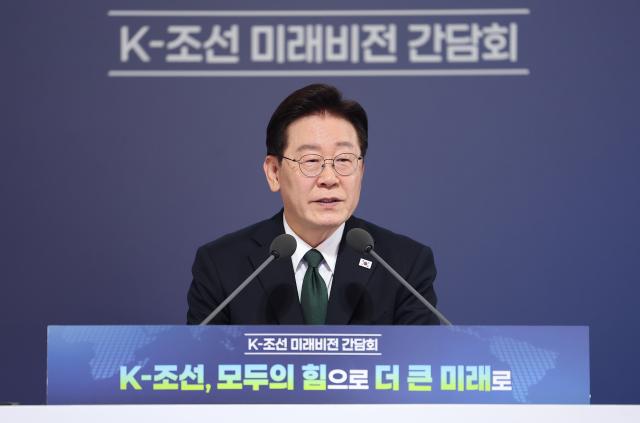
Amid intensifying global competition in the shipbuilding industry, the South Korean government plans to invest 525 billion won to secure the future of its shipbuilding sector. The initiative includes the development of the world’s first 24-hour autonomous AI shipyard project by 2030 and aims to accelerate results based on the MASGA project.
On May 13, Minister of Trade, Industry and Energy Kim Jeong-kwan announced the "K-Shipbuilding Future Vision" during a meeting led by President Lee Jae-myung in Ulsan.
The government recognizes the growing importance of the shipbuilding industry amid rapidly changing geopolitical conditions, such as conflicts in the Middle East. The United States has initiated efforts to revitalize its shipbuilding sector through the Maritime Action Plan (MAP) introduced in February, while countries like China and Japan are also expanding their shipbuilding capabilities.
After enduring a restructuring phase, South Korea's shipbuilding industry is showing signs of recovery. In the first quarter of this year, domestic orders reached 20.2 million CGT, a 1.5-fold increase compared to the same period last year. However, concerns are rising about the competitiveness of smaller shipbuilders compared to larger firms, particularly due to low-cost competition from China.
To secure a competitive edge in the global shipbuilding market, the Ministry of Trade, Industry and Energy has outlined three key strategies: strengthening the core industry, expanding markets, and fostering a cooperative ecosystem.
First, the government will activate the "Shipbuilding and Shipping Cooperative Council" to ensure domestic orders for four essential types of vessels: car carriers, energy carriers, bulk carriers, and offshore wind support vessels. This decision comes in response to the increasing reliance on foreign vessels for critical security-related transport.
Additionally, the government plans to invest up to 525 billion won over five years in seven types of vessels that represent the future of the shipbuilding industry, including LNG carriers, ammonia carriers, hydrogen carriers, liquefied CO2 carriers, electric propulsion vessels, offshore wind support vessels, and polar icebreakers. The focus will be on securing specialized cargo tank technologies and developing a unique Korean model.
The ministry is also advancing its key initiative for manufacturing AI transformation (M.AX). By 2030, it aims to invest approximately 1 trillion won in a public-private partnership to develop the world’s first fully autonomous AI shipyard, focusing on automation technologies across design, production, and operations.
Furthermore, the government is accelerating global projects by establishing a "Shipbuilding Alliance" with countries such as India, Vietnam, the Philippines, and Saudi Arabia, which have shown interest in shipbuilding cooperation with South Korea. In these countries, the focus will be on enhancing collaboration in the construction of general-purpose vessels, where South Korea lacks price competitiveness, while exporting key materials and designs.
The MASGA initiative, which provided a breakthrough in U.S.-Korea tariff negotiations, is now set to yield tangible results. Following a memorandum of understanding signed on May 9 between the Ministry of Trade, Industry and Energy and the U.S. Department of Commerce, the two countries will communicate closely through the "Korea-U.S. Shipbuilding Partnership Center" to explore ways to ensure that the revitalization of the U.S. shipbuilding industry translates into domestic work and exports.
Plans for workforce development and support for small shipbuilders are also in place. By 2030, the government aims to train 15,000 skilled professionals in the shipbuilding sector and will explore options for adjusting foreign labor. Given the challenges smaller firms face in obtaining refund guarantees (RG), the government will mobilize policy financing to provide support. Additionally, digital technology will be applied to enhance safety equipment for small shipyards and their partners, which often lack the financial capacity for safety investments.
Minister Kim Jeong-kwan emphasized, "In the current global order competition, our K-Shipbuilding must establish a solid foundation, innovative strategies, and robust readiness. As competition shifts from individual companies to ecosystems, collaboration among all stakeholders is crucial."
* This article has been translated by AI.
Copyright ⓒ Aju Press All rights reserved.