

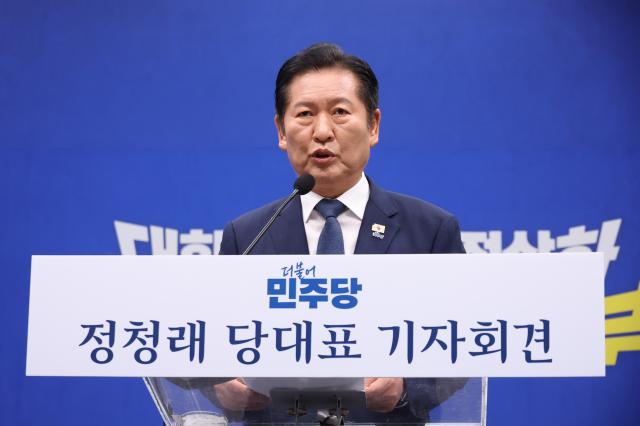
Democratic Party leader Jeong Cheong-rae holds a press conference at the National Assembly on May 13. [Photo: Yonhap News]
With just 20 days until the June 3 local elections, political experts are identifying Seoul, Busan, and Daegu as key battlegrounds. The outcome of the Seoul mayoral race is expected to have significant implications for the political landscape moving forward.
In a survey conducted by Ajou Economics on May 14, all six experts predicted an advantage for the ruling Democratic Party. However, forecasts varied, with some suggesting the party would win in 9 out of 16 regions, while others anticipated victories in up to 15 regions.
Initially, the Democratic Party was expected to achieve a decisive victory, leveraging the early support ratings for the Lee Jae-myung administration and the judgment narrative surrounding the Yoon Suk Yeol administration. However, recent analyses indicate that the local election results have become increasingly uncertain, even among experts.
Seoul, Busan, and Daegu: Experts Predict Ruling Party to Secure Majority in Local Elections
Experts unanimously agree that Seoul is the most critical battleground in this local election. Its symbolic significance as the capital, along with the perception that the Seoul mayor and Gyeonggi governor positions are stepping stones to the presidency, heightens the stakes. Additionally, Seoul is a region that the main opposition People Power Party won four years ago, making the contest for reclaiming or defending it particularly intense. The Democratic Party and the People Power Party have nominated Jeong Won-oh, the mayor of Seongdong District, and incumbent Mayor Oh Se-hoon, respectively.Eom Kyung-young, director of the Era of Spirit Research Institute, stated, "For the People Power Party, even if they fail to secure a majority of local government positions, winning in Seoul would be considered a success." Jo Sung-joo, head of the Political Development Institute, added, "The Democratic Party must reclaim Seoul to claim victory in the local elections, while the People Power Party will be evaluated positively if they maintain control in Busan, Daegu, and Gyeongnam."
The mayoral races in Daegu, featuring Democratic Party candidate Kim Boo-kyum, a former prime minister, against People Power Party candidate Choo Kyung-ho, a former economic minister, and the Busan mayoral race between former lawmaker Jeon Jae-soo (Democratic Party) and incumbent Mayor Park Hyung-jun (People Power Party) are also considered major contests.
Political analyst Park Sang-byeong remarked, "I see Seoul, Busan, and Daegu as battlegrounds where the margin of victory could be as narrow as 3 to 5 percent. A significant mistake in the final days could change the outcome." Jo Sung-joo also identified these three cities as key electoral battlegrounds.
Overall, experts predict that the Democratic Party will win in more than half of the 16 local government races. However, estimates for the number of Democratic Party winners range from 9 to 15. Park Sang-byeong predicts a decisive victory for the Democratic Party in 15 regions, while Lee Jong-hoon, another political analyst, noted that the worst-case scenario for the People Power Party could be a 15 to 1 loss.
Shin Yul, a professor at Myongji University, forecasts 12 to 13 wins for the Democratic Party, while Choi Jin, head of the Presidential Leadership Research Institute, anticipates 13 wins. Conversely, Eom Kyung-young believes that the People Power Party will successfully defend its positions in five regions in the Yeongnam area, predicting a 9 to 7 victory for the Democratic Party. Jo Sung-joo expressed caution regarding predictions of the number of winners.
Potential Variables: Special Investigation and Real Estate Issues May Not Shift Overall Trends
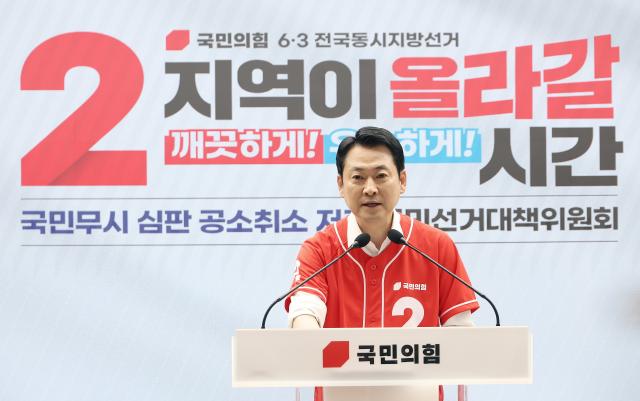
Experts predict that the special investigation law proposed by the Democratic Party and real estate issues could serve as variables in the upcoming election. The Democratic Party claims that the prosecution and law enforcement agencies manipulated investigations and prosecutions during the Yoon Suk Yeol administration, prompting them to propose a special investigation law. In response, the People Power Party argues that the special investigation aims to dismiss charges against President Lee Jae-myung and erase criminal records.
Lee Jong-hoon noted, "The People Power Party candidates are uniting around the special investigation issue rather than focusing on leader Jang Dong-hyuk, which could consolidate their support. Additionally, the impact of real estate prices following the end of the capital gains tax exemption on May 9 and potential last-minute candidate unifications could also influence voter sentiment."
Shin Yul added, "The special investigation could provoke anger among moderate voters, and issues related to long-term holding tax exemptions and property taxes may also have an impact. The government's response to the recent attack on a ship in the Strait of Hormuz could also connect to voter sentiment."
Conversely, some experts argue that the issues being raised as potential variables may not significantly alter the overall trends in voter sentiment. Choi Jin stated, "While constitutional amendments and special investigations are important topics in the political arena, the election will ultimately be decided through the narratives of 'judgment on Lee Jae-myung' and 'judgment on Yoon again (supporters of former President Yoon Suk Yeol),'" asserting that the 'judgment on Yoon' narrative will likely have a more substantial impact.
Park Sang-byeong also commented, "While issues like nomination disputes or inappropriate remarks can be significant, they are not likely to be game-changers in the election. Mistakes made just before the election can directly affect votes, but as the election approaches, the dynamics can shift frequently, so the impact on voter sentiment may not be substantial."
* This article has been translated by AI.
Copyright ⓒ Aju Press All rights reserved.