Notably, the meeting also addressed the potential impact of a general strike at Samsung Electronics, the nation's largest company, on the financial market and the real economy.
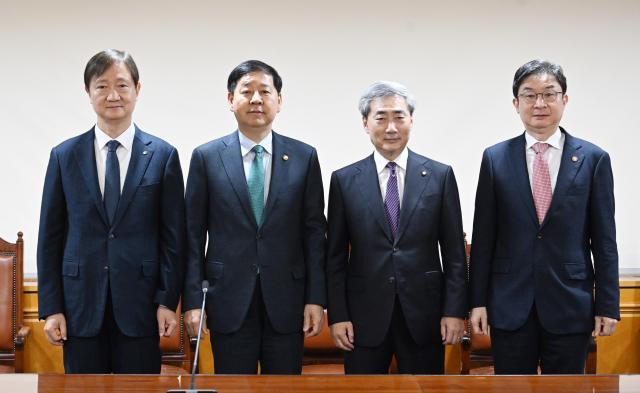
Koo Yun-cheol, Deputy Prime Minister and Minister of Economy and Finance, presided over the joint market monitoring meeting at the Korea Federation of Banks in Seoul. The meeting was attended by Bank of Korea (BOK) Governor Shin Hyun-song, Financial Services Commission Chairman Lee Eog-won, and Financial Supervisory Service Governor Lee Chan-jin.
The policy chiefs evaluated that the Korean economy continues to show higher-than-expected growth driven by robust semiconductors, with the fundamentals of the macroeconomy and financial markets remaining solid.
Still, the volatility in the won-dollar exchange rate has expanded recently due to the prolonged Middle East conflict, rising international oil prices, and uncertainty regarding the monetary policies of major economies.
Korea's gross domestic product (GDP) grew 1.7 percent in the first quarter, doubling the previous consensus of 0.9 percent. However, during the same period, the average exchange rate reached 1,469 won per dollar, weakening by more than 1 percent from 1,453.5 won in the previous quarter.
Government bond yields also rose by an average of 35.4 bps for the three-year bond and 41.1 bps for the 10-year bond.
KOSPI has grown into a globally top-tier market based on the competitiveness and earnings of key industries like semiconductors. However, they shared the consensus that efforts to improve the structure of the capital market must continue for it to solidify its position as a world-class market.
As of Thursday's close, Samsung Electronics and SK hynix accounted for 48.1 percent of the total KOSPI market capitalization, raising concerns about a "K-shaped" polarization in the securities market.
Regarding the weakness in the bond market, officials explained that the recent rise in treasury bond yields resulted from global inflation concerns, shifts in expectations for major countries' monetary policies, and strong first-quarter GDP growth.
The government evaluated that the structural demand base for the bond market is improving, supported by healthy fiscal soundness and capital inflows following the inclusion in the World Government Bond Index (WGBI).
They agreed the recent weakness of the won is excessive relative to the country's economic fundamentals. The government diagnosed that recent net selling of domestic stocks by foreign investors and an increase in offshore speculative trading have increased exchange rate volatility.
They pointed out foreign exchange liquidity remains at a good level, and institutional improvements such as the WGBI inclusion, the National Pension Service’s new framework, and the Return-to-Korea Investment Account (RIA) are contributing to the stabilization of supply and demand.
They projected that the exchange market would stabilize quickly if external uncertainties, such as the Middle East war, ease, supported by a record-high current account surplus.
The meeting also touched upon the labor conflict at Samsung Electronics. Participants expressed concern that a general strike could pose significant risks to growth, exports, and the overall financial market, emphasizing the need for a swift resolution through principled negotiations.
The management and labor union of Samsung Electronics have held negotiations since their first 2026 wage talk meeting on December 11 last year, but failed to bridge differences over the restructuring of the performance-based bonus system and the removal of the salary cap. The union secured the right to strike with a 93.1 percent approval rate in a March 18 vote and has intensified its struggle through rallies.
Following mediation by the Ministry of Employment and Labor and the National Labor Relations Commission, post-adjustment procedures were held from May 11 to 13 but failed to reach a final agreement. Immediately after the breakdown of talks, the union announced it would go on a full-scale strike for 18 days, from May 21 to June 7.
Copyright ⓒ Aju Press All rights reserved.