

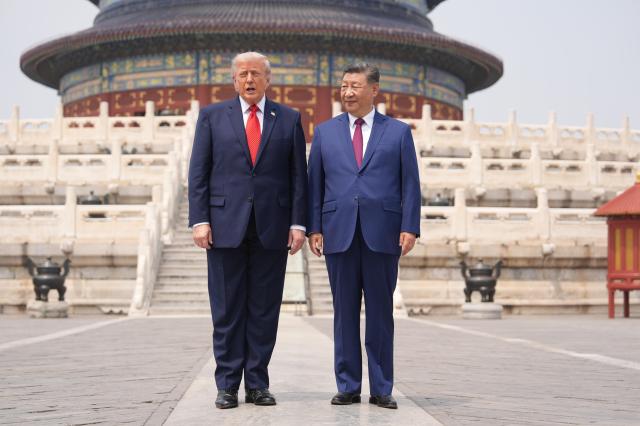
U.S. President Donald Trump and Chinese President Xi Jinping met again in Beijing on May 14. The summit between the world's top superpower and the second-largest economy is always a significant event that can influence global order, but this meeting carries particular weight and symbolism.
The backdrop includes the ongoing war in Ukraine, conflicts in the Middle East, competition for dominance in artificial intelligence (AI), the semiconductor race, issues surrounding Taiwan, control of rare earth elements, supply chain restructuring, and the dominance of the dollar versus the internationalization of the yuan.
This summit is not merely a diplomatic event between the two nations; it represents a significant exploration of who will shape the world order in the mid-21st century and how. The U.S. seeks to maintain the existing hegemonic order, while China aims to establish a new multipolar system. The world watches with both anxiety and anticipation as these two leaders navigate their relationship.
The two leaders held a summit for over two hours at the Great Hall of the People in Beijing. Following the meeting, they moved to the Temple of Heaven, a sacred site where Chinese emperors once prayed for national peace and a good harvest. A state dinner followed in the evening.
China's choice of the Temple of Heaven as one of the meeting venues is no coincidence. It symbolizes the authenticity of Chinese civilization and the concept of the Mandate of Heaven. This site was where emperors of the Ming and Qing dynasties confirmed their divine right to rule, reflecting China's self-perception as a civilization-state with a history spanning thousands of years, rather than just a modern nation-state.
The image of Trump and Xi walking together on the rainy stone paths of the Temple of Heaven was particularly symbolic. Trump described the experience as “wonderful,” but notably refrained from discussing Taiwan. This silence encapsulates the complex realities facing the U.S. today.
The U.S. remains the world's strongest nation, but it is increasingly unable to dominate all fronts as it once did. The war in Ukraine continues to drag on, and tensions between Iran and Israel are escalating in the Middle East. Domestically, the U.S. faces deepening issues of budget deficits, high interest rates, deindustrialization, and social polarization. While the U.S. pressures China in the AI and semiconductor sectors, it cannot ignore the reality that global supply chains would be destabilized without China.
China, too, faces challenges. It grapples with structural issues such as a real estate market slump, local government debt, youth unemployment, and sluggish domestic demand. However, it remains the world's largest manufacturing nation and maintains significant influence in the supply chains for rare earth elements, batteries, solar energy, and electric vehicles. Through this summit, China aimed to project itself as a “civilization-state” on par with the U.S.
The significance of the Temple of Heaven lies in this context. The U.S. is a relatively young empire, with just over 250 years of history, while China sees itself as the heir to a 5,000-year-old civilization. Xi's invitation to Trump to the Temple was not merely ceremonial; it was a strong message that China is not a fleeting state but a civilization with a long history, philosophy, and order.
The summit's key agenda items can be summarized into six main topics.
First is the issue of tariffs and trade. Trump appears to have strongly urged for increased purchases of U.S. soybeans, grains, and meat, mindful of American farmers and manufacturing workers. China, facing economic slowdown, also needs stability in the U.S. market. Ultimately, both nations are in a structure where they need each other despite their conflicts.
Second is the semiconductor and AI issue. The U.S. is restricting exports of advanced AI semiconductors and equipment to curb China's technological rise. However, China is rapidly pursuing domestic alternatives, particularly through companies like Huawei. This competition is not just about technology; it is about who will control the operational framework of future civilizations.
Third is the issue of rare earth elements and supply chains. Recently, China has utilized rare earth export controls as a strategic card, as it dominates key materials for electric vehicles, semiconductors, and defense industries. While the U.S. is pushing for supply chain diversification, completely severing dependence on China in the short term is challenging.
Fourth is the Taiwan issue. This was the most sensitive yet cautiously addressed topic during the summit. Xi reportedly warned that mishandling the Taiwan issue could increase the risk of conflict between the two nations. The U.S. cannot easily abandon Taiwan, but it also finds it difficult to confront China directly. The Taiwan Strait is likely to become one of the biggest geopolitical risk areas for the global economy moving forward.
Fifth is the Middle East issue. With the recent escalation of conflict between Iran and Israel, the U.S. finds itself needing China's role, given China's strategic relationship with Iran. China, which previously mediated reconciliation between Saudi Arabia and Iran, seeks to showcase its diplomatic influence once again.
Sixth is the issue of the dollar and yuan. Beneath the surface of this summit lies an invisible competition over the international financial order. The U.S. aims to maintain the dollar's dominance, while China seeks to expand the yuan's internationalization. If the yuan's share in energy and trade payments increases, it could shake the foundations of the global financial order.
However, the most significant takeaway from this summit is the fact that “dialogue continues amidst conflict.” The U.S. and China may seek to contain each other, but they are also in a relationship that is difficult to sustain without one another. Both nations face challenges without the other, and the global economy would struggle to cope with a complete separation.
Particularly in Northeast Asia, the situation is likely to enter a new phase following this summit. China will aim to minimize U.S. intervention in the Taiwan issue, while the U.S. will seek to strengthen security cooperation with Japan and South Korea. Japan is likely to accelerate its military buildup, and North Korea will closely monitor changes in U.S.-China relations.
Ultimately, Northeast Asia is poised to become the frontline of U.S.-China competition. While the Cold War era centered on military confrontations between the U.S. and the Soviet Union, the new Cold War is likely to involve a complex competition encompassing AI, semiconductors, energy, maritime issues, and supply chains.
So what should South Korea focus on? South Korea must look at structures rather than emotions. The U.S. is our key security ally, while China is one of our largest trading partners. We cannot survive by aligning with only one side. Therefore, South Korea should not merely align itself between the U.S. and China but should strive to create a strategic balance based on its technological, industrial, and diplomatic capabilities.
Particularly in sectors such as semiconductors, AI, shipbuilding, nuclear power, batteries, and defense, South Korea already possesses global competitiveness. The important thing is not to view itself as a “middle power” but to recognize its potential as a strategic nation amid the reconfiguration of Northeast Asian order.
The rain at the Temple of Heaven was not just a weather phenomenon. It may have signaled a transition to a new season in the global order. And on that rainy path, the U.S. and China were calculating their futures through different civilizational lenses.
* This article has been translated by AI.
Copyright ⓒ Aju Press All rights reserved.