

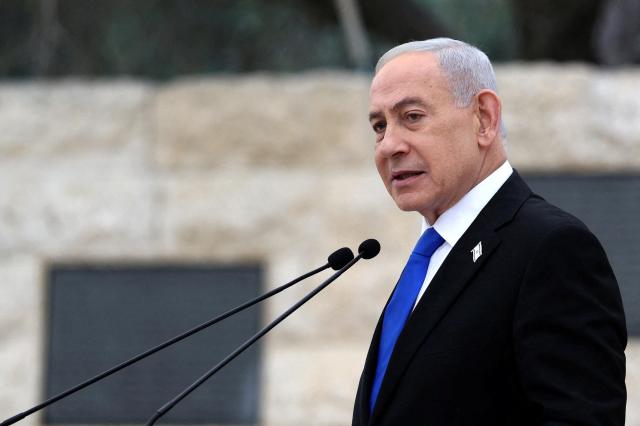
On May 14, the Israeli Prime Minister's Office announced via social media platform X (formerly Twitter) that "Prime Minister Netanyahu secretly visited the UAE during Operation Lion's Roar and met with UAE President Sheikh Mohammed bin Zayed Al Nahyan." The office described the visit as a historic breakthrough in relations between Israel and the UAE.
A source familiar with the discussions told Reuters that Netanyahu and President Sheikh Mohammed met on March 26 in the oasis city of Al Ain, near the Oman border, and that the talks lasted several hours. The source also revealed that David Barnea, head of Israel's Mossad intelligence agency, visited the UAE at least twice during the conflict to coordinate military operations.
However, the UAE has denied the claims regarding Netanyahu's visit. The UAE Ministry of Foreign Affairs issued a statement refuting reports that Netanyahu visited the country or met with an Israeli military delegation.
The UAE recognized Israel and established diplomatic relations in 2020 as part of the so-called Abraham Accords, alongside Bahrain. Since then, the two countries have expanded cooperation across various sectors, including economy, technology, and security.
The ongoing conflict with Iran has reportedly enhanced security cooperation between the UAE and Israel. The pan-Arab media outlet New Arab noted that the war has brought the two nations closer than ever.
During the conflict, the UAE faced concentrated attacks from Iran and felt it did not receive adequate support from neighboring Gulf states and traditional Arab allies, while openly welcoming Israeli assistance. Following the outbreak of war, Israel deployed Iron Dome missile defense systems and personnel to the UAE, marking the first time the Iron Dome has been stationed abroad. New Arab reported that Israel also contributed new laser defense systems and drone detection capabilities to bolster the UAE's air defense.
Alex Almeida, a security analyst at Horizon Engage, stated that the war has significantly accelerated defense relations between the two countries. He emphasized that there is a strong perception that Israel stepped up when traditional Arab allies of the UAE failed to do so, proving its value to the UAE.
However, experts caution that the close ties may not easily evolve into a public military alliance against Iran. Kyle Orton, a Middle East analyst, told New Arab that the question of whether the UAE-Israel alliance is aimed at Iran is complicated by the ongoing relationship between the UAE and Iran, particularly in the financial sector. Nicholas Heras, a senior director at the New Lines Institute, noted that the relationship with Israel is constrained by popular Arab issues, especially the Palestinian question.
UAE May Become a Target for Iran
Despite this, there are growing concerns that the UAE could become a primary target for Iran in the future. The Guardian recently reported that the UAE secretly struck Iran in early April, suggesting that if a ceasefire breaks down and tensions between the U.S. and Iran escalate, the UAE could be at risk.
Earlier, the Times of Israel cited Bloomberg, stating that the UAE conducted several military strikes against Iran in early April, targeting facilities on Iran's Lavan Island, some of which were coordinated with Israel.
Tensions in the region are also spreading to other Gulf nations. Iran has threatened retaliation against Kuwait for detaining members of its Islamic Revolutionary Guard Corps (IRGC), escalating tensions between the two countries.
Iranian Foreign Minister Abbas Araghchi claimed on X that Kuwait had illegally attacked Iranian vessels and detained four of its citizens with the apparent intent to incite discord. He warned that Iran has the right to respond, stating, "This illegal act occurred near an island used by the U.S. to launch attacks against Iran."
* This article has been translated by AI.
Copyright ⓒ Aju Press All rights reserved.