

"Can the U.S. and China overcome the 'Thucydides Trap'?" <Chinese President Xi Jinping>
"It is an honor to meet you again and be friends." <U.S. President Donald Trump>
On May 14, Chinese President Xi Jinping and U.S. President Donald Trump met at the Great Hall of the People in Beijing for the first time in six months. Their opening remarks revealed a stark contrast in tone. While Xi emphasized the importance of managing U.S.-China tensions and preventing conflict, Trump focused on praising Xi and highlighting their personal friendship.
Xi Calls for Constructive, Strategic, and Stable Relations
During the approximately 135-minute summit, both leaders agreed on the need to manage U.S.-China relations in a stable manner and to establish a framework for future cooperation.
According to China's state-run Xinhua News Agency, Xi stated, "We have agreed with President Trump to establish 'constructive, strategic, and stable relations' as a new guiding principle for our bilateral ties," adding that this would provide a strategic direction for U.S.-China relations for the next three years.
However, U.S. media noted the subtle tension reflected in the leaders' remarks. The Associated Press reported, "While President Trump continued to offer conventional praise, President Xi warned of the potential for conflict." This highlighted the differences in their positions on sensitive issues such as the Iran conflict, trade disputes, and U.S.-Taiwan relations, suggesting that the summit may have prioritized symbolism and protocol over substantive breakthroughs.
Xi remarked, "Can the U.S. and China overcome the 'Thucydides Trap,' which refers to the potential for conflict between a rising power and an established one?" He emphasized the need for both leaders to work together to prevent hegemonic competition from leading to conflict. He also stated, "The U.S. and China must maintain a partnership rather than an adversarial relationship, achieving mutual success and common prosperity while paving the right path for great power relations in the new era."
Xi has repeatedly referenced the term 'Thucydides Trap' since 2014 to describe U.S.-China relations. The AP noted that Xi's use of this expression at a time when Trump was starting his visit with an optimistic tone was noteworthy.
Additionally, Xi warned that the Taiwan issue is the most critical matter in U.S.-China relations, stating that mishandling it could lead to conflict between the two nations.
In contrast, Trump's opening remarks were filled with praise for Xi and China. He called Xi a "great leader" and said, "People may dislike me saying this, but I say it because it is true." He added, "It is a great honor to meet you again as friends," and emphasized that U.S.-China relations could reach the best level in history.
Xi Meets U.S. Business Leaders, Promises Market Openness
While economic and trade issues were significantly addressed during the summit, no immediate outcomes were announced. However, the meeting featured an unusual scene where top officials from both countries were joined by prominent American business leaders. During the summit, Xi met with over ten U.S. business leaders, including Elon Musk, CEO of Tesla; Tim Cook, CEO of Apple; and Jensen Huang, CEO of Nvidia.
Trump remarked, "This delegation is made up of great American business leaders who all respect China and look forward to expanding cooperation."
Xi also stated, "China's door will open even wider in the future," emphasizing that American companies have deeply participated in China's reform and opening process. He added, "China welcomes U.S. companies to strengthen mutually beneficial cooperation with China."
Xinhua reported that American business leaders also expressed high regard for the importance of the Chinese market and their willingness to expand business and strengthen cooperation in China.
According to the Wall Street Journal, after the summit, Musk said, "It was excellent. Many good things are happening." Jensen Huang described the meeting as "very well conducted," stating that both Xi and Trump were "incredible." Tim Cook responded to reporters' questions with a thumbs-up.
Limited Concrete Outcomes Raise Questions About Summit's Effectiveness
However, following the summit, no specific agreements were disclosed regarding the previously mentioned establishment of a U.S.-China trade committee and investment committee, the expansion of China's purchases of U.S. agricultural products, aircraft, and energy, or the extension of the trade truce and tariff reductions.
Regarding major security issues such as the Iran conflict and North Korea's nuclear program, the Chinese side only briefly stated that "the two leaders exchanged views on international and regional issues, including the situation in the Middle East, the Ukraine crisis, and the Korean Peninsula."
While the first day of the summit was filled with grand events and symbolic moments, evaluations suggest that the concrete outcomes were limited.
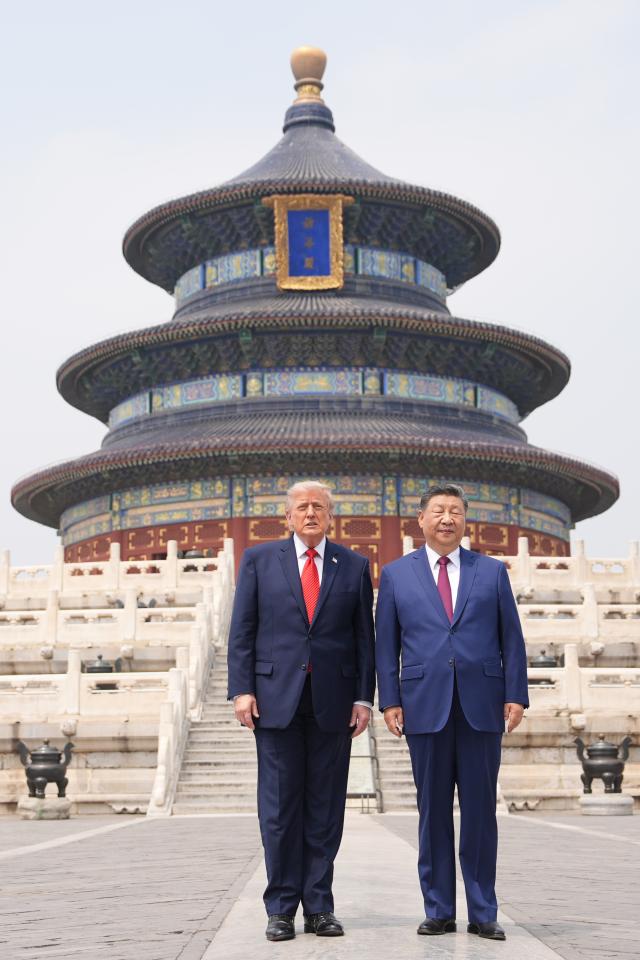
After the meeting, Trump and Xi took a walk together in Beijing's Temple of Heaven, a site where emperors once offered sacrifices to heaven. The two leaders walked for about 30 minutes starting around 1 p.m., accompanied only by interpreters.
Later that evening, a state banquet was held at the Great Hall of the People, attended by Xi, Premier Li Qiang, Zhao Leji, Chairman of the Standing Committee of the National People's Congress, Wang Huning, Chairman of the Chinese People's Political Consultative Conference, Cai Qi, a member of the Politburo Standing Committee, Li Shi, Secretary of the Central Commission for Discipline Inspection, and Ding Xuexiang, Vice Premier, among other top-ranking officials from the Chinese Communist Party.
On May 15, Xi is expected to invite Trump to Zhongnanhai, the heart of Chinese power, for tea and lunch.
* This article has been translated by AI.
Copyright ⓒ Aju Press All rights reserved.