

President Lee Jae-myung's visit to rural areas in Andong, Gyeongbuk, and Gunwi, Daegu, where he engaged directly with residents, has been positively received. On Teacher's Day, he visited his former teacher, participated in rice planting, and conversed with farmers, clearly conveying a message of 'field-centered governance.' His commitment to personally inspecting the field, moving beyond a bureaucratic reporting system, is a significant approach to governance.
However, if such actions remain one-time experiences or symbolic gestures, their policy impact will inevitably be limited. Field communication should be the starting point of policy, not the end goal. What the public expects is not 'politics of display' but 'politics that brings about change.'
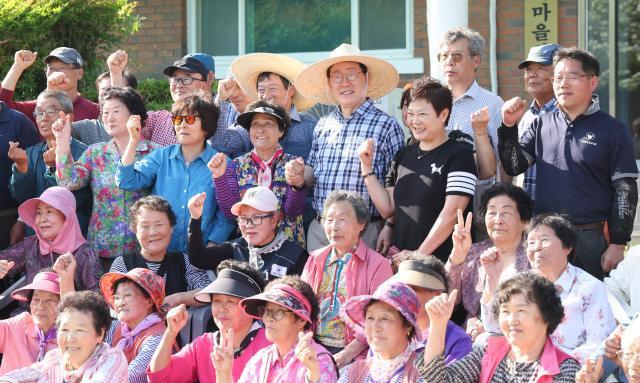
The key issues highlighted during this visit are agriculture and regional development. In the agricultural sector, the President's hands-on experience with rice planting is significant as it allows him to grasp the labor intensity faced by farmers. However, the structural problems in South Korean agriculture are already well-known, including an aging farming population, a lack of youth influx, and inefficiencies in production and distribution.
According to data from the Statistics Korea and the Ministry of Agriculture, Food and Rural Affairs, the farming population continues to decline, with the aging rate exceeding 40%. While the production base weakens, improvements in the distribution structure are slow. These issues cannot be resolved merely through field experiences or empathetic messaging. Practical policy measures such as expanding smart agriculture, reducing distribution stages, and strengthening price stabilization mechanisms must be implemented concurrently.
The issue of the Daegu-Gyeongbuk Integrated New Airport is similarly complex. This large infrastructure project, pursued by the city of Daegu and Gyeongbuk Province, faces significant challenges, including funding methods and project delays. Concerns have arisen regarding the sustainability of the project, particularly as the financial burden on local governments increases.
This matter requires a structural response at the central government level, going beyond simple field inspections. Without a review of financial support methods, project restructuring, and the establishment of a risk-sharing system, the issues of project delays and cost increases are likely to recur.
Ultimately, the key question is whether field communication translates into policy. If the opinions gathered from the field do not lead to actual institutional improvements, the significance of communication will be limited. Policies are evaluated based on concrete execution and results.
In particular, issues related to agriculture and regional development are structural challenges that cannot be resolved with short-term solutions. With population decline and industrial structural changes occurring simultaneously, many argue that existing policy frameworks are insufficient to respond effectively. Therefore, an approach that redesigns the entire system, rather than merely expanding support, is necessary.
The advantage of field visits lies in the ability to directly verify reality. However, this also increases the responsibility for policy. If issues are identified but do not lead to change, the gap between expectations and reality may widen.
The President's recent actions are significant in that they clearly establish a 'field-centered' direction. However, future evaluations of governance will be determined not by these actions themselves but by their outcomes. Concrete results such as improving agricultural income, revitalizing local economies, and mitigating project risks must follow to enhance the completeness of policies.
Politics begins with messaging but is evaluated based on results. The field has been sufficiently showcased. Now, what is needed is the speed and execution of policies. It is time to respond with results, not just images.
* This article has been translated by AI.
Copyright ⓒ Aju Press All rights reserved.