

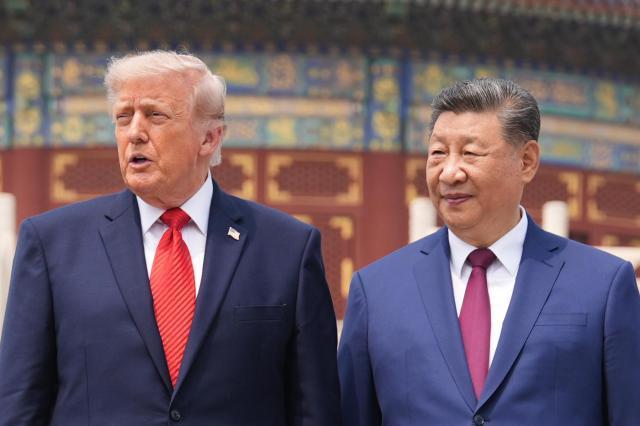
The United States and China have announced a principled consensus on reducing tariffs and easing non-tariff barriers during their recent summit. China's Ministry of Commerce stated that both countries have agreed to discuss mutual tariff reductions on a range of products and to improve market access in certain sectors, including agriculture. However, specifics regarding which items will see tariff reductions and the timeline for implementation have yet to be finalized, and negotiations are ongoing.
This announcement is significant as it suggests a potential shift in U.S.-China trade relations from a confrontational stance to a phase of partial cooperation. Previously, the two nations had engaged in a near 'economic war' characterized by high tariffs and various non-tariff barriers. A reduction in these tensions could lead to decreased uncertainty in the global trade environment.
However, this change may not necessarily benefit the South Korean economy. There is a growing concern that the 'spillover benefits' South Korea has enjoyed could weaken. During the height of U.S.-China tensions, South Korean companies often emerged as alternative suppliers due to supply chain disruptions and trade restrictions. This trend was particularly evident in key industries such as semiconductors, batteries, and chemicals.
Yet, if the U.S. and China begin to expand direct trade again, the situation could shift. As both countries procure necessary items directly from each other, South Korea's position as a supplier of intermediate goods may diminish. This is especially true if tariffs are lowered, which could increase competitive pressure on pricing.
Discussions on cooperation in agriculture and aviation should also be viewed in this context. If China increases its purchases of U.S. agricultural products and aircraft, and the U.S. improves its export conditions, market opportunities for third-country firms could diminish. This is not just an issue for specific industries but represents a broader change affecting the entire global trade structure.
The easing of non-tariff barriers is another critical variable. In trade, regulations, certifications, and market entry conditions often have a more significant impact than tariffs. If the two countries strengthen cooperation in these areas, the business environment itself could change dramatically. Industries that are heavily reliant on regulations, such as technology, food, and biotechnology, may see rapid shifts in market dynamics.
Nevertheless, it is not necessary to view this agreement solely in a negative light. A reduction in U.S.-China tensions could decrease uncertainty in global supply chains, potentially improving investment sentiment and trade conditions. This could be a positive factor for South Korea's export-dependent economy. The challenge lies in whether these changes will present opportunities or turn into crises, which will depend on the response strategies employed.
South Korea must now reassess its export strategy.
First, market diversification is essential. The country should reduce its dependence on specific nations and expand its export base to emerging markets in Southeast Asia, India, and the Middle East. Second, it needs to strengthen supply chain competitiveness. Moving away from merely supplying intermediate goods, South Korea should focus on core technologies and high-value products to remain resilient amid changes in U.S.-China relations.
Third, enhancing trade response capabilities is crucial. There is a need for timely information and negotiation power to respond swiftly to policy changes from both the U.S. and China. The government should bolster support for businesses by providing trade information and regulatory assistance, while also developing tailored strategies for different industries.
This U.S.-China agreement is not the final conclusion but part of an ongoing process. Specific details may change during future negotiations. However, the direction is clear: the relationship is shifting from one of conflict to a new phase of competition and cooperation.
South Korea's economy stands at the center of this change. Strategies that rely on past spillover benefits may no longer be effective. When the environment changes, strategies must adapt accordingly.
Now is not the time to wait but to prepare. As the U.S. and China begin to move, South Korea must also redesign its export strategy.
* This article has been translated by AI.
Copyright ⓒ Aju Press All rights reserved.