

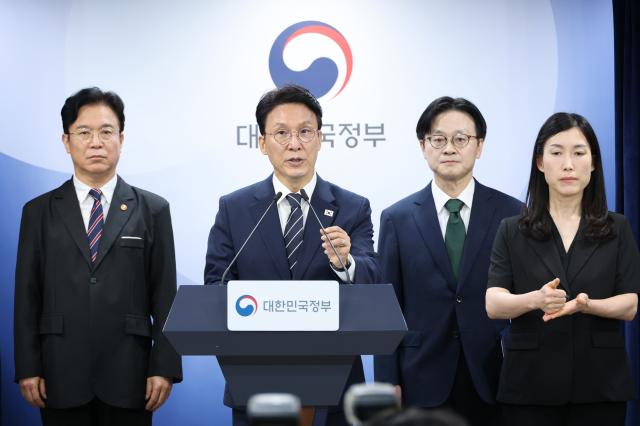
The government stated on May 17 that it is "very concerned about the significant damage to the national economy" if a strike at Samsung Electronics materializes, emphasizing that it recognizes the situation as extremely serious.
Prime Minister Kim Min-seok explained that the economic damage could reach up to 100 trillion won, warning that South Korea could lose the strategic advantage it has gained in the global AI semiconductor race to competing nations. He urged both labor and management to make efforts to find common ground.
In a public address at the Government Seoul Building, Kim requested that the Samsung Electronics union prioritize dialogue and compromise over a strike, stating, "If a situation arises where significant damage to the national economy is expected due to a strike, the government will have no choice but to consider all possible measures, including emergency mediation, to protect the economy."
The government held its second emergency ministerial meeting that morning. Kim remarked, "The government is acutely aware of the current situation," and expressed the need to convey the government's firm stance to the public, urging both sides to resolve this crisis through dialogue and compromise rather than resorting to extreme measures like a strike.
He added that negotiations on May 18 represent a crucial opportunity to prevent a strike, stressing that both labor and management should not take this moment lightly.
Samsung Electronics accounts for 22.8% of South Korea's exports (as of the first quarter of 2026) and comprises 26% of the total market capitalization, employing over 120,000 people and serving as a core pillar of the economy alongside more than 1,700 partner companies, according to Kim.
Kim warned, "If this strike occurs, the economic losses we face will be beyond imagination," noting that even a single day of halted operations at Samsung's semiconductor plants could lead to direct losses of up to 1 trillion won.
He further expressed concern that, due to the nature of semiconductor production lines, a brief stoppage could lead to months of disruption, with potential economic damages from wafer disposal during a strike estimated to reach up to 100 trillion won.
"Most concerning is that South Korea could entirely relinquish the strategic advantage it has painstakingly secured in the global AI semiconductor war to competing nations," he added.
Kim reiterated his strong request to both labor and management at Samsung Electronics, urging them to quickly establish a reasonable and mutually beneficial solution through sincere dialogue that aligns with the public's expectations.
He concluded by stating, "The government will actively support dialogue between labor and management to prevent any strike under any circumstances," and urged both sides to seek a path of cooperation for the future of South Korea's economy and businesses."
Kim emphasized, "However, if a situation arises where significant damage to the national economy is anticipated due to a strike, the government will have no choice but to consider all possible measures, including emergency mediation, to protect the economy."
Prime Minister Kim Min-seok explained that the economic damage could reach up to 100 trillion won, warning that South Korea could lose the strategic advantage it has gained in the global AI semiconductor race to competing nations. He urged both labor and management to make efforts to find common ground.
In a public address at the Government Seoul Building, Kim requested that the Samsung Electronics union prioritize dialogue and compromise over a strike, stating, "If a situation arises where significant damage to the national economy is expected due to a strike, the government will have no choice but to consider all possible measures, including emergency mediation, to protect the economy."
The government held its second emergency ministerial meeting that morning. Kim remarked, "The government is acutely aware of the current situation," and expressed the need to convey the government's firm stance to the public, urging both sides to resolve this crisis through dialogue and compromise rather than resorting to extreme measures like a strike.
He added that negotiations on May 18 represent a crucial opportunity to prevent a strike, stressing that both labor and management should not take this moment lightly.
Samsung Electronics accounts for 22.8% of South Korea's exports (as of the first quarter of 2026) and comprises 26% of the total market capitalization, employing over 120,000 people and serving as a core pillar of the economy alongside more than 1,700 partner companies, according to Kim.
Kim warned, "If this strike occurs, the economic losses we face will be beyond imagination," noting that even a single day of halted operations at Samsung's semiconductor plants could lead to direct losses of up to 1 trillion won.
He further expressed concern that, due to the nature of semiconductor production lines, a brief stoppage could lead to months of disruption, with potential economic damages from wafer disposal during a strike estimated to reach up to 100 trillion won.
"Most concerning is that South Korea could entirely relinquish the strategic advantage it has painstakingly secured in the global AI semiconductor war to competing nations," he added.
Kim reiterated his strong request to both labor and management at Samsung Electronics, urging them to quickly establish a reasonable and mutually beneficial solution through sincere dialogue that aligns with the public's expectations.
He concluded by stating, "The government will actively support dialogue between labor and management to prevent any strike under any circumstances," and urged both sides to seek a path of cooperation for the future of South Korea's economy and businesses."
Kim emphasized, "However, if a situation arises where significant damage to the national economy is anticipated due to a strike, the government will have no choice but to consider all possible measures, including emergency mediation, to protect the economy."
* This article has been translated by AI.
Copyright ⓒ Aju Press All rights reserved.