

Last week, the New York Stock Exchange reached new all-time highs again, buoyed by ongoing optimism over peace negotiations between the U.S. and Iran, as well as a surge in stocks benefiting from increased investment in artificial intelligence (AI). However, geopolitical risks remain, as President Donald Trump has withheld final approval of the agreement. In South Korea, the stock market is expected to experience volatility in early trading due to profit-taking pressures and expectations surrounding AI momentum, following a record high in the previous session. Notably, pre-market trading showed a significant rise in LG Group stocks, stimulating investor sentiment.
According to the financial investment industry, on May 29 (local time), the Dow Jones Industrial Average closed at 50,032.46, up 363.49 points (0.72%). The S&P 500 rose by 16.43 points (0.22%) to finish at 7,580.06, while the tech-heavy Nasdaq Composite gained 55.15 points (0.20%) to close at 26,972.62.
All three major indices set new records, driven by strong performances in AI-related stocks, alongside positive earnings expectations for software companies like Microsoft and Oracle. In contrast, the Russell 2000 index, which focuses on small-cap stocks, fell by 0.59%.
Market analysts attribute the stock market's rise to optimism surrounding the U.S.-Iran peace negotiations. President Trump indicated via social media that he would make a final decision regarding the peace talks and mentioned the potential lifting of the blockade in the Strait of Hormuz. As a result, international oil prices declined, with West Texas Intermediate (WTI) crude oil falling by 1.73% to $87.36 per barrel, and Brent crude dropping by 1.70% to $91.12.
However, it is important to note that the negotiations have not yet reached a final agreement. Reports over the weekend indicated that President Trump had postponed approval of the memorandum of understanding (MOU) draft and sent a revised proposal to Iran, which has also been preparing its own amendments. Analysts suggest that fluctuations in oil prices and interest rates may have a more significant impact on the market than the geopolitical situation itself.
U.S. Treasury yields fell, with the yield on the 10-year note dropping to 4.4355%, down 1.2 basis points, while the 2-year yield fell to 4.0041%, down 1.6 basis points. The dollar index also decreased by 0.08% to 98.942. However, the won-dollar exchange rate was expected to open slightly higher at 1,506.64 won in the offshore non-deliverable forward (NDF) market.
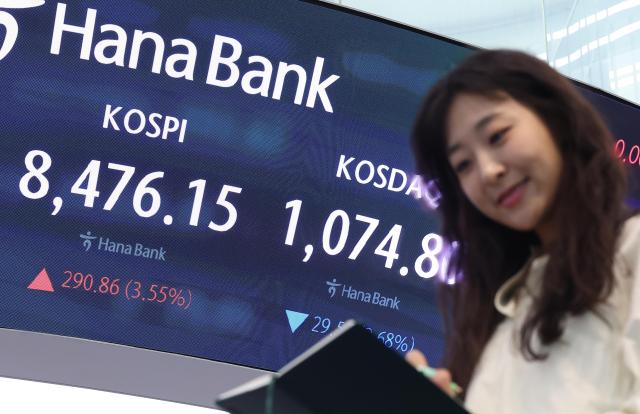
In South Korea, the stock market may be influenced by both AI-related momentum and profit-taking desires. On May 29, the KOSPI closed at 8,476.15, up 290.86 points (3.55%), marking a record high. Given the recent rapid rise, concerns about profit-taking are growing, particularly with the upcoming visit of Jensen Huang, CEO of NVIDIA, which could serve as an additional catalyst for further gains.
In pre-market trading, LG Group stocks showed strong performance, with some LG affiliates, including LG Electronics, rising over 10% between 8:00 and 8:50 a.m. This surge is attributed to expectations that CEO Huang will discuss collaboration in the AI sector with LG Group. The market is particularly focused on potential synergies in AI servers, robotics, and automotive sectors.
This week, the anticipated earnings report from Broadcom and CEO Huang's visit are also seen as key factors for domestic semiconductor and AI-related stocks. Han Ji-young, a researcher at Kiwoom Securities, noted, "Broadcom's earnings will be an event linked to the sustainability of the AI infrastructure investment cycle," adding that Huang's visit could stimulate expectations for collaboration with major groups like Samsung, SK, and LG.
However, analysts are cautious about the potential for increased volatility following the KOSPI's rapid rise. One researcher commented, "The symbolic significance of the KOSPI nearly doubling since the beginning of the year may trigger short-term profit-taking desires," and warned that fluctuations in growth stocks could increase depending on U.S. employment data, manufacturing indicators, and interest rate trends this week.
Today, the South Korean stock market may find support from the optimism surrounding AI investments from the U.S. and the strong performance of LG Group stocks in pre-market trading. Conversely, uncertainties related to U.S.-Iran negotiations, exchange rate pressures, and profit-taking from recent gains could limit upward movement. The market is expected to be influenced by the supply and demand dynamics of large-cap semiconductor and AI-related stocks, which will likely determine the KOSPI's direction.
* This article has been translated by AI.
Copyright ⓒ Aju Press All rights reserved.