


The New York Times chairman and publisher did not simply warn about artificial intelligence. He mounted a sweeping defense of journalism itself — arguing that AI companies are building trillion-dollar businesses on the back of original reporting while simultaneously threatening the economic foundations that make that reporting possible.
After Sulzberger concluded his keynote, the audience responded with sustained applause.
Moments later, BBC journalist and conference moderator Ros Atkins offered his own assessment.
"One of the most impressive addresses I've heard on journalism in the age of AI," Atkins told the audience.
The reaction reflected the mood in the room. While many discussions at WNMC 2026 focused on how publishers can adapt to AI, Sulzberger focused on a more fundamental question: what happens if the institutions that produce reliable information are weakened in the process?
'Original reporting is how you know what you know'
Speaking on the theme "AI Journalism and the Uncertain Future of the Public Square," Sulzberger made clear he was not arguing against artificial intelligence itself.
"The New York Times has a long record of embracing technology to advance the mission of independent journalism," he said.
"We had a history of respectful partnerships with tech companies."
He noted that Times journalists are already using AI tools "responsibly, ethically and with humans making the decisions," adding that "holding a powerful new technology at arm's length is a recipe for failure."
Yet the speech repeatedly returned to a central argument: AI systems ultimately depend on journalism.
"AI models are made of four basic ingredients," Sulzberger said. "Talent, compute, energy and data."
The first three, he noted, are paid for.
"In contrast, AI companies take data without consent or compensation."
What technology companies call "data," he argued, often means something far more specific: journalism, books, music, films and other copyrighted creative works.
"What might more accurately be called copyrighted content."
The heart of the speech came when Sulzberger described the unique role of journalists in creating information that does not previously exist.
"Reporters are the ones enriching the public record with previously unknown information," he said.
"That surprising fact, that telling detail, that quote from an eyewitness, that secret document."
Then came a line that many attendees later cited as the keynote's defining message.
"Original reporting is very often how you know what you know."
The value behind the headlines
To illustrate the scale of that work, Sulzberger pointed to The New York Times' own investment in journalism.
Last year alone, he said, the Times produced nearly half a million pieces of journalism — articles, photographs, videos and podcasts — at a cost of more than $2 billion.
The organization deployed journalists across all 50 U.S. states and in 155 countries.
In Ukraine alone, more than 70 journalists and support staff worked on the ground during 2025.
"This original work is valuable," Sulzberger said, "because it's been carefully written and edited, independently verified, held to the highest standards of fairness and accuracy."
Yet, he argued, many AI companies have treated that work as a free resource.
"OpenAI confessed that it would be impossible to train today's leading AI models without using copyrighted materials," he said.
And while AI companies pay engineers, purchase chips and build massive data centers, "AI companies take data without consent or compensation."

The most forceful portion of the address came when Sulzberger called on publishers to stop being passive.
"Our profession has been too quiet, too passive and too fragmented in the face of abuses by the companies leading the AI revolution," he said.
"We cannot allow AI cheerleaders to dominate the public conversation."
Nor, he said, can publishers remain silent while their content is used to create products that compete directly with them.
"We cannot sit by as this work is used to build replacement products that undermine our ability to earn the audience and revenue necessary to continue reporting the news."
The audience responded with one of the keynote's strongest rounds of applause.
A threat beyond journalism
Sulzberger argued that the stakes extend far beyond the news industry.
Creative industries worldwide employ millions of people and generate trillions of dollars in economic value annually.
The erosion of intellectual property protections, he warned, would weaken not only journalism but books, film, music and research.
But his deepest concern centered on public trust.
As AI-generated content proliferates online, distinguishing truth from fiction becomes increasingly difficult.
"It is becoming harder and harder to know where things came from and whether they are true," he said.
This dynamic, he warned, risks producing a culture in which people no longer trust anything.
"The effect isn't just that people believe untrue things."
"It's that they no longer believe true things."
According to Sulzberger, that loss of trust is already encouraging many people to disengage from public life altogether.
Four calls to action
Rather than ending with a warning, Sulzberger closed with a challenge to the industry.
His first message was blunt.
"Stand up for your rights."
"Intellectual property rights must hold if our profession is to have a path forward."
Second, he urged publishers to negotiate carefully with AI companies.
Third, he called on news organizations to push lawmakers to strengthen protections for journalism and intellectual property.
And fourth, he encouraged publishers to work together.
"The news industry's only path to counteracting that influence is by working together."
At the same time, he argued that newsrooms must embrace AI responsibly rather than reject it.
"Use AI the right way."
And perhaps most importantly, he urged publishers to build direct relationships with audiences rather than relying on platforms.
"Be a destination first."
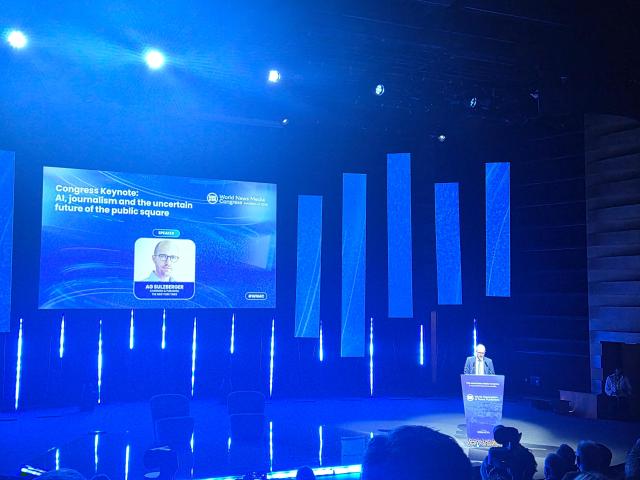
As the address drew to a close, Sulzberger returned to a phrase that echoed throughout the hall.
Decades ago, Silicon Valley popularized the idea that "information wants to be free."
But, he said, many people forgot the second half of Stewart Brand's famous observation.
"Information wants to be expensive because it's so valuable."
Then came the line that served as both a warning and a defense of journalism's future.
"Information is valuable. Journalism is valuable."
In a digital environment increasingly crowded by bots, synthetic content and misinformation, Sulzberger argued that trusted journalism may become more important, not less.
"News organizations should stand up as the reliable alternative to this mess."
As delegates rose from their seats and applauded, the message appeared to resonate.
For many in Marseille, the speech was not simply about AI.
It was about whether journalism can preserve the economic and civic foundations necessary to continue producing the original reporting on which both democracy — and increasingly AI itself — depend.
Copyright ⓒ Aju Press All rights reserved.


![[WNMC 2026] Media Leaders Discuss AI Strategies at World News Media Congress](https://image.ajunews.com/content/image/2026/06/01/20260601162718581718_278_163.jpg)