

On June 2, the Ministry of Trade, Industry and Energy announced that the Cabinet approved amendments to the High-Pressure Gas Safety Management Act. The key change allows semiconductor manufacturing equipment that meets global safety standards to be classified under specific facility criteria rather than general manufacturing facility standards.
Recently, semiconductor exports have been a driving force for the South Korean economy. Last month, semiconductor exports reached $37.16 billion, a staggering 169.4% increase compared to the previous year. This growth is attributed to robust demand and rising fixed prices for memory chips, fueled by increased capital investment from major U.S. tech companies.
There are predictions that South Korea's semiconductor-driven exports could achieve the so-called 'dream of $1 trillion.' Companies are increasing imports of essential equipment for advanced semiconductor production lines, but concerns have been raised about delays in equipment imports.
In response, the government has decided to streamline the domestic import process for EUV equipment, which is crucial for semiconductor manufacturing. This initiative aims to ensure that domestic semiconductor companies can timely acquire and quickly operate advanced manufacturing equipment, thereby maintaining the industry's competitive edge.
Previously, EUV equipment was classified as high-pressure gas manufacturing equipment due to the inclusion of high-pressure gas piping and devices. This classification required technical reviews, interim inspections, and final inspections for each equipment installation, extending the import process to about 34 days. The interim inspection process also necessitated pressure-tightness testing by overseas accredited inspection agencies, incurring inspection costs of approximately 500 million won per unit.
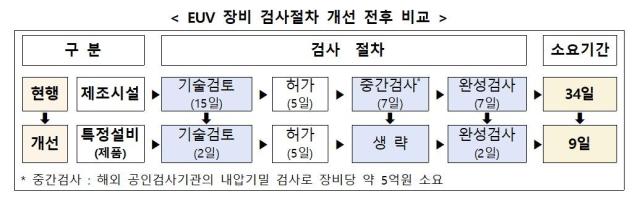
As a result, the technical review period will be reduced from 15 days to 2 days, interim inspections will be eliminated, and the final inspection period will be shortened from 7 days to 2 days. The total time required for the import process is expected to decrease from 34 days to 9 days, alleviating the financial burden associated with interim inspections.
Additionally, new tailored inspection standards will be established to facilitate the commercialization of eco-friendly 'liquid carbon dioxide cleaning equipment' that uses carbon dioxide instead of water and detergents. The safety management criteria for low-risk high-pressure gas facilities, such as commercial liquid carbon dioxide cleaning equipment and high-pressure gas storage facilities, will also be updated to reflect current realities.
The amendments are set to be enacted immediately following their announcement next week. Kim Jeong-kwan, Minister of Trade, Industry and Energy, stated, "This legislative amendment is a prime example of regulatory innovation aimed at achieving both safety assurance and enhancing the competitiveness of advanced industries. We will actively support investments in advanced industries through a rational safety management system that aligns with global standards."
* This article has been translated by AI.

Copyright ⓒ Aju Press All rights reserved.