

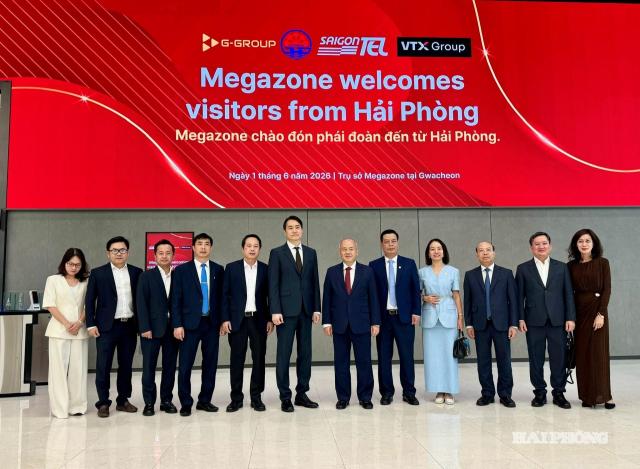
Vietnam's Hai Phong has officially launched its collaboration with South Korean companies in green and advanced industries. The city is prioritizing its green industrial zone strategy and the introduction of a carbon management system while exploring ways to expand investments and strengthen strategic partnerships with Megazone and SKC Group. Attracting high-quality foreign direct investment (FDI) focused on low-carbon transition is a key objective of this initiative.
On June 1, a delegation led by Doan Trung, Chairman of the Hai Phong People's Committee, attended a forum in Seoul titled "Developing Green Industrial Zones: Opportunities for Hai Phong," which focused on cooperation in green production value chains and investment promotion.
In his opening remarks, Chairman Trung emphasized that "Hai Phong is a key growth driver in northern Vietnam." He highlighted the establishment of three economic zones: the Dinh Vu-Cat Hai Economic Zone, the Southern Hai Phong Coastal Economic Zone, and a specialized economic zone, along with one free trade zone, covering a total area of 48,740 hectares. Additionally, he noted that 46 industrial parks have been developed over approximately 13,000 hectares, currently hosting around 1,500 FDI companies and more than 360,000 workers.
Trung explained that as global production standards become increasingly stringent, Hai Phong is proactively leveraging green development as a strategic lever to swiftly transition to a low-emission economic model. He stated, "The green industrial zone model is not just a solution to address climate change; it is a key card that will provide a decisive competitive advantage in attracting high-quality FDI."
The forum extensively discussed challenges facing South Korean manufacturing supply chains, carbon data management technologies for green industrial zones, and examples of green transitions within industrial parks. Jeong Man-ki, Chairman of the Korea Industrial Alliance Forum (KIAF), remarked, "Korean industrial parks have led the development of high-value-added industries such as automotive, electronics, and home appliances. In the context of green transition, industrial parks and companies have adapted to environmental and market standards." He expressed hope for enhanced cooperation and a stronger shift toward eco-friendly production between companies in Korea and Vietnam, particularly in Hai Phong.
Pham Van Tep, head of the Hai Phong Economic Zone Authority, stated that the city's green industrial zone strategy is based on four pillars: data transparency and emissions management, renewable energy independence, smart and circular water resource management, and specialized policy mechanisms. He also presented a vision to establish 83 industrial parks focused on advanced, green, and clean energy industries by 2030.
Hai Phong has made it a priority to implement carbon emissions management and measurement systems within its industrial parks and is ready to collaborate directly with solution providers possessing verified technologies and expertise. The city plans to pilot digital platforms and carbon data governance and aims to standardize ESG (Environmental, Social, and Governance) indices as mandatory criteria for evaluating next-generation industrial parks.
On the same day, a business meeting in Gwacheon led to more specific cooperation plans. During a meeting with Megazone, Trung emphasized Hai Phong's potential and investment incentives, actively promoting investments centered on advanced and core technologies.
He invited Megazone executives to visit Hai Phong, suggesting, "Let’s further specify our cooperation projects." Megazone, established in 1998, is a South Korean company with subsidiaries in AI, security, education, and fintech, and has been active in the Vietnamese market for over a decade.
Jang Ji-hwang, CEO of Megazone, praised Hai Phong's rapid development and technology-oriented policies, stating that the city possesses significant potential and advantages as a target market for high-tech industry development. He expressed hope for closer collaboration leading to practical and effective activities.
During discussions with SKC Group, existing investments and future cooperation expansion were addressed. Trung pointed out that SKC's production and business areas align perfectly with Hai Phong's focus on advanced technology, renewable energy, and eco-friendly development. He requested support for expanding investments and innovative activities, emphasizing the need to elevate their partnership to a strategic level. He also assured that the city would actively work to resolve challenges in ongoing projects and accelerate progress.
Kim Jong-woo, CEO of SKC, explained that SKC, a subsidiary of SK Group, continues to make strategic investments in new materials and renewable energy in Vietnam and is currently advancing related projects in the Hai Phong DEEP C industrial park. He noted, "Hai Phong's infrastructure, transportation, and investment attraction policies create very favorable conditions for enhancing competitiveness, and I hope our cooperation and investments will expand further in the future."
* This article has been translated by AI.

Copyright ⓒ Aju Press All rights reserved.