

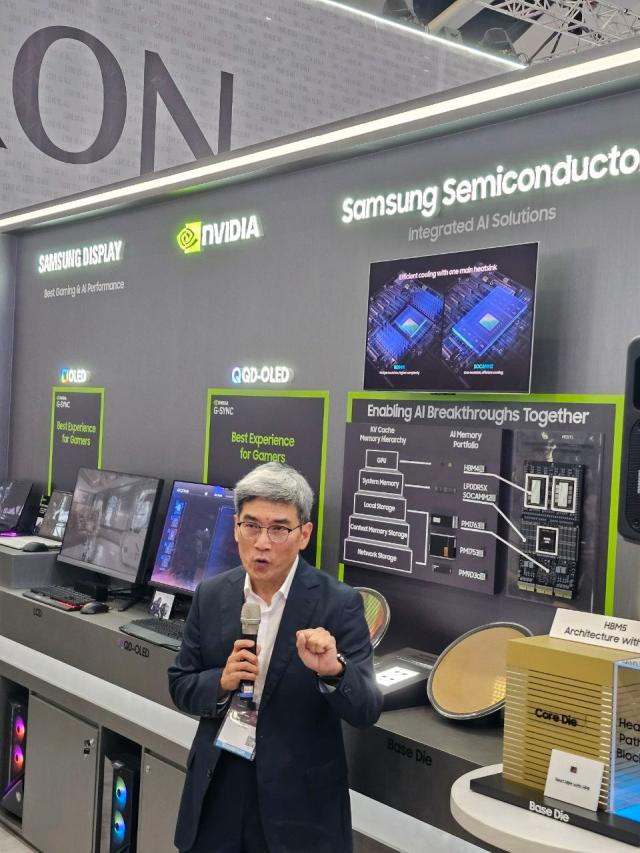
Samsung Electronics has revealed its direction for the next-generation High Bandwidth Memory (HBM) technology, HBM5, demonstrating its commitment to leading the AI memory market.
On June 2, Samsung showcased the HBM5 mockup and next-generation thermal management technology for the first time at Computex 2026 in Taipei. Song Jae-hyuk, CTO of Samsung's Device Solutions (DS) division, emphasized that the competitiveness of total solutions encompassing memory, foundry, logic, and packaging is becoming a key factor in the AI era.
The core focus of Samsung's HBM5 technology is thermal management. The company introduced a product structure utilizing Heat Path Block (HPB) technology to address heat generation issues in high-performance AI memory. HPB is designed to efficiently distribute and dissipate heat generated in the Physical Layer (PHY) area.
Song explained that HBM5's strength lies in its addition of a separate heat transfer path, which reduces thermal resistance and enhances operational stability. Samsung has already completed the implementation and verification of HPB technology in its HBM4E products, confirming both structural design and reliability as well as package stability.
Samsung also announced plans to proactively apply 2-nanometer base dies in HBM5, aiming to enhance its technological competitiveness in the next-generation HBM market by combining its memory, foundry, and packaging capabilities.
The exhibition also featured HBM4E wafers and chipsets. Samsung's HBM4E combines cutting-edge 1c DRAM core dies with its own 4-nanometer process base dies. The company completed sample shipments on May 29, achieving stable operation at 14 Gbps per pin and capable of reaching up to 16 Gbps, with a maximum bandwidth of 4 TB/s.
Samsung highlighted its memory and storage portfolio supporting NVIDIA's next-generation AI platform, 'Vera Rubin.' The exhibition showcased a Vera Rubin system equipped with Samsung products, emphasizing its lineup, including HBM4, SOCAMM2, and PM1763.
Market research firm Omdia projects that the HBM market will expand from approximately $58.9 billion in 2026 to about $198.3 billion by 2029, more than tripling in size.
Song stated, "We plan to continuously strengthen our next-generation memory technology competitiveness based on collaboration with global companies, including NVIDIA."
* This article has been translated by AI.

Copyright ⓒ Aju Press All rights reserved.