

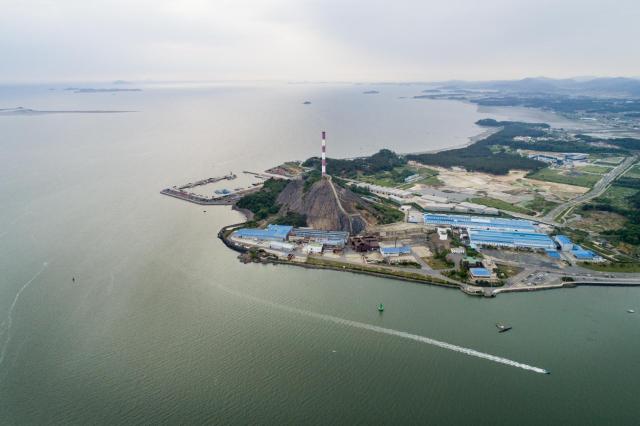
The Korean non-ferrous metal industry is set to celebrate its 90th anniversary on June 3. Since the first smelting of copper ore at the Janghang Smelter in Chungcheongnam-do in 1936, the industry has laid the groundwork for industrialization and is now gaining renewed attention due to the growth of artificial intelligence (AI) data centers, electric vehicles, and renewable energy. Once considered a traditional smokestack industry, smelting is re-emerging as a key strategic sector in the era of supply chain security.
On June 2, the 19th Non-Ferrous Metals Day celebration took place at the LS MnM Onsan Smelter in Ulsan. Jo In-rae, team leader at LS MnM, received a presidential citation for his contributions to stabilizing the supply chain by improving facilities and optimizing processes, increasing the processing volume of copper concentrate and scrap by 170%. Eighteen individuals were also recognized with government awards for their contributions to the development of the non-ferrous metal industry.
Since its inception at the Janghang Smelter on June 3, 1936, the domestic non-ferrous metal industry has supplied essential metals such as copper and zinc for key national industries, including electrical, electronics, automotive, and shipbuilding. It played a crucial role in industrialization until the 1980s, when environmental pollution issues led to its classification as a typical smokestack industry.
The Janghang Smelter, which marked the beginning of the domestic non-ferrous metal industry, ceased operations in 1989 amid environmental controversies. However, the smelting industry itself did not come to a halt. The Onsan Smelter, completed in 1979, took over as the center of domestic non-ferrous metal production. Since then, LS MnM, Korea Zinc, and Youngpoong have expanded the domestic supply chain through significant investments in facilities.
The status of the smelting industry, once viewed as a typical smokestack sector, is rising again due to the proliferation of AI data centers. The demand for transformers and circuit breakers is surging due to the need to upgrade the U.S. power grid and the expansion of AI data centers, leading to intense competition for copper. Industry experts have referred to copper as the “oil of the AI era.”
Copper, known for its high conductivity, is widely used in servers, power supply units, cooling systems, transformers, distribution panels, cables, and communication infrastructure necessary for AI computations. According to S&P Global, global copper demand is expected to reach 28 million tons by 2025 and surge to 42 million tons by 2040, a 50% increase. There are also analyses suggesting a potential annual copper supply shortage of 10 million tons during this period.
Copper prices are soaring, reaching approximately $14,490 per ton, a nearly 40% increase from the $10,360 recorded in May of last year. Compared to early this year, when prices were around $13,150 per ton, this represents about a 10% rise.
The competition for copper extends beyond pricing to issues of supply chain security. As copper is essential for key national industries such as electric vehicles, semiconductors, defense, and power grids, major countries are seeking stable sources of supply. While the U.S. does not rely heavily on imports of high-purity copper from China, it views the concentration of global smelting and refining capabilities in China as a risk. According to the United Nations Conference on Trade and Development, China accounts for about 60% of global copper ore imports and over 45% of high-purity copper production.
The U.S. has already begun treating copper imports as a national security issue. Last year, the White House directed an investigation into the impact of copper imports on U.S. national security, covering raw ore, copper concentrate, refined copper, copper alloys, scrap, and copper derivatives. As the demands of AI data centers, power grids, and defense intersect, copper is increasingly being classified as a strategic national asset rather than just a raw material.
However, South Korea is a resource-poor country with almost no copper mines. Most of its copper concentrate is imported from countries like Chile, Peru, and Indonesia for smelting. Nevertheless, South Korea has maintained a presence in the global non-ferrous metal supply chain with world-class smelting technology. Additionally, as the shift away from Chinese supply chains for critical minerals strengthens, South Korean smelting and refining technology is gaining attention. Companies like LS MnM, focused on copper, and Korea Zinc and Youngpoong, centered on zinc, lead, and rare metals, are crucial pillars of the domestic non-ferrous metal supply chain.
An LS MnM representative stated, "With the surge in copper demand driven by the expansion of AI data centers and the growth of the electric vehicle and battery markets, securing stable raw materials has become a core competitive advantage for South Korea's future growth industries. We aim to establish a long-term stable copper supply chain through diversified sourcing, investments in metal recycling, and strengthening global partnerships."
* This article has been translated by AI.
Copyright ⓒ Aju Press All rights reserved.