

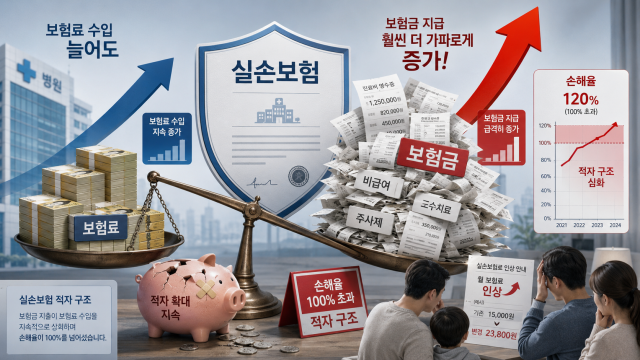
The structural losses in health insurance are deepening. While insurance companies have increased their revenue through premium hikes, payouts for certain non-covered treatments, such as physical therapy and non-reimbursed injections, have risen even faster. Concerns are growing that the loss ratio has exceeded the breakeven point again, potentially leading to higher costs for policyholders.
According to the Financial Supervisory Service on June 3, health insurance recorded a deficit of 1.87 trillion won (approximately $1.4 billion) last year, an increase of about 250 billion won from the previous year. As of the end of last year, there were 36.22 million active health insurance contracts, but the chronic deficit structure appears to be worsening.
The speed of insurance payouts has outpaced the growth in premium income. Last year, health insurance premium income reached 18 trillion won, a 10% increase from the previous year, while payouts to policyholders rose to 17 trillion won, marking an 11.4% increase. Consequently, the loss ratio for health insurance climbed to 101.0%, up 1.7 percentage points from the previous year.
The primary reason for the worsening loss ratio is attributed to non-covered treatments. Last year, payouts for non-covered services amounted to 9.7 trillion won, accounting for 57.1% of total insurance payouts. This indicates that more funds were allocated to non-covered items, which are not subject to health insurance price controls.
Notably, payouts related to musculoskeletal disorders, including physical therapy, reached 2.7 trillion won, surpassing the 2.6 trillion won allocated for severe conditions such as cancer, brain, and cardiovascular diseases. Additionally, payouts for outpatient non-covered injections, including nutritional supplements, have ballooned to around 1 trillion won. Insurance payouts related to robotic surgeries increased by 72.4% compared to the previous year, while payouts for prostate surgeries and high-intensity focused ultrasound treatments rose by 64.6% and 46.0%, respectively.
To address the leakage of insurance funds focused on non-covered treatments, financial authorities are prioritizing the establishment of fifth-generation health insurance. This new generation aims to categorize non-covered items into severe and non-severe categories, increasing the out-of-pocket expense for non-severe non-covered treatments to curb overuse.
However, market response has been lukewarm. Some major insurers, including Shinhan Life, KB Life, Mirae Asset Life, Dongyang Life, and Hana Insurance, are currently not selling fifth-generation health insurance. Even those that are selling it tend to limit their marketing efforts to exclusive agents rather than utilizing insurance brokerage channels.
The reluctance of insurers to actively sell fifth-generation health insurance stems from the perception that health insurance is structurally difficult to profit from. With payouts consistently exceeding premium income, there is little incentive to expand new sales. In fact, last year's loss ratios for each generation of health insurance were recorded at 102.3% for the first generation, 93.1% for the second, 120.3% for the third, and 115.1% for the fourth, all exceeding the breakeven point of 85%.
* This article has been translated by AI.

Copyright ⓒ Aju Press All rights reserved.