

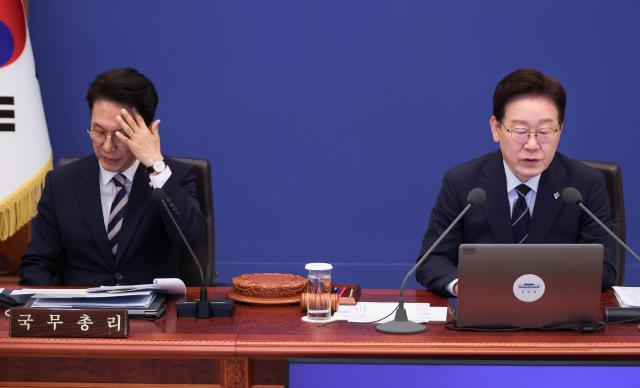
His longtime aide Justice Minister Jung Sung-ho and presidential chief of staff Kang Hoon-sik are emerging as the two possible candidates to carry out Lee's sweeping reforms and shape the future direction of his administration.
According to DP lawmakers and multiple presidential officials, Lee is expected to announce his nominee as early as Sunday, as Prime Minister Kim Min-seok is widely expected to resign to run in the DP's national convention later this summer.
In recent days, Lee has reportedly held separate private meetings with them, fueling such speculation
A DP lawmaker said Lee discussed Kim's political future including a possible party leadership bid, during their regular weekly meeting last Monday. The following day, Lee asked Jung to remain after a Cabinet meeting at Cheong Wa Dae and held a private lunch with him without other aides present.
Jung told AJP, "It was simply a gathering over a meal where we talked about old times." "There were no discussions whatsoever regarding the prime minister or a Cabinet reshuffle," he added.
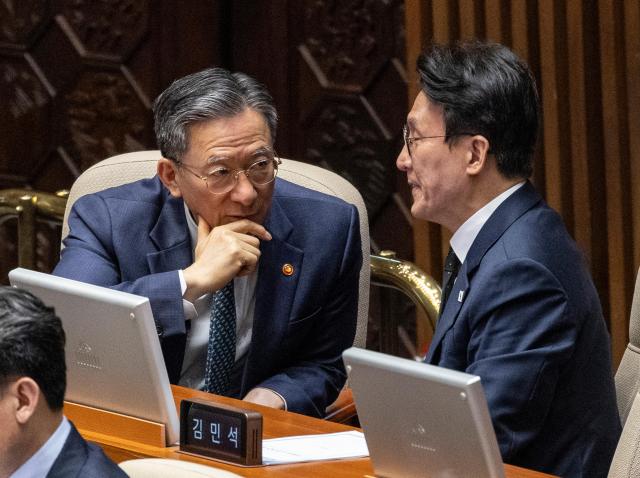
The two finalists represent sharply different political calculations for Lee.
Jung, a five-term lawmaker and longtime ally of the president, is widely viewed as a safe and stabilizing choice. Lee and Jung have known each other for roughly four decades and trained together at South Korea's Judicial Research and Training Institute.
As justice minister, Jung has overseen the Lee administration's prosecutorial reform drive and has maintained working relationships with opposition lawmakers, despite rising partisan tensions. Supporters say his moderate image and legislative experience could help Lee navigate politically sensitive reforms that would require cooperation from rival parties.
Ruling party officials say Jung is seen internally as one of the few figures capable of coordinating negotiations over Lee's so-called "six major reform tasks" including changes to pensions, labor policy, finance, education, regulation and the public sector.
Some officials also believe Jung could complete follow-up legislation tied to the administration's prosecutorial reforms before moving to the prime minister's office.
Jung has expressed reluctance about taking the job, citing health concerns and personal reasons.
A senior DP lawmaker close to Jung told AJP, "Jung says in private that he even wants to step down from his ministerial post."
"Jung says he wants to return to the National Assembly as soon as possible," he added.
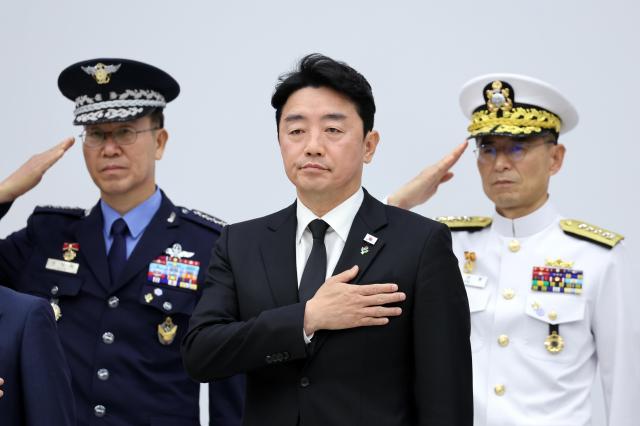
Supporters inside the ruling party argue that promoting Kang would reinforce the image of a younger Cabinet while also helping cultivate a next-generation presidential contender for the liberal camp.
That debate intensified after Wednesday's local elections, which weakened several liberal figures long viewed as potential presidential hopefuls.
Disgraced former Justice Minister Cho Kuk lost a parliamentary by-election race, while former Prime Minister Kim Boo-kyum failed in his bid for Daegu mayor and former South Gyeongsang governor Kim Kyoung-soo lost the gubernatorial race in South Gyeongsang Province.
Conservatives, by contrast, saw several high-profile victories. Seoul Mayor Oh Se-hoon secured a fifth term, and former Justice Minister Han Dong-hoon returned to politics by winning a parliamentary seat, strengthening speculation about future conservative presidential contenders.
Some ruling party officials now argue that Lee needs to elevate younger figures such as Kang to prevent the liberal bloc from falling behind in the race to cultivate future national leaders.
Still, Kang's possible nomination carries risks. South Korea has not seen a presidential chief of staff move directly into the prime minister's office in 35 years, since former Prime Minister Noh Jae-bong was appointed after serving as chief of staff to former President Roh Tae-woo.
The Prime Minister's Office has already begun preparations for a parliamentary confirmation hearing, forming a team of about 30 officials.
Under South Korean law, a prime ministerial nominee must undergo a parliamentary confirmation hearing and receive approval in a National Assembly vote before formally taking office. The current incumbent prime minister took 29 days to complete the process after his nomination.
Copyright ⓒ Aju Press All rights reserved.
