

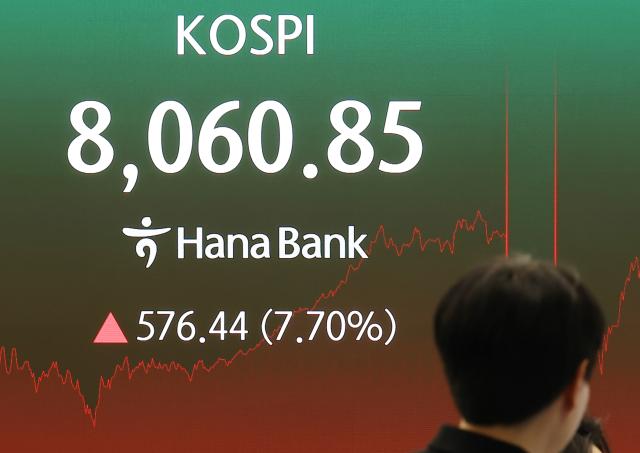
As the domestic stock market experiences a sharp decline, concerns over forced liquidations are rapidly increasing. Recent official statistics indicate that the amount of forced liquidations from margin trading has reached 305.3 billion won, and when considering the historically high margin debt levels, the actual pressure for forced liquidations in the market could be significantly greater than the statistics suggest.
According to the Korea Financial Investment Association, as of June 7-8, the actual amount of forced liquidations compared to margin trading debts was recorded at 305.3 billion won. The proportion of forced liquidations to margin debts was notably high, reaching 9.1% on June 5 and 8.2% on June 8, compared to the usual range of 1-2%.
However, this figure does not represent the total amount of forced liquidations in the market. The statistics compiled by the Korea Financial Investment Association are limited to margin trading. The scale of forced liquidations arising from margin loans, where investors borrow funds from brokerage firms to purchase stocks, is not disclosed separately.
Margin trading is a common leverage investment tool that allows investors to borrow money from brokerage firms to buy stocks. While rising stock prices can amplify profits, falling prices can quickly lead to significant losses. If the value of collateral falls below a certain level, investors must deposit additional margin, and failure to do so results in brokerage firms forcibly liquidating their holdings.
Currently, the amount of margin loans in the domestic stock market is at a historic high. As of June 8, the total balance of margin trading loans stood at 37.779 trillion won, with the securities market accounting for 28.3265 trillion won and the KOSDAQ market for 9.4639 trillion won. Additionally, the balance of collateralized securities loans was recorded at 26.5509 trillion won. Combined, the total margin debt reaches an unprecedented 64.3413 trillion won.
This indicates that if stock prices continue to decline and investors fail to meet additional margin requirements, a large volume of forced liquidations could occur. Notably, individual investors have net purchased about 17 trillion won in the KOSPI market this month, which means that if market volatility increases sharply, the value of collateral for margin traders could deteriorate rapidly.
While analysts believe that the long-term upward trend of the stock market has not been compromised, they anticipate continued high volatility in the short term.
Han Ji-young, a researcher at Kiwoom Securities, stated, "Given the significant shock from the two-day plunge, there will be a struggle between investors looking to reduce their positions and those seeking new entry opportunities during this rebound. There is a possibility that high volatility will persist for the remainder of the week."
She added, "As we process the U.S. Consumer Price Index (CPI) announcement for May, Oracle's earnings, and the SpaceX listing event, the KOSPI may temporarily dip below the 7,400 level, but this is likely to be a short-term undershooting."
* This article has been translated by AI.
Copyright ⓒ Aju Press All rights reserved.