The Treasury said it would raise individual buybacks in the 10-to-20-year and 20-to-30-year sectors to at least $4 billion from $2 billion, with the higher limits applying from Sept. 9 through Nov. 4.
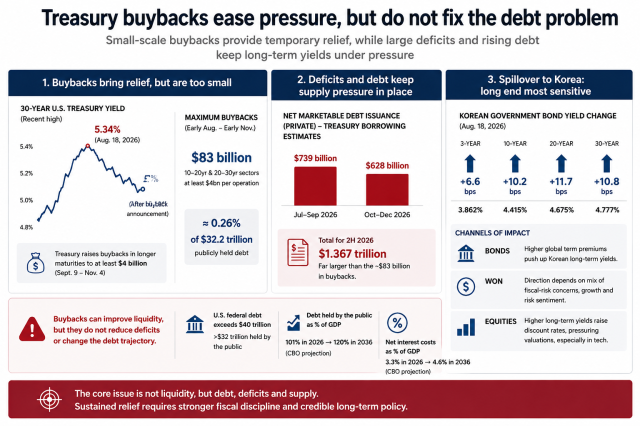
The response was immediate, with the 30-year Treasury yield retreating to around 5.18 percent after touching 5.34 percent, its highest level since 2007.
But the program remains small relative to the market it is attempting to stabilize, with maximum repurchases between early August and early November totaling about $83 billion against more than $32 trillion of publicly held U.S. debt.
The gap becomes wider when measured against Washington's financing needs, as the Treasury expects to borrow $739 billion in privately held net marketable debt in the July-September quarter and another $628 billion in the final three months of the year.
Buybacks can improve liquidity in older securities and redistribute duration across the yield curve, but they do not reduce the deficit that keeps generating new Treasury supply.
That makes the expanded program a tool for easing market stress rather than a fundamental solution to the long-bond selloff.
Citi's Dan Gottlander said the expanded operations could have a significant effect on longer maturities but noted that the program "does not change deficits," leaving the government to finance its borrowing elsewhere along the curve.
Washington has also taken the unusual step of joining Japan in yen-buying intervention, another measure that can relieve immediate market pressure without changing the monetary, fiscal and supply forces driving currencies and long-term bond yields.
The broader challenge is that the selloff is not confined to the United States, with Japanese long-term yields approaching multi-decade highs while borrowing costs in Germany and France have also risen sharply, increasing competition for global fixed-income capital.
The New York Fed's estimate of the U.S. 10-year term premium has climbed to around 80 basis points, close to a 12-year high, suggesting that investors are demanding greater compensation for holding long-term debt beyond expectations for the Federal Reserve's policy rate.
Foreign demand has also become less certain, with Treasury holdings by Japan, Britain and China declining in June as higher yields elsewhere and changing portfolio incentives make it less certain that overseas buyers will absorb new U.S. issuance at existing prices.
The pressure comes as total federal debt has crossed $40 trillion, including more than $32 trillion held by the public, while the Congressional Budget Office projects that publicly held debt will rise from around 101 percent of gross domestic product this year to 120 percent by 2036.
For South Korea, the clearest transmission channel is the bond market because higher global term premiums can push up domestic long-term borrowing costs even without a change in the Bank of Korea's policy rate.
That sensitivity was evident on Aug. 18, when the three-year Korean government bond yield rose 6.6 basis points to 3.862 percent while the 10-year jumped 10.2 basis points to 4.415 percent, the 20-year gained 11.7 basis points to 4.675 percent and the 30-year rose 10.8 basis points to 4.777 percent.
The larger moves at the long end showed how a U.S. duration and fiscal shock can be transmitted into Korean borrowing costs independently of expectations for the BOK, potentially tightening financing conditions even if policymakers in Seoul do not raise the base rate further.
The currency channel is less straightforward because higher U.S. yields driven by stronger growth or Fed tightening typically support the dollar, while yields rising because investors demand a larger fiscal-risk premium can coincide with dollar weakness.
A more severe Treasury-market disruption could produce the opposite response, however, if global risk aversion triggers demand for dollar liquidity and puts renewed downward pressure on the won.
Equities face a similar transmission channel through discount rates, as persistently higher long-term yields reduce the present value of future earnings and put particular pressure on technology and other growth stocks.
South Korea's chip-heavy equity market is therefore exposed to renewed increases in global long-term rates even when domestic earnings remain strong, adding another channel through which U.S. fiscal conditions can influence Korean asset prices.
Washington can buy time with larger Treasury buybacks and currency intervention, but it cannot buy back the deficit, and if the center of gravity in long-term yields continues shifting from Fed policy toward fiscal supply and term premiums, Korea may increasingly find itself importing U.S. fiscal risk as well as U.S. monetary policy.
AJP Takeaways
• The U.S. Treasury doubled longer-dated bond buybacks to at least $4 billion per operation, but the program remains small compared with Washington's borrowing needs and more than $32 trillion of publicly held debt.
• U.S. buybacks can ease liquidity stress and temporarily lower yields, but they do not reduce the fiscal deficit that keeps generating new Treasury supply.
• South Korea's bond market showed direct spillovers on Aug. 18 as 10- to 30-year government yields rose more sharply than the three-year yield during the global long-bond selloff.
• South Korean markets remain exposed to U.S. fiscal risk through long-term borrowing costs, the won and equity valuations even without another change in the BOK's policy rate.

Copyright ⓒ Aju Press All rights reserved.