Whether that strength can last is less certain. Their divergence from U.S. markets rests partly on short-covering in bonds and expectations of corporate dollar conversions supporting the won — forces that could prove temporary.
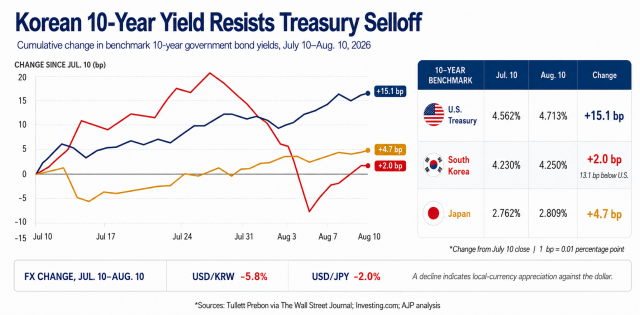
The U.S. 10-year Treasury yield rose from 4.562 percent on July 10 to 4.713 percent on Aug. 10, an increase of 15.1 basis points. Over the same period, the equivalent yield rose 4.7 basis points in Japan and just 2.0 basis points in Korea.
The currency move was even more striking.
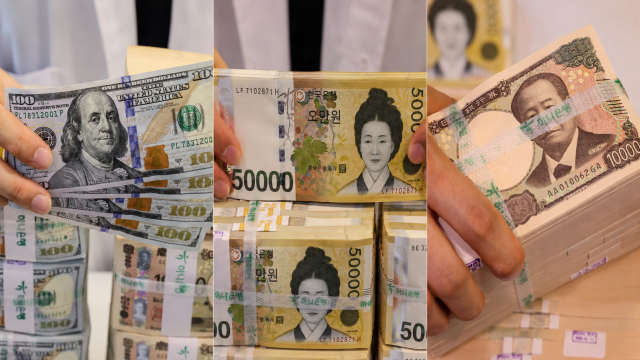
USD/KRW fell 5.8 percent over the period, while USD/JPY declined 2.0 percent, meaning the won appreciated nearly three times as much against the dollar as the yen did.
That marks a sharp reversal from the first half, when the greenback gained 7.7 percent against the won, more than double its 3.5 percent advance against the yen.
The rise in U.S. Treasury yields reflected mounting concerns over inflation, oil prices, the fiscal deficit and debt supply. The 30-year Treasury yield climbed to around 5.25 percent on Aug. 10, near its highest level in 19 years.
Korea did not escape those pressures. But a sharp reversal in domestic positioning prevented them from feeding fully into Korean government bond yields.
After the Bank of Korea raised its base rate from 2.50 percent to 2.75 percent on July 16, foreign investors initially positioned for further tightening.
They subsequently reversed course, making net purchases of 137,410 three-year bond futures contracts over 12 consecutive sessions from July 23 through Aug. 7.
The three-year Korean government bond yield fell from 3.959 percent to 3.669 percent during that period even as U.S. Treasury yields headed higher.
The move points largely to short-covering rather than a fresh wave of long-term bond buying, leaving the market vulnerable once investors finish unwinding positions built around expectations of additional BOK tightening.
Korea’s phased inclusion in the FTSE World Government Bond Index, which began in April, has provided a more durable source of demand and helped cushion the bond market.
BOK research also indicates that much of the overseas passive money tracking bond indexes is currency-hedged, weakening the direct link between WGBI inflows and won appreciation.
The currency has instead drawn support from Korea’s swelling export income.
The country posted a record $49.73 billion current-account surplus in June, lifting the first-half surplus to $191 billion.
Exporter dollar sales have been reinforced by expectations that part of the $26.5 billion raised through SK hynix’s U.S. American depositary receipt offering will eventually be converted into won to finance investment at home.
No specific SK hynix conversion has been confirmed. But expectations of additional dollar supply were strong enough to help offset $4.6 billion of Korean retail purchases of U.S. stocks in July and 8.8 trillion won of foreign selling in Korean equities.
The mystery is that money has been flowing out through overseas stock purchases and foreign equity selling, yet the won has strengthened sharply.
The next complication comes from the BOK.
Senior Deputy Governor Ryoo Sang-dai said Tuesday that another rate increase was likely unless an extraordinary shock intervened, arguing that stronger domestic demand would generate gradual but persistent inflation pressure.
The remarks were explicitly his personal view. Ryoo is also due to retire on Aug. 20, before the BOK’s Aug. 27 policy meeting, meaning he will not vote on the next decision and limiting the remarks' direct policy weight.
Markets nevertheless took notice without treating them as a new shock.
The three-year Korean government bond yield closed 3.6 basis points higher at 3.812 percent but remained below its intraday high of 3.831 percent, suggesting Ryoo largely confirmed expectations already embedded in the market.
Pressure was greater at the long end.
The 10-year yield gained 6.2 basis points to close near its session high at 4.303 percent as higher U.S. yields and oil prices exerted greater pressure, steepening the Korean yield curve.
The won strengthened as far as 1,412.24 per dollar before giving back some gains to trade around 1,417 late Tuesday.
For Korea’s bond and currency markets, the question is now whether a move born partly from positioning and expectations can turn into something more durable.
U.S. inflation and oil prices will test the global side of that divergence, while the BOK’s Aug. 27 meeting will test the domestic side.
___________________________________________________________________________________
AJP Takeaways
• South Korea’s market momentum shifted from KOSPI and semiconductor stocks in the first half to the Korean won and government bonds in early second-half trading.
• From July 10 through Aug. 10, Korea’s 10-year government bond yield rose just 2.0 basis points, compared with increases of 15.1 basis points in U.S. Treasuries and 4.7 basis points in Japan, while the won appreciated nearly three times as much as the yen.
• Korean government bonds were supported by foreign short-covering in three-year futures and phased FTSE World Government Bond Index inclusion, although weaker July bond inflows suggest that support may fade as positions normalize.
• The won drew strength from Korea’s record $49.73 billion June current-account surplus, exporter dollar sales and expected conversions of SK hynix’s $26.5 billion ADR proceeds, rather than mainly from currency-hedged WGBI inflows.
• Ryoo Sang-dai reinforced expectations of another BOK rate increase, but his Aug. 20 retirement and the limited three-year yield reaction reduced the remarks’ direct market impact, leaving U.S. inflation, oil prices and the Aug. 27 BOK meeting as the next tests.

Copyright ⓒ Aju Press All rights reserved.