

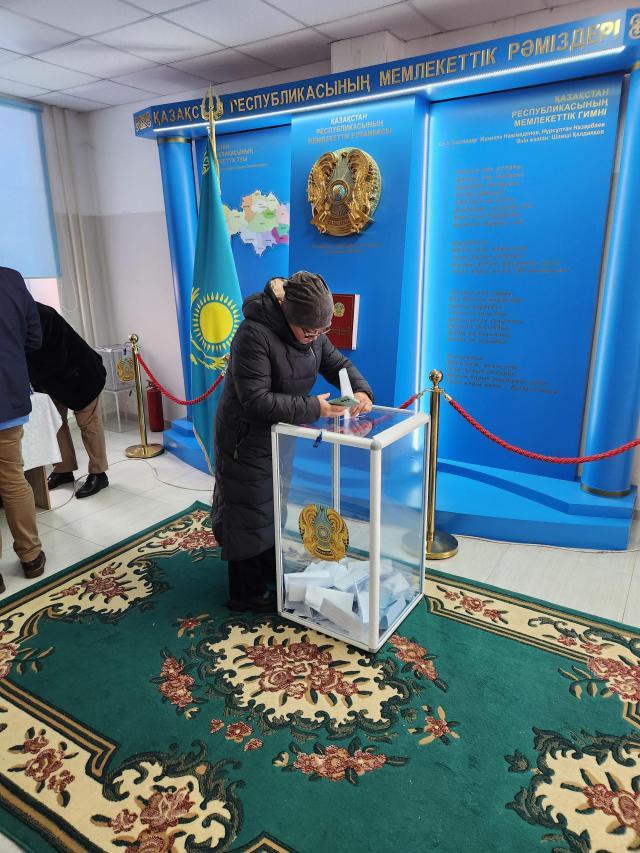
SEOUL, August 20 (AJP) - Voters in Kazakhstan choose all 145 seats of the Kurultai on Sunday, filling the single-chamber legislature that replaced the country's two houses of parliament and completing an institutional change written into a constitution that took effect seven weeks ago.
The Central Election Commission has registered 12,605,788 voters and 545 candidates across seven party lists. Every seat is contested in one nationwide district under closed-list proportional representation, with a threshold of 5 percent of valid votes. Deputies serve five years.
This is the first national vote under the new constitutional order, and the first in which every seat in the legislature is filled by election. The old Parliament paired an elected lower house, the Mazhilis, with a Senate of 50 members, 10 of them named by the president. Neither chamber exists now, and the Kurultai has no appointed seats.
The new body passes legislation, approves the national budget, oversees the executive and may consider confidence in the government. Its consent is required for presidential nominees to the newly created post of Vice President, to the office of Prime Minister, and to senior positions including the Constitutional Court, the Central Election Commission (CEC) and the Supreme Audit Chamber.
The same constitution creates a second new institution alongside it. The Halyk Kenesi, or People's Council, is designated the highest consultative body, and its members are appointed by the president rather than elected. Its 126 seats are split evenly three ways, among ethnocultural associations, major public organizations, and local assemblies and regional public councils. It meets in full session at least once a year, with a standing presidium known as the Toralka working between sessions.
Its powers reach into the legislative process. The council may submit draft laws to the Kurultai and may initiate national referendums, which places an unelected body alongside the elected one. It absorbs two institutions now being retired, the Assembly of the People of Kazakhstan, created in 1995 to represent the country's ethnic groups, and the National Kurultai. Parliament passed the first reading of the constitutional law establishing the council in May, and it has not been seated.
Ballots list the seven parties in an order drawn by lot, followed by an option to vote against all of them. Voters mark a single choice and cannot pick individual candidates, because seats won by a party go to the names on its registered list in the order the party set. Only registered parties may nominate, and self-nomination is not allowed. If only one party clears the threshold, the party with the next-highest total also enters the chamber.
The name reaches back to the assemblies of the Kazakh Khanate, where khans were raised to power and questions of war, migration and succession were settled collectively by the leading figures of the tribes rather than by a single ruler. The word is Turkic in origin and means gathering or council, and versions of it survive in the names of legislatures and public assemblies from Bashkortostan to Kyrgyzstan.
President Kassym-Jomart Tokayev proposed applying it to the new parliament in January, at a session of the National Kurultai in Kyzylorda, arguing that the historical weight of the term was worth carrying into a modern institution. That body, a consultative forum he established in 2022 for officials, academics and public figures, shares the name but not the function. The Kyzylorda session was its last.
Tokayev first raised the shift to a single chamber in his address to the nation in September 2025, when he proposed putting it to a referendum in 2027 and said the public discussion would take at least a year. He appointed a working group on parliamentary reform in October under State Counselor Erlan Karin. In January he told the Kyzylorda session that the changes had grown extensive enough to amount to a new constitution rather than an amendment, and a Constitutional Commission chaired by Constitutional Court head Elvira Azimova took over the drafting. The text was published Feb. 12 and went to a nationwide referendum on March 15, more than a year ahead of the original date. The CEC put support at 87.15 percent on turnout of 73.12 percent. The constitution entered into force July 1, ending the mandate of the old Parliament, and Tokayev signed the decree calling the election the same day.
Adilet holds first place on the ballot and the largest list, with 186 candidates. The party held its founding congress May 7 and was registered by the Justice Ministry on June 1 under Aibek Dadebay, who had stepped down as head of the presidential executive office. Amanat, which took 53.9 percent in 2023 and held the largest bloc in the Mazhilis, voted at its congress June 12 to join Adilet, and Adilet delegates approved the accession two days later.
The remaining six lists carry between 33 and 75 candidates. Auyl, an agrarian party, finished second in 2023 with 10.9 percent. Respublica, associated with business, took 8.59 percent and Ak Zhol, which campaigns on market liberalization and stronger parliamentary oversight, took 8.41 percent. The People's Party of Kazakhstan won 6.8 percent and the Nationwide Social Democratic Party 5.2 percent. Baitaq, an environmental party, fell short at 2.3 percent. Adilet did not contest that election, so the two ballots cannot be compared party for party.
Of the 545 candidates, 172 are women and 373 are men, with an average age of 45.4 years, according to the CEC. The field includes 74 candidates under 35 and 19 with disabilities. Each party had to reserve at least 30 percent of its list for women, young people and persons with disabilities and must apply the same proportion when distributing the seats it wins. All seven met the list requirement.
More than 10,400 polling stations will open across the country, staffed by roughly 71,000 commission members. Another 79 stations will operate at Kazakh diplomatic missions in 61 countries. Voting is in person only, with no postal or online option, and the CEC is printing 12,731,847 ballots in Kazakh and Russian, including a statutory 1 percent reserve.
Campaigning began July 23 and ends at midnight on Aug. 21, with Aug. 22 set aside as a day of silence. Publication of opinion polls, forecasts and other election research has been barred since Aug. 18.
The CEC had accredited 781 foreign and international observers as of Aug. 17. The Organization for Security and Co-operation in Europe has deployed 39 long-term and 208 short-term monitors through its Office for Democratic Institutions and Human Rights, which is expected to release initial findings the day after the vote and a full report later.
Once results are published, the president has 30 days to convene the first session, and the government surrenders its powers before the incoming chamber. Within two months of that sitting, and only with the Kurultai's consent, Tokayev must appoint a Vice President along with the leadership of the Constitutional Court, the CEC, and the Supreme Audit Chamber.
Copyright ⓒ Aju Press All rights reserved.
