

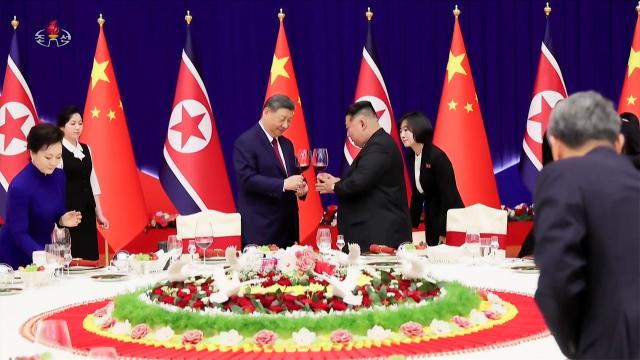
Chinese President Xi Jinping returned to Beijing on the afternoon of June 9 after completing a state visit to North Korea, his first in seven years. During the two-day visit, Xi reaffirmed the traditional friendship between China and North Korea with Kim Jong Un. Notably, while their 2019 meeting focused on denuclearization and peace on the Korean Peninsula, this visit emphasized strategic cooperation and socialist solidarity between the two nations.
According to China's state-run Xinhua News Agency, on the second day of his visit, Xi toured the China-North Korea Friendship Tower and the Central Party School of the Workers' Party of Korea with Kim.
Established in 1959, the Friendship Tower commemorates the Chinese People's Volunteer Army soldiers who fought in the Korean War and symbolizes the alliance between China and North Korea. Xi laid a wreath inscribed with the phrase "The martyrs of the Chinese People's Volunteer Army will be immortal" and paid his respects.
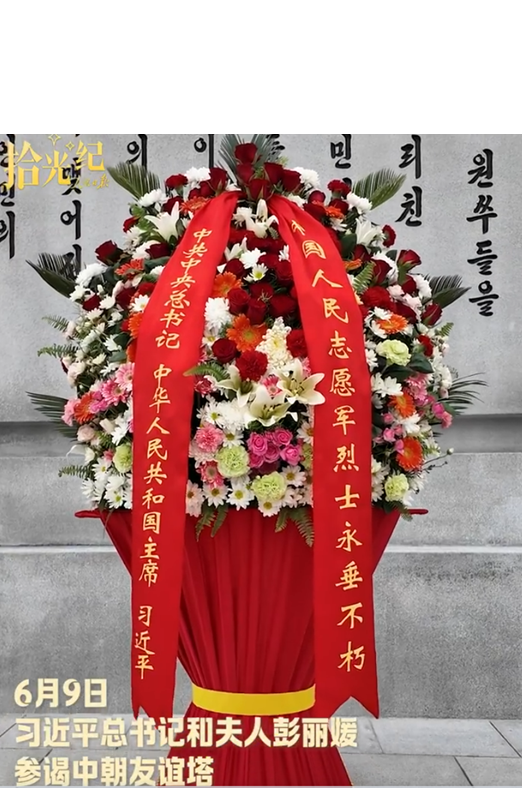
Xinhua reported that Xi and Kim shared a mutual understanding that the history of their countries fighting together in the 1950s is a lasting collective memory. They agreed to inherit and develop the spirit of the Korean War and to pass down the traditional friendship between China and North Korea to future generations. China refers to the Korean War as the "War to Resist U.S. Aggression and Aid Korea."
The two leaders then visited the Central Party School, where they observed a class and participated in a commemorative tree-planting ceremony. A stone marker inscribed with "The friendship between China and North Korea is everlasting" was placed in front of the fir tree they planted together. Xinhua noted that the evergreen fir symbolizes the unchanging friendship between the two nations.
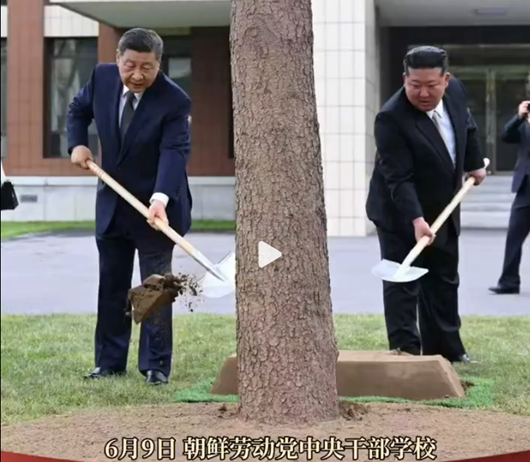
The tribute at the Friendship Tower and the tree-planting ceremony symbolize the commitment of both leaders to honor the history of their alliance formed during the Korean War and to pass it on to future generations.
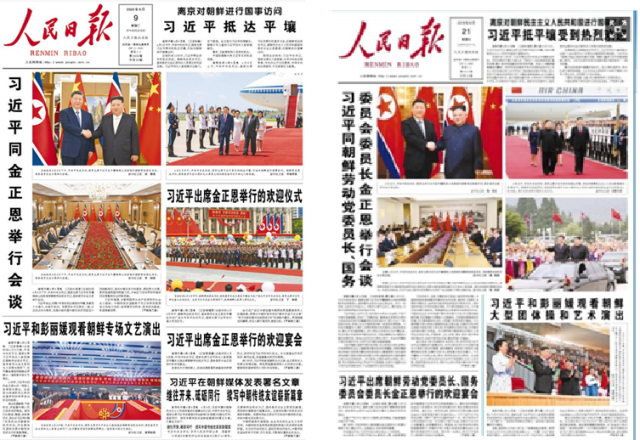
Chinese state media extensively covered Xi's visit, promoting a friendly atmosphere between China and North Korea. The People's Daily, the official newspaper of the Communist Party of China, filled its front pages with articles and photos related to the visit, emphasizing the significance of expanding strategic cooperation between the two countries.
Yang Shiyu, a researcher at the China Institute of International Studies, predicted that the Communist Parties of China and North Korea will enhance exchanges and cooperation across various fields to promote joint socialist development. Dong Xiangrong, a researcher at the Chinese Academy of Social Sciences, also noted that expanding practical cooperation between the two countries is a crucial direction for deepening China-North Korea relations.
This visit comes amid significant changes in the international landscape compared to Xi's first visit in 2019. At that time, North Korea was in a state of international isolation following the collapse of the Hanoi summit between North Korea and the United States, and the two leaders focused on denuclearization and peace as key agenda items. However, with North Korea recently expanding military and economic cooperation with Russia, the current summit has shifted the focus from nuclear issues to strategic cooperation between China and North Korea.
Indeed, a commentary published in the Rodong Sinmun just before Xi's visit reflects this shift. While the 2019 commentary emphasized "peace on the Korean Peninsula" and mentioned "Korean Peninsula" six times, the recent piece focused on "opposition to hegemony" and "strategic cooperation," with no mention of the Korean Peninsula. The Hong Kong Ming Pao noted that this clearly indicates that the nuclear issue is no longer a central topic in China-North Korea relations.
As China refrains from emphasizing the nuclear issue, there are concerns that it may be tacitly endorsing North Korea's nuclear armament. The Hong Kong South China Morning Post cited experts who suggest that the restored China-North Korea relationship could indirectly promote North Korea's military buildup.
* This article has been translated by AI.
Copyright ⓒ Aju Press All rights reserved.