

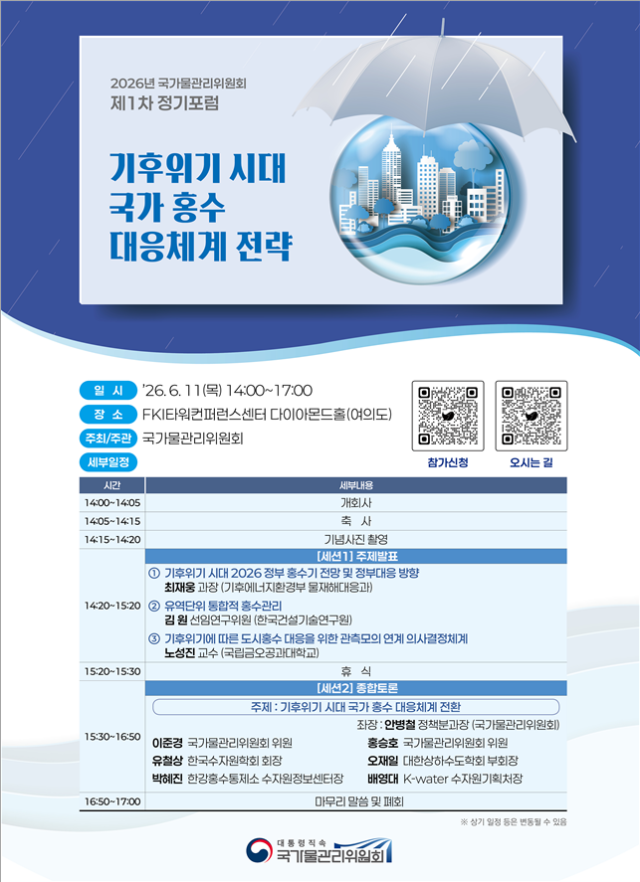
The National Water Management Committee, under the direct supervision of the President, announced on June 10 that it will hold its first regular discussion forum of the year on June 11 at the FKI Tower Conference Center in Yeongdeungpo, Seoul, focusing on "National Flood Response Strategies in the Era of Climate Crisis."
Recent extreme rainfall events, which have exceeded historical hourly precipitation records, have heightened flood risks. Previously, river overflow in specific areas was the primary concern, but now, the simultaneous occurrence of urban flooding and overflow from mountainous regions and tributaries has emerged as a complex disaster.
Particularly, repeated flood damage in relatively vulnerable areas such as local rivers and tributaries has raised calls for a reassessment of the existing flood control policies that focus mainly on national rivers.
The upcoming forum will bring together government officials, academics, researchers, and water management specialists to discuss the direction for transitioning to a national flood management system suitable for the climate crisis.
During the presentations, Choi Jae-woong, head of the Water Disaster Response Division at the Ministry of Climate, Energy, and Environment, will outline this year's flood season outlook and the government's response strategy. Following that, Kim Won, a senior researcher at the Korea Institute of Civil Engineering and Building Technology, will present integrated flood management plans at the watershed level, while Professor Noh Seong-jin from the National Kumi University of Technology will discuss urban flood prediction and decision-making systems in response to climate change.
Additionally, the forum is expected to address the "Flood Sharing System," which has recently been proposed as a new alternative in water management. This system aims to manage floodwaters by connecting various facilities within a watershed, such as dams, reservoirs, retention basins, and wetlands. It represents a shift from the traditional reliance on dams and river maintenance to a concept where the entire watershed shares the burden of floodwaters, marking a new paradigm in water management.
The subsequent comprehensive discussion will involve the National Water Management Committee, related agencies, and experts, focusing on the development direction of the national flood response system and necessary institutional improvements.
This forum is particularly noteworthy as it takes place ahead of the peak summer flood season, during which the government is working to enhance flood response capabilities centered on local rivers and tributaries. As flood risks become a constant threat due to climate change, attention will be on whether national flood management strategies can shift from "post-disaster recovery" to a focus on "preemptive forecasting and distributed response."
Kim Jwa-gwan, co-chair of the National Water Management Committee, stated, "Floods in the era of climate crisis are not just issues for specific regions or agencies; they require an integrated national response. We aim to develop effective alternatives that the public can feel through the diverse opinions presented at the forum."
* This article has been translated by AI.

Copyright ⓒ Aju Press All rights reserved.