

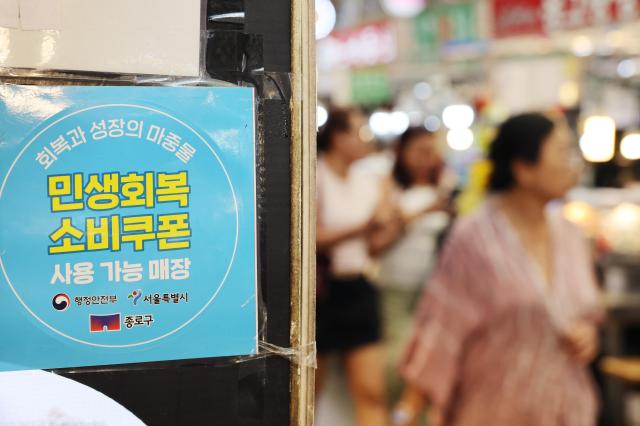
The consumer recovery coupons distributed to all citizens last year have reportedly increased South Korea's economic growth rate by approximately 0.12%. The Bank of Korea's research department released these findings on June 10 in its "BOK Issue Note" analyzing the economic impact of the consumer recovery coupons.
A total of 13.522 trillion won was allocated for the consumer recovery coupons, with about 70% provided through credit cards and the remainder through local love gift certificates and prepaid cards. As of the usage deadline on November 30 of last year, 99.8% of the amount distributed via credit cards was utilized for actual consumption.
The Bank of Korea analyzed big data from six credit card companies and estimated that the average monthly sales at locations accepting the coupons increased by 2.91% compared to those that did not. This resulted in an estimated additional sales boost of about 2.8 trillion won nationwide, which corresponds to approximately 30.9% of the financial input (9.1 trillion won based on credit cards).
However, the effects were short-lived. The impact from the first round of distribution lasted about two months, while the second round's effects diminished within a month. The Bank of Korea assessed that this indicates the consumer coupons were an effective short-term policy tool in a situation where stabilizing the economy was urgent.
In response to concerns that the additional sales increase effect was only around 30% of the financial input, Ha Jung-seok, head of the Bank of Korea's research department, stated, "Rather than definitively judging the efficiency of a specific policy, it is a matter of determining suitable measures based on economic conditions when the government implements fiscal policies. However, it has been observed that there was a short-term effect, indicating it served as a catalyst."
Regionally, the effects were most pronounced outside the capital area. While the integrated effect in the metropolitan area was not statistically significant, a 6.37% increase in sales was confirmed in non-metropolitan areas. This suggests that coupon policies can have a greater economic stimulation effect in regions with relatively limited consumer spending capacity.
By industry, the largest effects were seen in general merchandise stores, casual dining restaurants, and leisure activities, whereas sales at educational institutions and medical clinics actually decreased.
A survey conducted to measure the consumer stimulation effect indicated that the marginal propensity to consume (MPC) from the coupons was estimated at 0.20, meaning that 20% of the coupon spending generated new consumption that did not previously exist.
The MPC was higher among lower-income households, with the bottom 20% (first quintile) recording an MPC of 0.25, while the top 20% (fifth quintile) was only 0.17. The Bank of Korea explained that this suggests that differential support targeting low-income groups could further enhance consumption stimulation effects.
Comparing the first and second rounds of distribution, the first round (MPC 0.21) slightly outperformed the second round (0.18). The Bank of Korea interpreted this as a result of the reduced amount per person in the second round (100,000 won) compared to the first round (150,000 to 550,000 won), which weakened the perceived impact of the policy.
The Bank of Korea concluded that if similar policies are implemented in the future, there is a need for more precise timing, differential support methods, and usage design. By encouraging usage in industries with high inter-industry effects, such as restaurants (impact coefficient 1.18), the overall economic ripple effect could be increased.
Additionally, it emphasized the need for policy efforts to enhance productivity and facilitate long-term structural improvements so that small businesses and self-employed individuals can develop resilience without relying solely on financial support.
* This article has been translated by AI.

Copyright ⓒ Aju Press All rights reserved.